The Royal Government of Bhutan is reportedly offloading its Bitcoin reserves, signaling a potential failure of its state-run mining experiment as major financial institutions globally continue aggressive BTC accumulation. This strategic divestment contrasts sharply with the sustained institutional buying frenzy, raising critical questions about national cryptocurrency strategies versus corporate adoption trends.
Bhutan Bitcoin once stood for a rare national strategy. The kingdom used hydropower to mine Bitcoin through Druk Holding and Investments instead of buying coins in the open market. Reuters reported last year that the country saw green crypto mining as a way to turn surplus electricity into foreign-currency income.
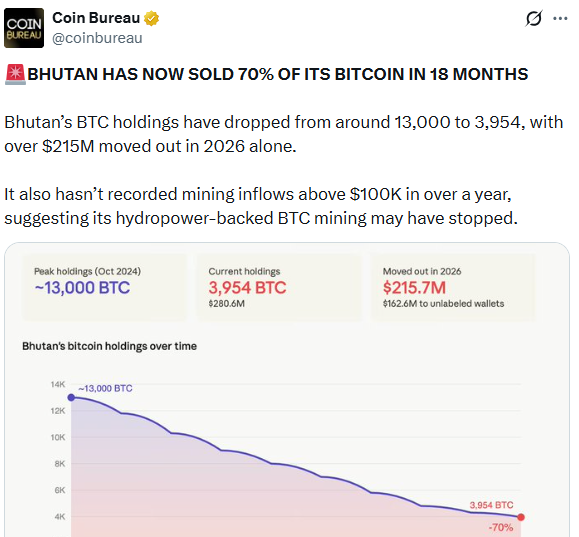
Recent Arkham-linked reporting, cited by CoinDesk and Blockonomi, shows the stash has fallen from about 13,000 BTC in October 2024 to roughly 3,774 to 3,954 BTC now, depending on the wallet snapshot used. That means about 70% of the reserve has been sold. Reports also say state-linked wallets moved roughly $215.7 million to $233 million worth of the asset in 2026 alone.
The country is still not a small holder. Public tracking still places it among the largest nation-state crypto wallets, even after the drawdown. That is why the latest transfers matter so much.
Bhutan Bitcoin Shift Raises Mining Exit Questions
This week added fresh weight to the story. Arkham-linked coverage showed another 250 BTC, worth about $18 million, moved to a new wallet. That came after a separate transfer of around 319.7 BTC, worth about $22.68 million. Reports say some funds moved to unlabeled wallets, while other flows touched routes linked in past reporting to Galaxy Digital and OKX.
That pattern does not prove stress. It does suggest planning. A single treasury move can mean little, but a steady chain of transfers over months looks more like a managed reduction in exposure.
Bhutan Bitcoin Mining Revenue Has Almost Vanished
The revenue signal is the sharper part of this story. Recent reports say no state-linked wallet has received a mining inflow above $100,000 for more than a year. Druk Holding and Investments has also not given a public explanation for the recent transfers.
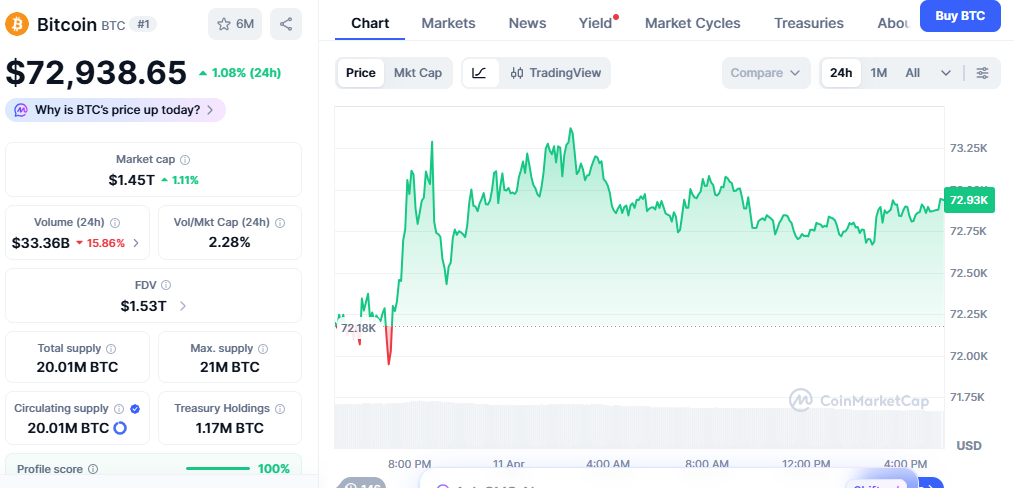
That missing inflow does not fully prove a shutdown. Still, it strongly suggests mining has slowed hard or stopped. The BTC now trades near $72,938, network difficulty is high, and the post-halving reward remains 3.125 BTC per block, which leaves far less room for small and mid-sized miners.
Bhutan Bitcoin Is Turning Into An Energy Story
This may be the angle others miss. The country may be selling coins for treasury reasons, but it may also be making a simple power-market choice. Official government material says it exports surplus electricity to India, and that trade already brings revenue into the country.
If selling hydropower brings steadier returns than mining with it, the drawdown looks less ideological and more economic. In that light, Bhutan Bitcoin stops being only a crypto story. It becomes an energy story with a blockchain wrapper.
While the state trims, others are doing the reverse. Strategy says it bought 4,871 for about $329.9 million, taking its holdings to 766,970 . CoinDesk also reported that spot crypto ETFs absorbed around 50,000 coins over a recent 30-day period. That contrast makes Bhutan Bitcoin unusual in the current market.
Future Outlook
The next clue will come from wallets, not speeches. If transfers continue and fresh inflows remain absent, Bhutan Bitcoin may soon be seen less as a green energy success case and more as a real-world test of when sovereign mining stops making economic sense.
Bhutan still holds roughly $272 million to $281 million in BTC. That means the country has not walked away from the asset. Yet the stronger question now is not why the state sold coins. It is why it may have stopped making new ones.
This article is for informational and educational purposes only. It is not investment advice, tax advice, or a recommendation to buy, sell, or hold any digital asset.



Log in to Reply
Log in to comment your thoughtsComments