Blockchain Gaming Dead Debate Deepens: Meta’s Horizon Worlds Shutdown Sparks Industry Reckoning

The 'Blockchain Gaming Dead' debate has intensified dramatically after Meta Platforms confirmed the immediate shutdown of its flagship metaverse project, Horizon Worlds. The platform, launched with fanfare in 2021 by CEO Mark Zuckerberg, failed to achieve critical mass despite billions in investment, culminating in a devastating $6 billion loss reported by Meta's Reality Labs unit in January 2026 and over 1,000 job cuts. This high-profile collapse has sent shockwaves through the crypto and gaming sectors, forcing a brutal reassessment of the economic viability and user adoption timelines for immersive virtual ecosystems.

The app will be removed from Quest devices by March 2026 and fully shut down on VR by June 15, continuing only as a mobile platform. This Metaverse shutdown has raised broader skepticism around blockchain GameFi models, many of which were built on similar metaverse-driven narratives.
Following this backdrop, Solana Foundation president Lily Liu reignited controversy by stating that Blockchain Gaming Dead is not just a trend, but a reality.
Solana Foundation President Declares Blockchain Gaming Dead
Lily Liu argued that if Meta, a tech giant that rebranded itself around the metaverse, could not make virtual worlds successful, then blockchain-based GameFi never had a strong chance.
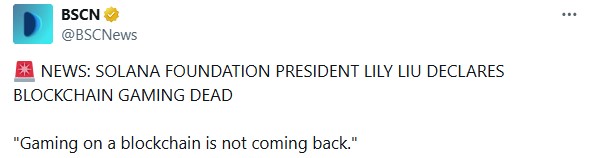
This is not a new stance. Since early 2026, Liu has argued that on-chain technology is better suited for finance rather than GameFi. She described years of Blockchain Gaming NFT and play-to-earn narratives as “intellectually lazy,” suggesting they relied more on marketing hype than real user demand.
Blockchain Gaming Dead View: Billions Invested, But Results Fell Short
The debate is rooted in real market outcomes. Over the past few years, billions of dollars flowed into crypto gaming platforms, backed by major investors like Andreessen Horowitz and Animoca Brands.
However, many flagship projects struggled to sustain momentum. Popular titles like Axie Infinity saw declining user activity, while ambitious projects such as Star Atlas faced delays and slow development. Other Web3 token ecosystems collapse majorly due to speculative interest fading, reinforcing Liu’s argument that the sector lacked sustainable foundations.
Following this structure, funding was also dropped significantly in 2025–26, falling to under $300 million compared to multi-billion peaks in earlier years.
The play-to-earn model, once seen as revolutionary, lost traction as token values dropped and user incentives weakened. This has fueled the idea that the Blockchain Gaming Dead narrative reflects a broader market correction rather than a sudden collapse.
Blockchain-Based Technology: If Not Gaming, Then What?
Blockchain technology is one of the fastest adapted frameworks which continues to grow into millions to billions, despite Play-to-earn industry shocks, into broader markets.
Industry data shows that blockchain-based technology continues to expand rapidly, especially in finance, payments, and institutional adoption. Stablecoins, decentralized finance (DeFi), and real-world asset tokenization have emerged as the primary use cases for decentralized system, with total value locked (TVL) standing at $96.2 billion, excluding stablecoin’s $346 billion market capitalization.
This data somehow supports Liu’s emphasis that blockchains excel in ownership, transparency, and financial systems—not entertainment.
Today, banks, governments, and corporations are actively integrating blockchains into real-world applications, from cross-border payments to supply chain tracking.
Estimates suggest the global distributed ledger market could grow into hundreds of billions in value over the next decade, driven largely by finance and enterprise adoption.
A Turning Point, Not The End: Community View
Despite criticism, many developers and investors reject the Blockchain Gaming Dead narrative.
Some argue that the industry is simply evolving after the collapse of unsustainable play-to-earn models. Instead of focusing on tokens, newer projects aim to deliver better gameplay while integrating on chain web3 NFT ownership features more naturally.
Market projections still show growth. Estimates for the Blockchain-based GameFi industry in 2026 range between $25 billion and $60 billion, with long-term forecasts reaching hundreds of billions or more.
However, the failure of the metaverse experiment has exposed the gap between vision and real user demand, innovation continues. The next phase of on-chain gameplay structure may not be about quick profits—but about building games people genuinely enjoy.
