CFTC Issues First Rules Direction for Event-Based Trading: Regulatory Clarity Arrives for Prediction Markets

The U.S. Commodity Futures Trading Commission (CFTC) has issued its first formal guidance for event-based trading, warning prediction exchanges that contracts tied to real-world outcomes must be vetted to prevent market manipulation and insider trading risks. In a move that could reshape the burgeoning prediction market sector, the regulator advised platforms to consult authorities before launching new contracts, signaling heightened scrutiny over decentralized finance (DeFi) instruments that speculate on elections, sports, and other events. While exchanges may still use self-certification processes, the CFTC's directive mandates careful evaluation to avoid price distortion and unfair advantages—a development that crypto practitioners view as a necessary step toward mainstream legitimacy, despite potential short-term compliance pressures.
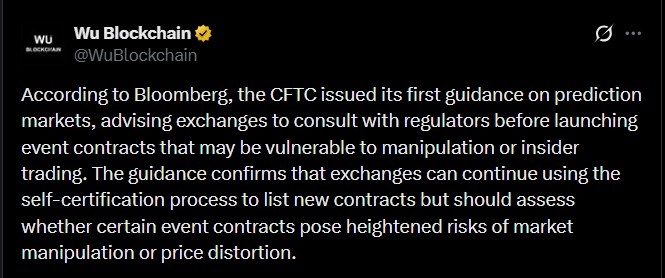
Source: X Official
This move marks the first formal direction from the agency focused specifically on the rapidly expanding prediction-market sector.
Why Regulators Are Paying Attention
Authorities are increasingly concerned about the possibility of insider trading within event-based exchanges. Prediction platforms allow users to speculate on outcomes such as political events, sports results, economic indicators, or corporate developments.
Key concerns include:
Private information advantage: Government officials, athletes, or company insiders might possess non-public information that could influence outcomes.
Outcome manipulation: Certain events could be affected by individuals or small groups, creating opportunities for unfair market influence.
Because these contracts rely on real-world events, regulators fear that market integrity could be compromised if participants trade based on information unavailable to the public.
Ongoing Debate: Trading Tool or Gambling?
Another issue drawing regulatory scrutiny is the legal classification of event contracts. Some policymakers argue that certain prediction markets resemble online betting rather than legitimate financial derivatives.
Important debate points include:
Nature of contracts: Critics say some markets look similar to wagers on sports or political results.
Regulatory framework: Supporters argue that prediction markets provide useful information and price discovery about future events.
This ongoing discussion has pushed regulators to clarify boundaries between regulated financial instruments and gambling-like activities.
Possible Future Regulatory Measures
While the latest guidance does not introduce immediate rule changes, it signals potential developments ahead. The statement indicates that regulators may explore stronger oversight as the sector grows.
Possible regulatory steps could include:
Insider-trading standards specifically designed for event contracts
Limits on certain contract types that carry high manipulation risk
Cooperation with sports leagues to monitor the integrity of sports-based markets
Different rules for retail and institutional participants
As part of this process, CFTC issues additional discussions with industry participants, encouraging platforms to evaluate risk before launching new markets.
How the Move Could Benefit Investors
For traders and investors, the guidance may improve transparency and trust in prediction markets. Stronger oversight could help prevent unfair advantages while maintaining innovation in financial products.
Potential benefits include:
Fairer trading environment with lower manipulation risk
Greater investor protection across derivatives and emerging crypto-linked markets
The regulator has repeatedly emphasized that market growth must be balanced with clear safeguards that protect participants while supporting responsible innovation in digital finance.
Conclusion:
The latest guidance signals a careful step toward stronger oversight of event-based trading. As CFTC issues clearer expectations for exchanges, prediction markets may become more transparent, ensuring fair participation while protecting investors and strengthening confidence across traditional and crypto-connected financial ecosystems.
