India Launches Virtual Asset Lab Under FIU to Track Offshore Crypto Exchanges

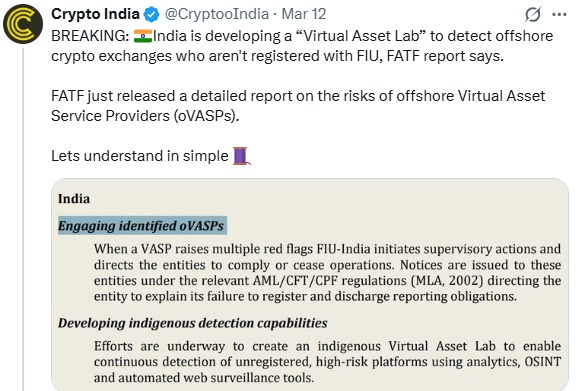
Indian regulators are escalating their crackdown on unregistered offshore cryptocurrency exchanges with the launch of a specialized Virtual Asset Lab under the Financial Intelligence Unit (FIU). The move targets Virtual Asset Service Providers (oVASPs) operating from foreign jurisdictions without local registration, which authorities claim continue to serve Indian traders while evading regulatory oversight. The new lab is designed to enhance detection and monitoring capabilities for platforms with no physical presence in India, following enforcement actions against more than 85 such entities to date.
Source: X (formerly Twitter)
How will the Virtual Asset Lab under FIU Work?
The Virtual Asset Lab under FIU will use data analysis, blockchain tracking, and open-source intelligence tools to identify offshore exchange serving Indian users. It will also rely on automated web monitoring to spot suspicious websites or mobile apps targeting the country.
The project involves cooperation between FIU India and the Home Ministry, along with a multi-agency taskforce that watches risks in the digital asset sector.
This group will share case studies, follow new trends, and help authorities act faster when suspicious activity appears.
Indian Crypto Regulators are also working with banks, payment companies, and registered digital assets exchanges to create what they call Red Flag Indicators.
These are warning signals that can help detect unusual activity, such as unknown exchange accepting Indian payments or suspicious transaction patterns.
When these warning signs appear, FIU-India can start supervision and issue notices under anti-money-laundering rules. Service providers that ignore these notices may face blocking orders or further action.
Offshore Platforms Using Indian Payment Systems
Investigations show that several offshore exchanges continue to attract Indian users through local payment options. Some exchanges allow deposits using UPI or bank cards, while withdrawals are routed through intermediaries.
Because the main company is located outside India, it becomes difficult for authorities to identify which entity is responsible for handling user funds or personal data. This creates challenges for enforcement agencies.
Recently, authorities issued notices to 52 offshore crypto service providers that were operating in India without registering with the Financial Intelligence Unit. Under India’s rules, any digital assets service offering products to Indian users must register with FIU-India, even if it operates from another country.
Crypto Tax Rules Pushed Some Traders Offshore
The growth of offshore trading is partly linked to the tax policy introduced in 2022. The government placed a 30% tax on crypto gains and a 1% tax deducted at source (TDS) on transactions.
After these rules came into effect, many traders moved their activity to foreign platforms that promised fewer restrictions. However, regulators believe this shift created more risks for investors and made monitoring difficult.
Through the Virtual Asset Lab under FIU, authorities want to detect platforms that try to bypass rules related to AML checks, KYC verification, travel rule requirements, and taxation.
Wider Developments in India’s Crypto Regulation
At the same time, India’s crypto regulatory framework continues to evolve. Recently, the Financial Intelligence Unit clarified that there is no official order forcing exchanges to remove privacy coins such as Monero or Zcash.
However, exchanges are still required to closely monitor high-risk transactions, especially those involving anonymity tools or transaction-mixing services.
Suspicious activity is tracked through Suspicious Transaction Reports (STRs) submitted by exchanges and other reporting entities. These reports help authorities detect unusual wallet movements and possible financial crimes.
Final Thoughts
The plan to create a Virtual Asset Lab under FIU shows that India is trying to strengthen oversight of offshore crypto platforms serving its users. By using analytics tools, web monitoring, and cooperation between agencies, authorities aim to spot risky platforms earlier and ensure that exchanges dealing with Indian traders follow the country’s compliance rules.
