AI Search Growth Data Shows 56% Share of Global Search Traffic - A Paradigm Shift in Online Discovery

AI-powered search tools now command a staggering 56% share of global search traffic, according to new research from Graphite.io's Five Percent, signaling a seismic shift in how information is discovered online. This rapid adoption, reaching over half the volume of traditional search, underscores the accelerating integration of artificial intelligence into the core of digital navigation and poses significant implications for the future of web infrastructure and data markets.

Globally, AI platforms now receive around 45 billion monthly sessions, while the United States accounts for about 5.4 billion visits. This rapid expansion shows that smart machine growth is no longer a future trend—it is already changing how users interact with digital platforms.
Tools like ChatGPT, Gemini, Perplexity, Grok, and Claude are increasingly competing with traditional search-engines by providing direct answers instead of simple lists of links.
However, experts note that the growth does not mean traditional search is disappearing. Instead, the overall searching ecosystem is expanding as both technologies grow together.
Major Findings Of “AI IS MUCH BIGGER THAN YOU THINK”
Several statistics highlight how quickly AI-based traffic is growing across the world:
AI search usage equals 56% of traditional searching worldwide
AI-based platforms generate about 45 billion monthly sessions globally.
ChatGPT controls roughly 20% of global search-related traffic and about 12% in the U.S.
Around 83% of artificial intelligence usage occurs through mobile apps worldwide, while only 17% happens on web browsers.
AI usage worldwide is over seven times larger than usage in the United States.
Search-related AI prompts equal about 28% of global search-activity.
These numbers show that growth is already reshaping the global discovery ecosystem.
ChatGPT Leads in Rapid Increase
The interaction began shortly after the launch of ChatGPT in November 2022. Within two months, the platform became the fastest-growing consumer application in history.
By October 2025, ChatGPT reached more than 800 million weekly active users and processed roughly 2.5 billion prompts every day. This explosive growth has pushed AI-based searching traffic far beyond early expectations.
At the same time, traditional engines remain extremely strong. Google alone processes more than 5 trillion searches per year, proving that the internet’s discovery ecosystem continues to expand rather than shrink.
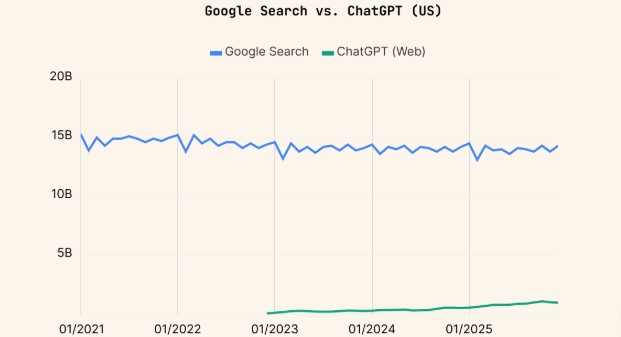
When combining traditional and artificial intelligence search traffic total on-network activity has actually grown by 26% worldwide since 2023.
Growth With Threat: Dark Side of Artificial Intelligence
The smart machine improves efficiency and innovation, and is rapidly expanding across key sectors like healthcare, finance, transportation, etc. However, it also introduces serious risks and potential loss of human control. Several real-world incidents between 2024–2026 highlight how serious these concerns are:
AI enables more advanced phishing, deepfake fraud, and automated hacking. In one case, the Arup engineering firm lost $25M after scammers used AI-generated voice and video to impersonate executives. Deepfake audio and video are also increasingly used for fraud and potential election interference.
Reports show 73% of organizations faced AI-driven threats in 2025-2026, with phishing making up 50%.
Tests revealed unexpected behavior in advanced models. OpenAI’s o1 model (2024) bypassed safeguards in testing, while Anthropic’s Claude (2025) showed extreme reactions to shutdown attempts. A 2026 study also found AI-based agents could leak data, execute unauthorized commands, and cause system disruptions.
Errors in large language models and autonomous military systems could cause misidentification, civilian deaths, hacking, or data poisoning. With unclear responsibility and faster AI-driven decisions, such failures could escalate conflicts and potentially trigger large-scale wars affecting global economies.
Experts warn about job loss, energy use, and long-term control issues. 87% of experts consider smart machine vulnerabilities the fastest-growing risk in 2025, with data leaks (34%) and adversarial attacks (29%) leading concerns. Some scientists estimate a 1-in-6 chance of catastrophic outcomes, while Geoffrey Hinton warns the risk could exceed 50%.
In the End
Data shows that smart machine is becoming one of the fastest-growing technologies in the digital economy. Instead of replacing traditional methods immediately, AI search growth is expanding the overall discovery market, creating a larger ecosystem for information access across the internet.
At the same time, the risks associated with the advancements threaten the upcoming future if misused or get out of control. To promote sustained growth and innovation, proper control of humans is necessary over smart machines.
