Banks Demand Crypto Clarity Now as Global Competitors Sprint Ahead

Traditional finance is screaming for a rulebook while the rest of the world plays the game.
The Regulatory Vacuum
Legacy banks are stuck in a holding pattern, watching from the tarmac as jurisdictions from Singapore to Switzerland green-light digital asset frameworks. Their demand is simple: give us clear rules or watch us become irrelevant. The hesitation isn't about technology—it's about liability. No executive wants to be the test case for an unproven regulation.
The Global Sprint
While committees debate, fintechs and forward-thinking nations are building. They're launching regulated exchanges, approving tokenized securities, and attracting billions in capital that once flowed through New York and London. The innovation isn't waiting for permission; it's finding friendlier shores.
The Cost of Caution
Every month of delay isn't just a missed opportunity—it's active erosion. Talent, startups, and institutional liquidity are migrating to clearer jurisdictions. Banks are left managing spreadsheets for assets they can't officially touch, a modern twist on counting someone else's money.
The closing argument writes itself: you can either write the rules for the next financial system, or you can follow the ones written by your competitors. The clock's ticking, and for once, Wall Street's usual 'move fast and break things' mantra has been replaced by 'move slow and get broken.'
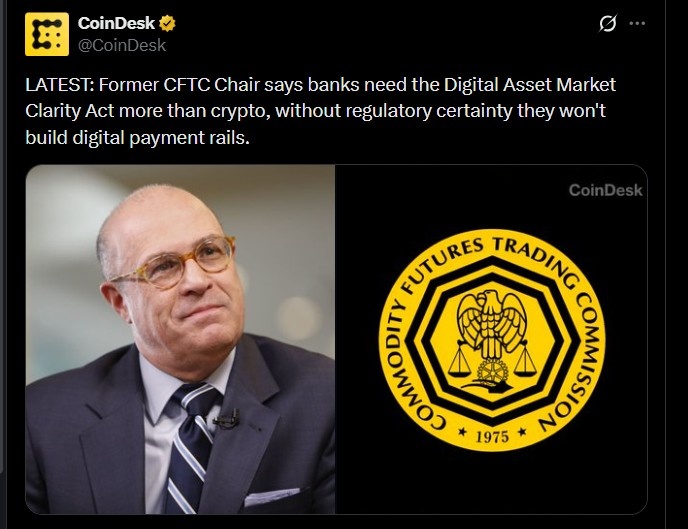
Source: X Official
Finance institutions operate within strict compliance frameworks, meaning every strategic investment must align with existing laws. Without defined rules, deploying capital into digital asset systems becomes legally risky.
Banks fear legal exposure when entering digital-asset infrastructure.
Regulatory uncertainty is slowing institutional innovation.
What Giancarlo’s Statement Means
Giancarlo clarified that innovation in the digital asset sector is continuing despite regulatory delays. Crypto companies are still launching products, platforms, and blockchain tools globally. However, Finance Institutions face a completely different situation because they must operate under formal legal frameworks before investing in new financial technology.
He explained that legal departments within Financial Institutions are warning leadership that investing heavily in blockchain systems without regulatory clarity could expose them to lawsuits or compliance violations.
Crypto firms can innovate without immediate legal approval.
Banks require defined rules before allocating billions to infrastructure.
Why Some Banks Are Hesitant About the Bill
Despite supporting regulatory clarity, parts of the banking sector remain cautious about certain aspects of the proposed legislation. One of the biggest concerns revolves around stablecoin rewards offered by blockchain platforms.
If digital platforms provide attractive yields or incentives, customers might move funds away from Financial Institutions into crypto-based accounts.
Deposit migration could weaken traditional banking liquidity.
Reduced deposits may limit the funds Financial Institutions use for lending.
Warning About Global Financial Competition
Giancarlo also warned that delaying regulation could shift innovation to other regions. Countries in Europe and Asia are already moving faster in building legal frameworks for digital assets and blockchain payments.
He described blockchain-based payment networks as the new architecture of finance, suggesting that whoever adopts them first may shape the future of global financial systems.
Crypto innovation could shift toward Europe and Asia.
American banks risk falling behind in technology.
Political Delays and the Future of the Bill
The latest debate also follows comments from Donald Trump on X, where he indicated that no additional legislation would move forward until the proposed Save America bill advances. This political stance has indirectly slowed progress on the crypto clarity act, which was originally expected to be announced in March 2026.
Earlier policy meetings in February had shown promising progress, with banks and digital-asset companies reportedly nearing a mutual understanding. However, developments have stalled, and the White House has already shifted potential approval toward mid-2026.
Analysts now believe the timeline could extend even further due to global instability.
Rising geopolitical tensions involving the United States, Israel, and Iran are affecting economic priorities.
Experts suggest the legislation could move toward late 2026 if instability continues.
Conclusion:
The debate surrounding the crypto clarity act reflects a turning point for finance innovation. While banks seek regulatory certainty before investing in blockchain systems, political priorities, global conflict, and economic instability may continue delaying the legislation throughout 2026.
