Crude Oil Perpetual Trading Launches as Market Volatility Spikes - Your Next Big Play?

Oil's wild ride just got a permanent trading lane. Forget the old futures contracts with their expiry dates and delivery headaches—perpetual contracts for crude oil have officially hit the scene. This isn't just another derivative; it's a 24/7, no-expiration gateway to the world's most politically charged commodity.
The Timing Is Everything
Launching right as traditional oil markets start swinging like a pendulum? That's no accident. Geopolitical tensions, OPEC+ whispers, and inventory surprises are creating the perfect storm of volatility. Perpetual contracts let traders ride those waves without getting caught in the monthly rollover rip current that eats into profits.
How It Cuts Through the Noise
The mechanism is sleek. A funding rate mechanism keeps the contract price pegged to the spot market—no more decoupling as expiry nears. It bypasses the physical delivery maze entirely, offering pure price speculation. Long or short, the position stays open until you decide to close it. It's leverage, simplified and supercharged.
A New Arena for Capital
This opens the floodgates. Crypto-native capital, already fluent in perpetuals for Bitcoin and Ethereum, now has a familiar vehicle for macro bets. Traditional energy traders get a sandbox to test strategies without the logistical nightmares. The convergence is here, and the liquidity pool is about to get a lot deeper.
The Bottom Line
More tools, more opportunity, more ways to be brilliantly right or spectacularly wrong. In a market where fortunes are made on predicting chaos, a perpetual contract is the ultimate volatility capture device. Just remember—in finance, every 'innovation' that promises to simplify speculation usually ends up creating new, more exciting ways to lose money faster. Trade accordingly.
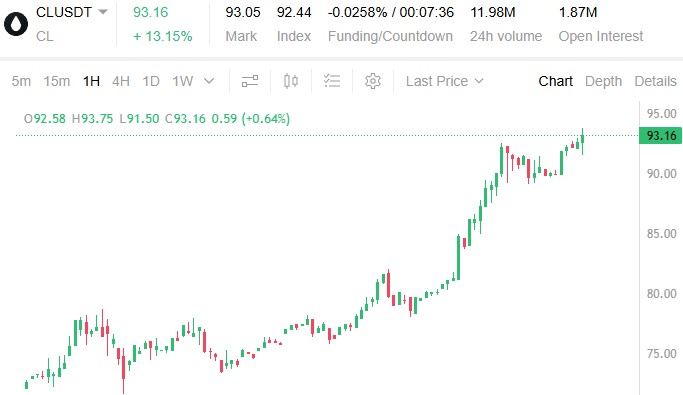
The launch introduces several incentives for traders. These include:
0% Maker Fees: No fee for placing maker (limit) orders.
1.2x Aster Airdrop Points: Earn 20% extra points for $ASTER rewards.
$10,000 $ASTER Competition: Trading volume helps to gain eligibility for $10K $ASTER prizes.
The move signals Binance’s growing interest in bridging traditional finance markets with crypto-style trading tools which offers faster settlements, greater transparency, and more flexible trading options.
It also reflects a broader industry shift where crypto exchanges are expanding beyond digital tokens to include tokenized versions of real-world financial assets, helping connect conventional finance with the rapidly evolving digital asset ecosystem.
Timing That Matters: Crude Oil Prices On a Critical Turn
The timing of the Binance Crude Oil trading launch is notable because Crude Oil prices have recently experienced sharp volatility. Following the entry in 2026, also the beginning of US–Iran tensions, the prices have been noting great upswings.
In early March 2026, global oil markets were record-surging due to escalating tensions in the Middle East–region having 30–40% of total oil-reserves, and damage to the Strait of Hormuz, one of the most crucial trading routes.
Prices of WTI Crude Oil futures jumped 12%, from around $65–$71 per barrel in late February to more than $90 per barrel by March 6, noting the highest since August 2022. It’s now measuring around 41.2% monthly hikes. At the same time, Brent crude climbed to roughly $92.6, marking the highest levels in over a year.
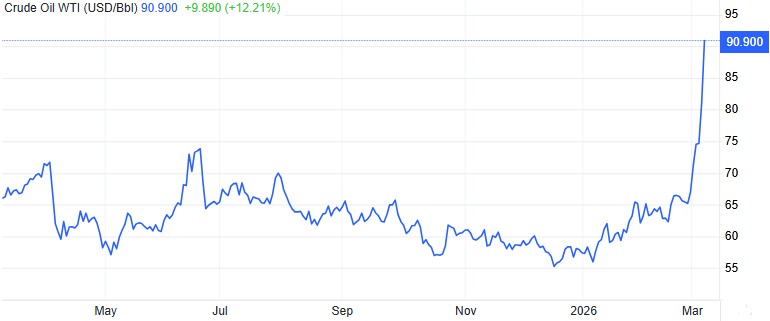
In these situations, the launch of $CL by Binance Wallet is already in the center of attention.
Binance: The Exchange Building Beyond the Crypto
Binance remained the dominant crypto exchange for years, holding ~39% of the global CEX market share, meaning nearly 4 out of every 10 crypto trades happen on the platform.
With more than 300 million users, trillions in trading volumes, deep liquidity, and now expansion into tokenized real world commodities, Binance wants to continue its strong influence across the global crypto market.
Along with energy resources, the exchange has already launched several commodity-based perpetual futures. For example, traders can access metals like Gold (XAUUSDT), Silver (XAGUSDT), Platinum (XPTUSDT), and Palladium (XPDUSDT) on Binance Futures. Industrial commodities such as Copper (COPPERUSDT) have also been added recently.
These markets allow traders to speculate on price movements using USDT-margined perpetual futures, which operate similarly to crypto derivatives but track real-world commodities.
Together, these developments pushed the platform’s already huge trillions-level trading volume even higher.
Traders React to $CL Trading on Crypto Platforms: Growth vs Purity
Initial reactions from traders have been mixed. Some users welcomed the ability to trade Crude-Oil futures directly through a crypto wallet, calling it another step toward integrating traditional assets into blockchain platforms.
However, others remain cautious, arguing that adding commodities like metals and oils to crypto platforms could shift focus away from crypto-native markets and blur the line between decentralized trading and traditional finance.
Still, the launch highlights a growing trend: commodities, metals, and other traditional assets are increasingly being traded alongside cryptocurrencies.
As market volatility continues and commodity prices fluctuate, platforms like Binance are betting that traders want all major markets in one place—from Bitcoin to oil.
This article is for informational purposes only and should not be considered financial or investment advice.
