Arthur Hayes’ Bold Bitcoin Prediction: How Iran Conflict Could Ignite the Next BTC Surge

Geopolitical powder kegs have a funny way of making digital gold look awfully shiny.
BitMEX co-founder Arthur Hayes just dropped a provocative thesis: escalating tensions in the Middle East, specifically a potential war involving Iran, could be rocket fuel for Bitcoin. Forget safe-haven narratives about bonds or the dollar—Hayes argues the real capital flight heads straight for the crypto exits when traditional systems seize up.
The Sanctions Evasion Playbook
Modern warfare isn't just fought with missiles; it's waged with financial blockades. SWIFT bans, asset freezes, and dollar-denominated trade embargoes are the standard playbook. Hayes points out that nations and entities caught in this crossfire need a lifeline—a neutral, borderless, and censorship-resistant network for moving value. Enter Bitcoin.
It's not about ideology; it's about utility. When correspondent banking channels get severed, a peer-to-peer monetary protocol that operates 24/7 on a global mesh of nodes starts looking less like a speculative asset and more like critical infrastructure. Capital seeks the path of least resistance, and a well-trodden blockchain often cuts faster than a bureaucratic waiver.
The Institutional Reckoning
This scenario forces a brutal reassessment for traditional portfolio managers. What's your 'safe' asset when the issuer's military is actively engaged? Sovereign debt, fiat currencies, and even traditional commodities get tangled in the geopolitical web. Bitcoin's unique value proposition—its political neutrality and lack of a central issuer—flips from a theoretical curiosity to a tangible hedge.
It exposes the silent hypocrisy of 'risk-free' rates. A 10-year Treasury is only as risk-free as the nation backing it. A shooting war recalibrates that risk overnight, sending savvy capital scrambling for truly apolitical ground. Some of it might just land in the Bitcoin network, adding real buy-side pressure beyond retail speculation.
A Cynical Fuel for a Digital Fire
Let's be blunt: the machinery of war is expensive. Historically, conflict leads to monetary debasement as governments print to fund armies and reconstruction. This latent inflationary pressure, even if initially localized, feeds the broader Bitcoin narrative as a hard-capped alternative to endlessly printable fiat. It’s a grim calculus—human suffering translating into a bullish macro signal for a decentralized ledger. The finance world has always profited from chaos; Bitcoin just offers a newer, digital avenue.
Hayes's prediction is less a forecast for peace and more a bet on human ingenuity under pressure. When gates slam shut, people find—or build—new doors. If conflict escalates, watch for the capital flows. They might just reveal that Bitcoin's killer app isn't buying a latte, but bypassing a central bank. After all, in the high-stakes game of global finance, the ultimate hedge is against the system itself.
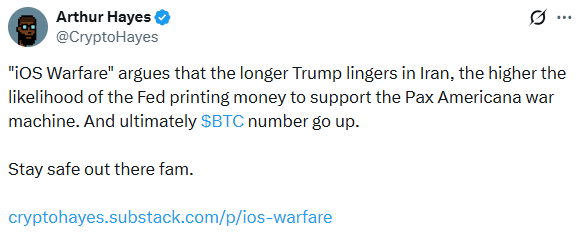
According to the Arthur Hayes bitcoin outlook, this new wave of cash known as liquidity is exactly what risk assets need to grow. Right now, BTC is trading near $68,179.42, showing a 7.69% increase over the last week. However, it is still far below its record high from October 2025. Arthur predicts that as the government spends more on the "war machine", the growing money supply could push Bitcoin toward a long-term goal of $500,000 to $750,000.
Historical Patterns Guiding the Arthur Hayes Bitcoin Strategy
The Arthur Hayes Bitcoin thesis is built on forty years of history, not just guesses. He points to a clear pattern where the Federal Reserve eases its policies during Middle Eastern conflicts. He uses three major events to prove his point:
After the war started, the Fed prepared to lower rates. Even though oil prices were causing inflation, they cut rates by late 1990 to help the economy.
Following the September 11 attacks, Chairman Alan Greenspan quickly cut rates by 50 basis points. This MOVE was designed to keep markets stable and boost public confidence.
During this time, the Fed had already dropped rates to zero and started "quantitative easing". This flooded the system with cash, helping both the military and the financial markets.
He suggests that today’s focus on Iran follows this same path. He believes the Fed has "political cover" to make money cheaper under the goal of protecting national security.
Expert Analysis: Future Outlook
The immediate success of the Arthur Hayes Bitcoin prediction depends on the next Federal Reserve meeting on March 17-18.
Some big players are already showing confidence. For example, the company Strategy recently bought 3,015 BTC even as airstrikes were making headlines.
However, Arthur himself suggests a more careful "wait and see" approach. He advises investors to look for real proof of rate cuts or new money being printed before buying more heavily. If the Fed keeps interest rates high, Bitcoin might stay stuck below the $70,000 mark. But if they shift to a "dovish" or easier policy because of war costs, it could spark the massive rally that Hayes expects.
Investing in cryptocurrency involves high risk. This report is for informational purposes only. You should always talk to a financial professional before making investment choices.
