Gold’s Meteoric Rise Signals Monetary Stress - Is Bitcoin Poised to Become the Next Safe Haven?

Gold just punched through another record high. That's not just a shiny headline—it's a flashing red signal from the global financial system.
The Canary in the Coal Mine
When investors stampede into a 5,000-year-old store of value, they're not chasing yield. They're running from something. Currency devaluation, geopolitical instability, or just a deep-seated distrust in central bank omnipotence—the reasons don't matter. The flight to gold is a primal scream against monetary stress.
Enter the Digital Contender
This is where Bitcoin enters the chat. For over a decade, its proponents have pitched it as 'digital gold'—a hard-capped, decentralized, and portable hedge against the same systemic risks. While gold sits in vaults, Bitcoin moves at the speed of light, bypassing borders and bank holidays with a cryptographic signature.
The narrative is seductive, especially when traditional finance starts to smell like a rigged game (another quarter, another bank fine for 'conduct issues' that magically never touch the C-suite). If the old guard's fortress is showing cracks, why not build a new one?
The Volatility Paradox
Here's the rub, and every crypto native knows it: Bitcoin is still a teenager compared to gold's ancient lineage. Its price charts look less like a safe harbor and more like a seismograph during an earthquake. Can an asset that can swing 10% in a day truly be a 'haven'? Its advocates argue that's the price of early adoption—the volatility is the friction before it becomes foundational.
So, is Bitcoin next? The market is placing its bet. Every uptick in monetary uncertainty doesn't just lift gold—it fuels the argument for a digital alternative. The race isn't just about price; it's about proving which asset can truly anchor wealth when the financial weather turns stormy. The old king has the throne, but the challenger has the technology. Place your bets.
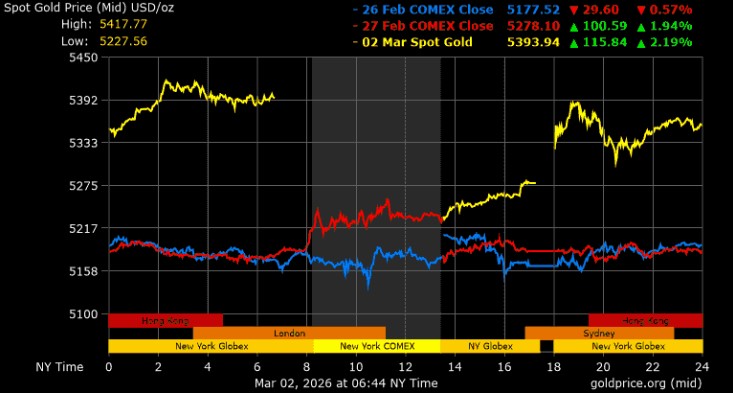
This surge reflects a "monetary reset" in progress, where investors and sovereigns’ fear increasing demand for safe-haven investments. But why is bitcoin considering a major part of this safe-haven-led demand in 2026? Because the golden asset is always seen as a hedge against volatility. Let’s break it in more depth.
Gold Price Rally 2.0, Silver Follows: Metals On Demand
Gold is currently trading around $5,390–$5,415 per ounce, up roughly 2.1–2.6% today, testing the $5,400 resistance level. The metal has gained about 9% over the past month and is up 86–87% year-over-year, after hitting an all-time high of $5,608 in January 2026.
Central bank buying continues to support gold, as in 2025, central banks purchased roughly 863 tonnes, slightly below 2024’s record 1,092 tonnes but still historically strong. BRICS nations are leading accumulation, adding an estimated 800–850 tonnes annually and controlling nearly 50% of global gold production. China and Russia together hold over 4,600 tonnes.
Silver, meanwhile, is trading NEAR $95–$96 per ounce, rising 1.8–2.2% today. It has climbed 12% over the past month and surged 202% year-over-year, though still below its record high of $121.64 in January 2026.
The rally is driven by a combination of safe-haven demand, often tracking gold, and strong industrial use, particularly in solar energy, which accounts for about 30% of demand.
Demand Is Rising Due to Fears: What Is the Market Afraid Of?
Markets face a mix of macro and geopolitical risks:
U.S. Debt: The U.S. national debt has climbed to around $38.6–$38.7 trillion, rising more than $2 trillion year-over-year. Interest payments alone now exceed $1 trillion annually. With debt-to-GDP near 136%, investors are worrying about long-term fiscal stability.
War Tensions: U.S.-Israel strikes on Iran and disruptions in the Strait of Hormuz pushing oil up 7–9%. When war risks rise and oil prices jump, alternative assets out of centralization become a protection. This surge signals fear, not speculation.
Rate Uncertainty: Fed funds rate at 3.5–3.75%, with March rate-cut odds around 7–10%, creating bond market volatility.
Liquidity Stress From Money Printing: Countries engaging in heavy monetary expansion and facing severe currency debasement include the United States, where Fed end QT in Dec 2025 and adding ~$20–$40B/month.
Bitcoin as a Monetary Escape Route
Bitcoin trades around $66,000–$66,800, down about 1% recently. Supporters see it as a digital hedge against fiat fragility due to its fixed 21 million supply cap.
After the 2024 halving, block rewards dropped to 3.125 BTC, reducing new supply issuance. Historically, halving cycles have triggered strong rallies, Bitcoin rose nearly 300% during the 2020 COVID crisis after a major crash like the current one.
Will Bitcoin Follow Gold’s Move — Or Lag Behind? What Could Stop Bitcoin From Breaking Out?
Bitcoin does not always MOVE with gold. Over the past 12 months, its correlation with gold has been around –0.44, while it shows stronger correlation with equities, roughly 0.75–0.88 with major U.S. indices.
This means Bitcoin often reacts to liquidity conditions and risk sentiment, not just safe-haven demand.
Several factors could slow a breakout:
A strong U.S. dollar (DXY near 98)
Ongoing regulatory scrutiny
A sudden liquidity crunch from macro shocks
Risk-off sentiment tied to war escalation
In liquidity-rich environments, Bitcoin could surge. But in tight conditions, it tends to move like a high-beta risk asset.
Is This the Start of an Alternative Assets Supercycle?
Many analysts believe 2026 could mark the beginning of a broader hard asset supercycle, which could later be followed by digital ones.
Drivers include:
Massive global debt expansion
De-dollarization efforts
Geopolitical fragmentation
AI and energy infrastructure spending
Persistent commodity supply constraints
While volatility remains high, structural demand continues to outpace supply in several markets. If debt expansion and geopolitical tensions persist, hard assets, both physical and digital, may remain central to the global investment narrative for years to come.
This article is for informational purposes only and should not be considered financial, investment, or trading advice.
