Why Middle East Conflict Sends Commodities Soaring While Crypto Crashes?

War drums beat, oil prices spike—and Bitcoin tanks. Here's the brutal market logic behind the divergence.
The Flight to Tangible Havens
When geopolitical tensions erupt, capital flees toward perceived 'real' assets. Gold, oil, and wheat have centuries of precedent as crisis stores of value. Their supply chains get disrupted, creating immediate scarcity. Traders pile in, driving prices higher on pure fear and fundamentals. It's a classic, almost reflexive move.
Crypto's Liquidity Trap
Digital assets, for all their promise, still get treated as risk-on tech growth stocks in a panic. Investors liquidate positions to cover losses elsewhere or raise cash for safety. The sell-off accelerates as algorithmic trading kicks in. Unlike a barrel of oil, you can't power a tank with a Bitcoin—a distinction that becomes painfully clear when bullets fly.
The Decoupling Mirage
Proponents tout crypto as an uncorrelated, decentralized hedge. Yet in acute crises, that narrative often crumbles. The market reveals its true colors: dominated by speculative capital that values liquidity over ideology when the stakes are life-and-death. It's a harsh reminder that adoption curves and whitepapers mean little against primal fear.
A Cynical Footnote for Finance
Of course, the same banks that trumpet commodities research have trading desks profiting from both sides of the volatility—because why pick a side when you can collect fees from everyone's panic?
The pattern holds until it doesn't. The real test for crypto won't be a bull run, but weathering its next global storm without being the first asset sold. Until then, it remains the hedge fund's favorite risk asset—the first to get cut when the going gets tough.
Middle East War Drives Oil and Gold Prices Higher
Major commodities are having their best value rallies in these tense situations.
Leading the space, oil has noted the highest levels. Brent crude briefly jumped to around $80 per barrel before settling NEAR $78–$79, up nearly 8%. U.S. WTI crude also climbed above $72 (+8%).

The conflict has disrupted activity around the Strait of Hormuz, a key global oil shipping route. As a result, energy markets reacted quickly. Analysts warn oil could MOVE toward $90 or even $100 if the Middle East war expands.
Precious metals also surged as investors reached for SAFE haven assets. Gold gained 2.31% in this weekly period, currently valued around $5,399–5,400, possibly crossing its January 2026, ATH of $5,589, setting a new record. Silver, enjoying highest year-on-year gains (200%), is measuring +2% at $95.5 price. Copper, Lithium, Platinum are also in green trading fields.
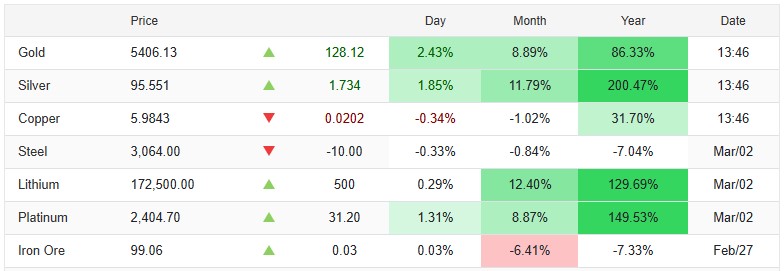
Along with this, the U.S. Dollar Index (DXY) is trading around 98.00–98.32, up roughly 0.71%, marking five-week highs. Meanwhile, the U.S. Treasury yields reflect a flight to safety, with the 10-year yield steady near 3.96–3.97% after briefly touching 3.93%.
This reflects the safe-haven demand that strengthens amid geopolitical tensions, especially U.S.-Israel strikes on Iran and disruptions near the Strait.
Crypto Markets Testing Resilience, But Why?
The Middle East war has shaken digital assets, which are already suffering from the October 2025 crash. Since the tensions first escalated in Mid-January, the crypto market has lost more than 12% of its total cap, from $3.28T to $2.27T as of today.
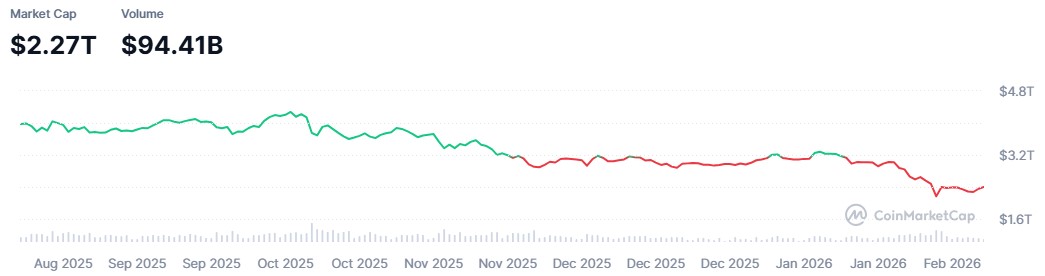
Bitcoin initially dropped to the $63,000–$65,000 range during early panic selling. It later rebounded toward $66,000–$67,000, showing partial resilience but still behaving like a high-risk asset. ethereum traded near $1,950–$1,970, while major altcoins such as Solana and XRP also declined.
Historically, investors viewed crypto as a hedge during geopolitical stress, and situations like this blessed crypto-space, especially Bitcoin, with uptrends. In 2020, during the COVID, bitcoin rebounded 300%.
However, in recent times, BTC has acted more like a technology stock, falling alongside equities during risk-off moments before stabilizing. Following the golden asset’s behaviour, the majority of cryptocurrencies are now becoming heavily volatile.
The change in pattern is significantly related to the adulteration of its original concepts, like decentralizations, immunity, transparency, and rising risks of crypto-related frauds and crimes.
A few mining pools control 50%+ of Bitcoin’s hash rate, and centralized exchanges dominate trading volume.
Fraud has surged: $17 billion was stolen in crypto scams in 2025, illicit flows reached $158 billion (up 145% YoY), broke users' trust and account.
Platforms perform “Hard Fork” programs to get back the stolen funds through hacking, or exploits, which affects the irreversible feature crypto-space, splitting blockchains into parts.
Launching of more centralized tokens in the marketplace, activities from crypto-holding governments (Bhutan sold Bitcoin during panic), also affect the sentiments.
What’s For Next?
Right now, investors remain cautious. Oil and gold are benefiting from uncertainty, while crypto and equities face short-term pressure.
The direction of the Middle East war will likely determine whether markets stabilize or experience deeper volatility in the coming weeks. Until clearer diplomatic signals emerge, traders across commodities, stocks, and digital assets are likely to stay on high alert.
