Vitalik Buterin Unveils Ethereum Execution Layer Roadmap for 2026: The Next Evolution Begins

Ethereum's co-founder just dropped the blueprint for the network's next major leap. The 2026 execution layer roadmap isn't just an update—it's a complete rewire of the world's largest smart contract platform.
The Core Pillars
Forget incremental upgrades. Buterin's vision targets foundational bottlenecks head-on. The plan zeroes in on parallel transaction processing, a move that slashes network congestion at its source. It also details aggressive state expiry models to keep the chain lean and mean. This isn't about making Ethereum faster; it's about making it scalable enough to handle the next billion users without breaking a sweat.
Why This Matters Now
The timing is strategic. With institutional capital finally flowing into the space, Ethereum needs to prove it can handle the load without exorbitant fees—something that still sends traditional finance suits into a mild panic. The roadmap directly addresses the 'gas fee boogeyman' that haunts every investor deck. It promises a future where complex DeFi transactions don't cost more than the assets being moved—a novel concept for a network that sometimes feels like a luxury good.
The Bottom Line
This roadmap cuts through the speculative noise. It bypasses vague promises and lays out concrete technical targets for 2026. Execution is everything, and the pressure is on for core devs to deliver. If they succeed, Ethereum cements its dominance. If they stumble, the 'ETH killer' narrative gets a fresh tank of fuel—and you can bet the hedge funds watching from the sidelines will be the first to flip their positions.
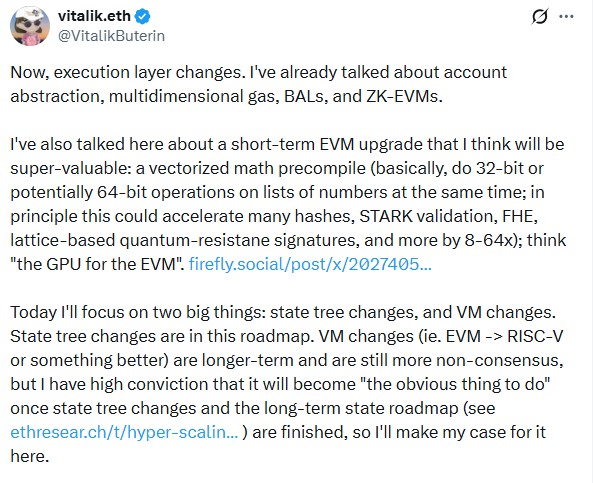
The Move to Binary State Trees
One of the most important parts of the Ethereum Execution Layer Roadmap is a change in how the network stores data. Currently, the network uses something called a "hexary Merkle Patricia tree". The new plan, known as EIP-7864, suggests switching to a "binary tree" structure. This might sound like a small technical detail, but it has a huge impact.
A binary tree makes the "branches" of the data four times shorter. This means that when a computer needs to prove that a piece of information is correct, it has much less work to do. This change WOULD lower the bandwidth needed for light clients wallets that run on phones or simple hardware. It also allows for the use of faster "hash functions" like Blake3 or Poseidon, which can speed up the process of proving transactions by up to 100 times.
Replacing the EVM with RISC-V
The second big part of the Ethereum Execution LAYER upgrade involves the virtual machine, which is the "engine" that runs smart contracts. For a long time, the EVM has been the standard. However, Buterin is now suggesting a move toward a new system based on RISC-V.
RISC-V is an open-source technology that is already popular in the world of computer chips and ZK-proving. By moving to this system, Ethereum could become much simpler. The plan would happen in three steps:
Use the new system to handle basic, repetitive tasks.
Allow developers to build new apps directly on the RISC-V system.
Turn the old EVM into a "wrapper" that runs inside the new system, so all existing apps still work perfectly.
Why These Changes Matter for You
You might wonder how these "deep" changes affect the average user. The main goal of the Ethereum Execution Layer Roadmap is to make the network "prover-friendly". This means that in the future, your wallet could prove that a transaction is valid right on your own device. This would increase privacy and security for everyone.
Additionally, the binary tree design groups data into "pages". This allows apps to save a lot of money on gas fees, potentially more than 10,000 gas per transaction for some DeFi apps. While these changes are big and will take time, they are essential for making the network a "beautiful" and efficient protocol for the next decade.
Expert Analysis: The Future Outlook
This roadmap shows that Ethereum is willing to make "jet engine changes" while the plane is still flying. While some developers worry about the complexity of moving away from the EVM, the focus on RISC-V shows a clear bet on ZK technology as the future of scaling. We should expect the community to debate these changes throughout 2026. If successful, this will turn the ecosystem into a much leaner system that is ready for global use.
This article analyzes technical protocol roadmaps. It is for informational purposes only and does not constitute financial advice.
