Are Robots Replacing Humans? The AI Job Layoffs Trend Explained - 2026 Reality Check

Headlines scream it daily: another round of cuts, another department automated. The AI job displacement trend isn't coming—it's here. And the numbers are starting to tell a brutal, undeniable story.
The Automation Playbook: Efficiency Over Empathy
Forget the slow creep of mechanization. Modern AI implementation moves at board-meeting speed. It's not about building a robot colleague; it's about identifying cost centers and deploying algorithms that work 24/7 without benefits, breaks, or morale issues. The calculus is cold, simple, and overwhelmingly attractive to a C-suite staring down quarterly projections.
Which Roles Are on the Chopping Block?
The initial wave hit predictable targets: data entry, routine customer service, basic content generation. Now, the reach is extending. Mid-level analysis, compliance screening, even preliminary creative tasks are being parsed by models that learn faster than any human team. The vulnerability isn't about manual labor anymore—it's about any process that can be mapped, predicted, and optimized.
The Human Counter-Strategy: Adaptation or Obsolescence?
This isn't a prophecy of universal unemployment. It's a forcible evolution. The emerging mandate is hybrid intelligence—leveraging AI tools to augment human creativity, strategy, and emotional intelligence. The jobs that survive will be those that manage, interpret, and ethically direct the automated workflows. The rest? They're being quietly folded into a server's operational budget.
The great corporate irony? Many firms touting 'AI-driven growth' to pump their stock are using the savings to buy back shares, not retrain their workforce. The machines cut costs, the C-suite cashes in, and the displaced are left to navigate a job market rewriting its own rules in real-time. The trend isn't just explained—it's accelerating. The only question left is how you adapt before the algorithm does it for you.
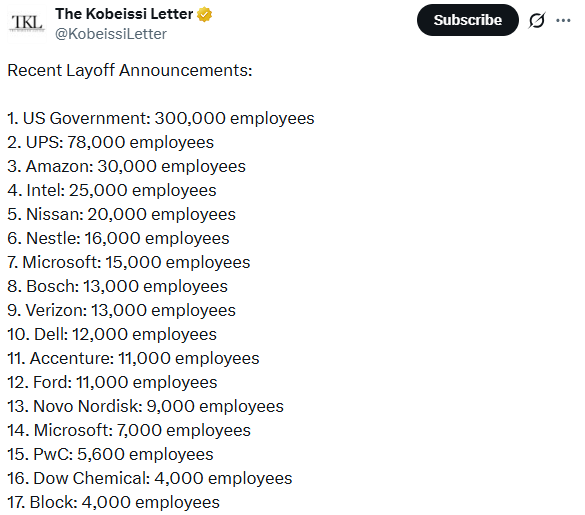
A viral list from Milk Road claims hundreds of thousands of jobs are being lost to Artificial Intelligence. The list includes big names like Amazon, Intel, and UPS. However, the real story is more complex. Experts say many of these cuts come from overhiring during the pandemic. High interest rates and fast expansion are also to blame.
The Block Case Study: Efficiency or Incompetence?
Jack Dorsey’s changes at Block Inc. are a perfect example of how Artificial Intelligence is redefining business. Even though the company was making a profit, Dorsey chose deep job cuts. He wanted one big round of cuts instead of many small ones. Investors loved the move. Block’s stock price jumped 25% in one day. This shows that Wall Street now values AI efficiency more than a large staff.
But not everyone agrees. Some critics say these cuts hide bad management from the COVID-19 hiring boom. Data from Challenger, Gray & Christmas shows that Intelligence tools only caused about 4.5% of total job cuts in 2025. Most layoffs actually happened because of market conditions and general cost-cutting.
Crypto Market Impact and the AI Job Layoffs Wave
For the crypto sector, AI Job Layoffs have a direct impact on market valuations. Block Inc. saw its shares surge because investors rewarded the pivot toward AI-driven efficiency. While robots now dominate high-frequency trading and automated audits, they are not perfect. For example, the AI bot Lobstar Wilde recently lost its entire $250,000 treasury due to a simple decimal error. This proves that while Intelligence tools can crunch bitcoin data, humans remain irreplaceable for providing the "common sense" and gut feeling needed to predict market sentiment or whale behavior.
Corporate Trends and "Artifial Intelligence Washing"
Labor experts are now worried about "AI washing". This happens when a company blames Intelligence tools for jobs cut to tell a "good news" story to investors. It hides the fact that their products might have weak demand or poor planning. For example, while Microsoft and Dell have cut thousands of roles, they are still hiring for new AI teams.
Company | Recent Layoffs | Primary Reason Cited |
US Government | 300,000* | General Efficiency |
UPS | 78,000 | Weak Demand |
Block Inc. | 4,000 | Artificial Intelligence& Flat Teams |
Amazon | 30,000 | Efficiency |
*Note: Reports of 300,000 federal jobs cut currently lack official government confirmation.
Expert Analysis: Future Outlook
We are seeing a "pivot" rather than a total replacement of humans. As the AI job layoffs stays in the news, the focus will MOVE from "job replacement" to "role evolution". Some jobs will face high risks, like data entry and basic support. However, roles that need human judgement and creativity will see more demand. Companies that use automation to empower people will likely build more trust and better cultures.
This report discusses labor and market trends. It is for informational use only and is not financial or career advice. Always consult a professional before making investment or career moves.
