Fabric Foundation Announces Listing Date on Binance and Major Exchanges

The wait is over—Fabric Foundation just dropped its official listing schedule. Binance leads the pack, with other top-tier exchanges confirming integration dates in the coming weeks.
Why This Move Matters
Getting listed on Binance isn't just another line on a roadmap. It's a liquidity magnet. Projects that secure a major exchange debut often see a significant valuation spike as institutional and retail capital floods in. For Fabric, this marks the transition from speculative asset to tradable commodity.
The Mechanics of a Major Listing
Behind the scenes, exchange integrations are a brutal technical gauntlet. Teams work around the clock to ensure wallet compatibility, liquidity pool stability, and security audits pass muster. One failed test can delay everything—exchanges have zero tolerance for network instability.
Market Impact and Trader Sentiment
Pre-listing volatility is almost guaranteed. Whales accumulate, speculators position, and social sentiment hits a fever pitch. The real test comes post-listing: can the token hold its price against sell pressure, or does it become another 'pump-and-dump' statistic in the crypto graveyard? Remember, a listing is a liquidity event, not a business model—though some founders seem to confuse the two.
Looking Beyond the Initial Pop
The true measure of success won't be the first-day green candles. It'll be sustained volume, developer adoption, and real-world utility that emerges once the hype settles. Fabric's tech will now face its most public stress test yet.
Final Take: A listing on this scale is a double-edged sword—it brings legitimacy and liquidity, but also intense scrutiny. For every project that uses this momentum to build, another treats it as an exit strategy. Let's see which category Fabric falls into.
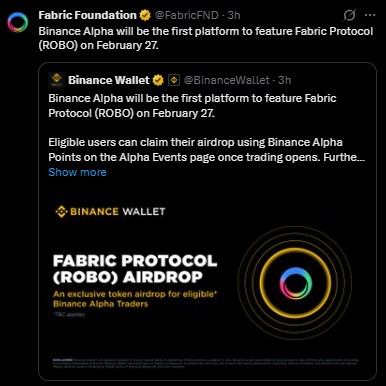
The Fabric Foundation listing date signals the shift from ROBO airdrop verification to market discovery. Early ecosystem contributors completed eligibility checks between 20–24 February, closing the verification window and preparing users for the claim phase.
Fabric Foundation Listing Date and ROBO Airdrop Claim Phase
Major platforms including Bybit, Bitget, KuCoin and Binance Alpha will support the initial rollout, with Binance Alpha expected to be the first platform to feature trading. Eligible users can claim rewards using Alpha Points once trading opens, with further instructions to follow through official exchange channels.
As per MEXC X tweet, Pre-market activity already started. MEXC launched USDT pre-market perpetual futures on 25 February 2026 at 13:30 UTC. Market data shows the token trading around $0.03568 with approximately $131.355 million in 24-hour volume, indicating strong early participation before spot trading begins.
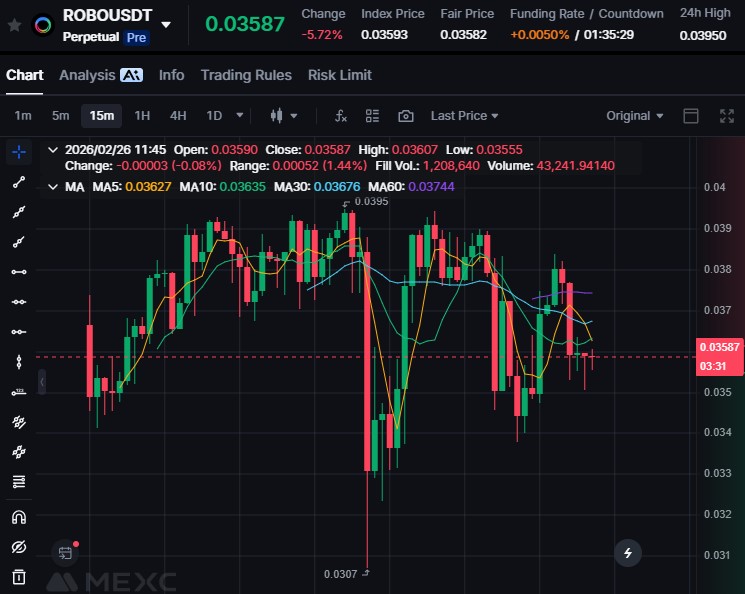
The Fabric Foundation listing date therefore marks a transition from community distribution to open market liquidity, a phase often associated with volatility and price discovery.
ROBO Tokenomics Structure and Supply Dynamics
Token distribution reveals a long-term vesting design. Total supply is 10 billion tokens.
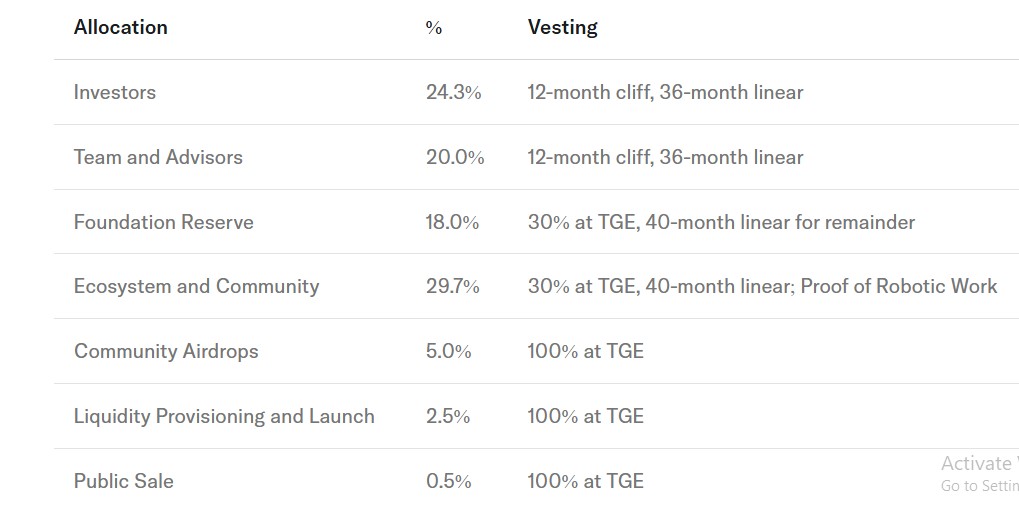
Investors: 24.3% (12-month cliff, 36-month vesting).
Team & Advisors: 20% (same vesting schedule).
Foundation: 18% (30% at TGE, rest linear).
Ecosystem & Community: 29.7% for growth incentives.
Airdrops: 5% unlocked at TGE.
Liquidity: 2.5% unlocked at launch.
Public sale: 0.5% unlocked at TGE.
ROBO Token Price Prediction and Future Outlook
Initial trading is expected to open NEAR $0.04–$0.055 depending on liquidity and sentiment. Early unlocked supply could create selling pressure, but ecosystem incentives may help stabilize price over time.
Short-term projections suggest a possible range of $0.08–$0.10 within one to three months as vesting limits sudden supply shocks. Mid-term performance will depend on partnerships and adoption. Over a longer 12–24 month period, gradual distribution and ecosystem expansion could support a MOVE toward $1–$3 under favourable market conditions.
Expert analysis highlights that structured vesting and strong community allocation often reduce extreme supply shocks, though early volatility remains typical for new token listings.
Conclusion
The Fabric Foundation listing date introduces the next phase for ROBO as trading, claims and liquidity begin together. With structured tokenomics and strong early activity, the launch may shape price discovery in coming months. Market reaction will likely depend on adoption, liquidity depth and ecosystem execution.
This article is for informational purposes only and does not constitute financial or investment advice. Cryptocurrency markets are volatile. Readers should conduct independent research and consult a financial advisor before making investment decisions.
