AI Data Centers Energy Pledge Secures Power for US Tech Growth

The lights stay on. A landmark energy pledge from major AI data center operators just guaranteed the juice needed to fuel America's next tech boom—no rolling blackouts required.
Powering the AI Engine
Forget about silicon shortages. The real bottleneck for artificial intelligence was always going to be the grid. Training the next generation of models consumes electricity at a scale that makes crypto mining look like a hobbyist's project. This pledge isn't about being green; it's about being online. It's a pre-emptive strike against capacity constraints that could have stalled innovation from Silicon Valley to Austin.
The Grid Gets an Upgrade
The commitment triggers a cascade of private investment into grid infrastructure and next-gen power procurement. We're talking long-term purchase agreements for nuclear, natural gas, and yes—a growing slice of renewables. It's a pragmatic, all-of-the-above strategy that prioritizes reliability first. Wall Street analysts, always late to the party, are now scrambling to upgrade utility stock ratings—a classic case of betting on the horse after it's already left the gate.
Future-Proofing Compute
This move does more than keep servers humming. It sends a clear signal to global tech firms: the U.S. is serious about maintaining its infrastructure advantage. By securing predictable, scalable power, it removes a massive layer of uncertainty for anyone planning billion-dollar data center investments. The race for AI supremacy isn't just won with algorithms, but with megawatts.
The pledge effectively mortgages a chunk of the future energy grid to power the servers of tomorrow. It's a high-stakes bet that the economic output of AI will far outweigh the cost—a bet that, for once, doesn't rely on venture capital fairy dust but on cold, hard electrons.
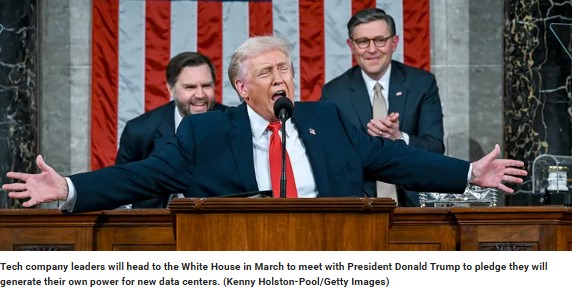
The companies will either build, buy, or bring their own power supplies to new smart technology facilities. A formal signing ceremony is scheduled for March 4, 2026. Trump emphasized that this initiative ensures power security while allowing U.S. AI infrastructure growth without adding pressure to the public grid.
AI-Related Growth Drives American Energy Focus; Or Something Else
AI data centers already consume 2–3% of global electricity, with demand expected to triple to 1,000 TWh annually by 2026 according to the International Energy Agency.
In the U.S. demand is accelerating even faster. Data-center power load could reach up to 76 GW by 2026, and by 2030 may consume 7–12% of US power supply.
This surge makes energy one of the biggest limits to artificial intelligence expansion and that is why Trump’s 2026 “Ratepayer Protection Pledge” policy marks importance. By generating their own electricity, US tech companies can reduce reliance on traditional grids and prevent AI-related price spikes for consumers.
Behind Supply: China’s AI Surge Puts US Firms and Regulators on Edge
U.S. technology power shift in artificial intelligence is also seen as a result of China’s rapid AI-related advancements. In early 2025, when China’s DeepSeek released highly efficient models like R1, it rattled U.S. markets and triggered a heavy selloff in Nvidia.
Although Nvidia's stock rebounded strongly by late 2025, surging over 97%, amid sustained demand, and now in 2026 earnings it again faces short-term scrutiny.
Nassim Taleb before described this scenario as a “reality check,” warning that America’s AI dominance was more fragile than markets assumed, especially if China could deliver competitive models with far less compute under chip restrictions.
With this, China US technology power shift turned the smart technology race into a contest of adaptability, cost, and geopolitical leverage, not just scale.
While the pledge is officially focused on artificial intelligence, it also raises a bigger question: what comes after smart machine learning in U.S. energy policy?
What Comes After AI? Could Bitcoin Be Next?
President Trump is well-known for his crypto-favoured stance, often called the pro-crypto leader of the US. That makes some observers wonder whether this AI-first power-strategy could later extend to crypto, especially bitcoin mining.
Bitcoin mining and AI data centers face the same Core challenge – energy is the bottleneck, not technology. Both require large amounts of reliable, low-cost energies to scale. If hyperscalers begin generating their own electricity through private nuclear, gas, or renewable systems, it could free up grid capacity and create a blueprint other sectors can follow.
Several countries already use this model. Bhutan, for example, leverages surplus hydropower to mine Bitcoin, turning excess energies into a national revenue stream. A similar approach in the U.S. could allow miners to co-locate NEAR dedicated energy-generating sources such as renewable hubs, reducing grid stress while keeping mining domestic.
Opportunities in Some, Hopes on Others
Although there is no official signal, by normalizing the idea that large power users must “build, bring, or buy” their own electricity, the administration may be laying groundwork that Bitcoin mining could eventually plug into.
For now, reactions to the news are positive. Tech giants (MSFT, GOOGL, AMZN, META, ORCL) now have clearer energy strategies, reducing a major risk in AI expansion. Uranium and nuclear energy stocks, such as CCJ and UEC, may see gains due to increased demand for private-sector power solutions.
However, energy experts still caution that while the pledge is promising, it only covers new AI data centers and doesn’t replace the need for grid upgrades.
