Tether’s Market Cap Plunge Sparks Urgent Liquidity Crisis Fears

Tether's market cap just took a nosedive—and the entire crypto market is holding its breath. This isn't just a number on a chart; it's a direct threat to the lifeblood of digital asset trading: liquidity. When the world's dominant stablecoin shrinks, the gears of crypto finance start to grind.
The Domino Effect of a Shrinking Anchor
Think of Tether as the primary reservoir for crypto's trading ecosystem. A significant decline doesn't just sit in a vault—it gets pulled out of circulation. That means fewer USDT pairs available for swaps, wider bid-ask spreads, and increased volatility across the board. Trading desks suddenly find their key tool in short supply.
Decoding the Signal in the Noise
Market veterans watch this metric like hawks. A contracting stablecoin supply often signals one of two things: mass redemptions due to fear, or capital fleeing the ecosystem entirely for 'safer' pastures. Either scenario paints a worrying picture of short-term sentiment and leaves altcoins particularly exposed to sell-pressure.
Beyond the Immediate Squeeze
The real question isn't about today's price swing—it's about structural fragility. An over-reliance on a single centralized stablecoin creates a critical single point of failure. It's the financial equivalent of building a city on one well, then being surprised when a drought causes panic.
While some will spin this as a healthy 'de-leveraging,' the timing never seems to coincide with calm, rational decisions—just ask any trader trying to execute a large order during the dip. The system's resilience is now under a stark, real-time stress test. How it holds up will reveal more about crypto's maturity than any glossy institutional report ever could.
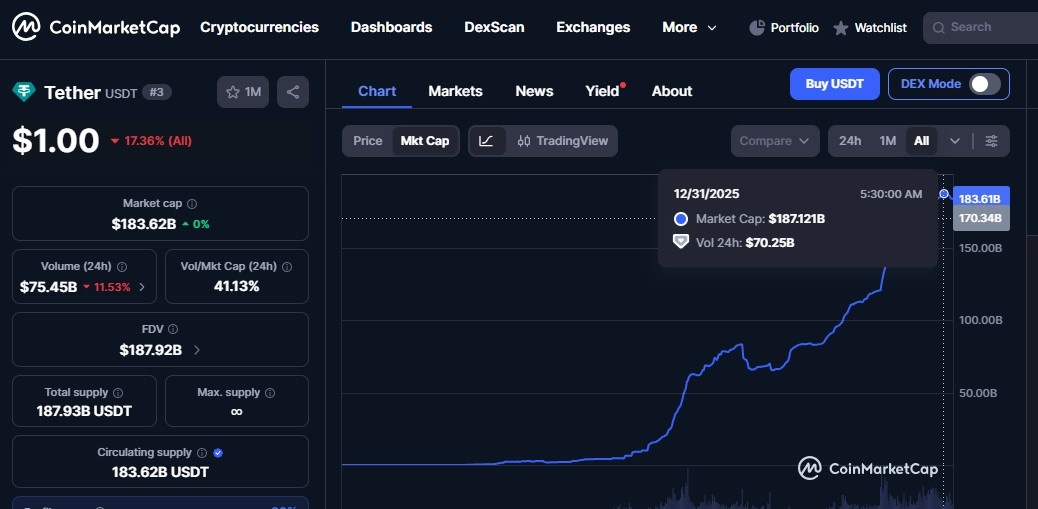
Source: CoinMarketCap Official
Stablecoins often reflect liquidity conditions across digital asset space. When supply shrinks, it can signal reduced trading activity, capital rotation, or cautious sentiment among participants. The latest numbers, therefore, highlight broader shifts rather than isolated movement.
Comparison With Past Shock: Terra Collapse 2022
The previous notable contraction in major stablecoin supply occurred during 2022’s Terra collapse, a significant event in crypto history. Terra’s algorithmic UST lost its dollar peg after a sharp sell-off, triggering a chain reaction that erased billions in value.
The incident impacted confidence across the ecosystem because many investors relied on stablecoins for liquidity and yield strategies. As panic spread, withdrawals increased, liquidity pools shrank, and several projects faced pressure. That period marked one of the largest supply contractions before the current Tether Market Cap Decline trend.
While the present drop is far smaller, comparisons highlight how stabletoken metrics often act as early indicators of risk sentiment.
Why Stablecoin Supply Is Falling Now
Multiple factors appear to be driving the recent Tether Market Cap Decline. Crypto analysts point to reduced speculative activity and slower capital inflows following strong cycles in previous quarters.
At the same time, bitcoin trading near $65,000 reflects cooling momentum compared with earlier bullish phases. When major assets consolidate or weaken, trading volumes frequently decline, leading to lower demand for stable liquidity.
Possible reasons behind capital rotation include:
Profit-taking after previous rallies
Reduced leverage across trading platforms
Another discussion centers on macro policy expectations. Some observers suggest uncertainty around potential TRUMP policy direction, including regulation, fiscal stance, and global trade decisions, may influence risk appetite. Even without direct impact, policy narratives can affect sentiment and portfolio positioning.
In such environments, investors may temporarily MOVE funds into cash equivalents or traditional spaces rather than maintaining large stabletoken balances inside exchanges.
Market Signals and Stablecoin Competition
The ongoing Tether Market Cap Decline may signal slower liquidity growth rather than structural weakness. Stablecoin supply often expands during aggressive risk cycles and contracts during consolidation phases.
At the same time, USDC has shown partial recovery, rising to roughly $75 billion after January lows. However, its overall trajectory remains relatively flat year-to-date, reflecting broader stagnation among major dollar-pegged assets.
This pattern suggests the sector is entering a pause phase rather than a sharp contraction. When stabletoken growth slows, it can indicate cautious positioning ahead of macro events, policy clarity, or major market catalysts.
Traders often monitor these metrics because stabletoken supply acts as “dry powder.” Expansion typically signals incoming liquidity, while contraction can imply reduced speculative demand.
Conclusion:
The current Tether Market Cap Decline highlights softer liquidity conditions following the previous expansion. With Bitcoin consolidating, policy uncertainty shaping sentiment, and stablecoin growth slowing, markets appear to be entering a cautious phase rather than a crisis-driven contraction.
