Step Finance Shutdown After $40M Hack: What Happens to STEP Holders Now?

Step Finance goes dark. A $40 million exploit forces the platform offline, leaving STEP token holders in limbo.
The Immediate Fallout
Security protocols failed. The breach drained liquidity, triggering an automatic shutdown. Trading halts, withdrawals freeze—the platform's core functions grind to a standstill. Users stare at frozen dashboards, their assets locked behind a digital crime scene tape.
Holder's Dilemma
What now for STEP? The token's utility—tied entirely to the now-defunct platform—evaporates overnight. Its value hinges on a recovery plan that doesn't yet exist. Holders face a brutal choice: wait for a potential resurrection or cut losses in a fire sale. Community channels erupt with panic, speculation, and demands for transparency that may never come.
The Road to Recovery?
Insiders hint at forensic audits and legal maneuvers. The team scrambles to trace funds, but blockchain's anonymity often wins. Promises of restitution sound hollow against the sheer scale of the loss. In crypto, a 'full investigation' often translates to 'prepare for bad news.'
This isn't just another hack—it's a platform-killer. It exposes the fragile trust holding DeFi together and delivers a masterclass in how a single vulnerability can vaporize a project's entire value proposition. Remember, in high-yield finance, if it seems too good to be true, it probably is—until the smart contract gets a little too smart.
What Happened To Step Finance in January 2026?
The company experienced a compromise of management devices at the end of January. This crypto hack was an internal operational security breach, unlike the usual smart contract exploits. It is also reported that hackers accessed an executive gadget and were able to transfer about 261,854 SOL, which was worth between $26 million and $40 million back then, into treasury wallets.
Notably, the team explained that smart contracts were not misused. Rather, the attack revealed weaknesses in operational security, especially at the device-level access. The funds were not recovered even though immediate response efforts were made.
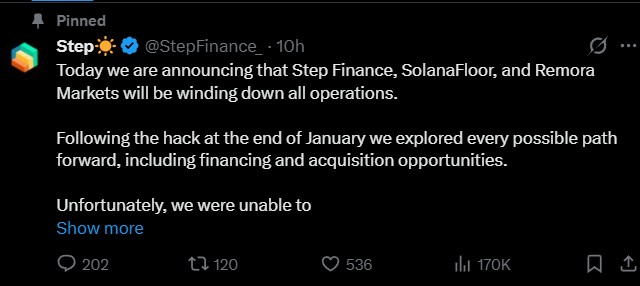
Source: Official X
Why is Step Finance closing down rather than recovering?
After the breach, the team considered several recovery measures, such as:
Fundraising initiatives
Strategic financing
Merger and acquisition opportunities.
Nevertheless, after weeks of negotiations, the company said that no feasible way forward could be achieved. Consequently, the group decided to close down all its operations immediately. The team thanked its millions of users in an official statement and stated that the most responsible course of action in the situation was closure.
What happens to STEP Token Holders?
Among the greatest issues in the community is about token holders. The team confirmed:
A buyback strategy is being worked on.
The buyback will be pegged on a snapshot made before the incident.
This will help to reduce unjustified losses suffered due to the hack and offer some degree of financial support to holders. More information should be provided in the next few days.
Source: X
Are Remora rToken Holders Protected?
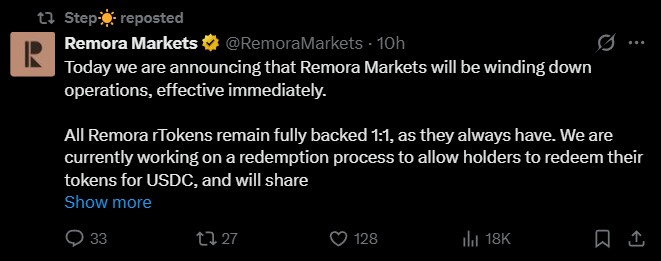
To Remora Markets users, it is partially reassuring. It confirmed:
Remora rToken redemption process is under preparation.
Remora tokens will be 1:1 backed.
This implies the holders must be in a position to redeem their assets at full backing value, even though the wider shutdown takes place.
Step Token Price Crash Today
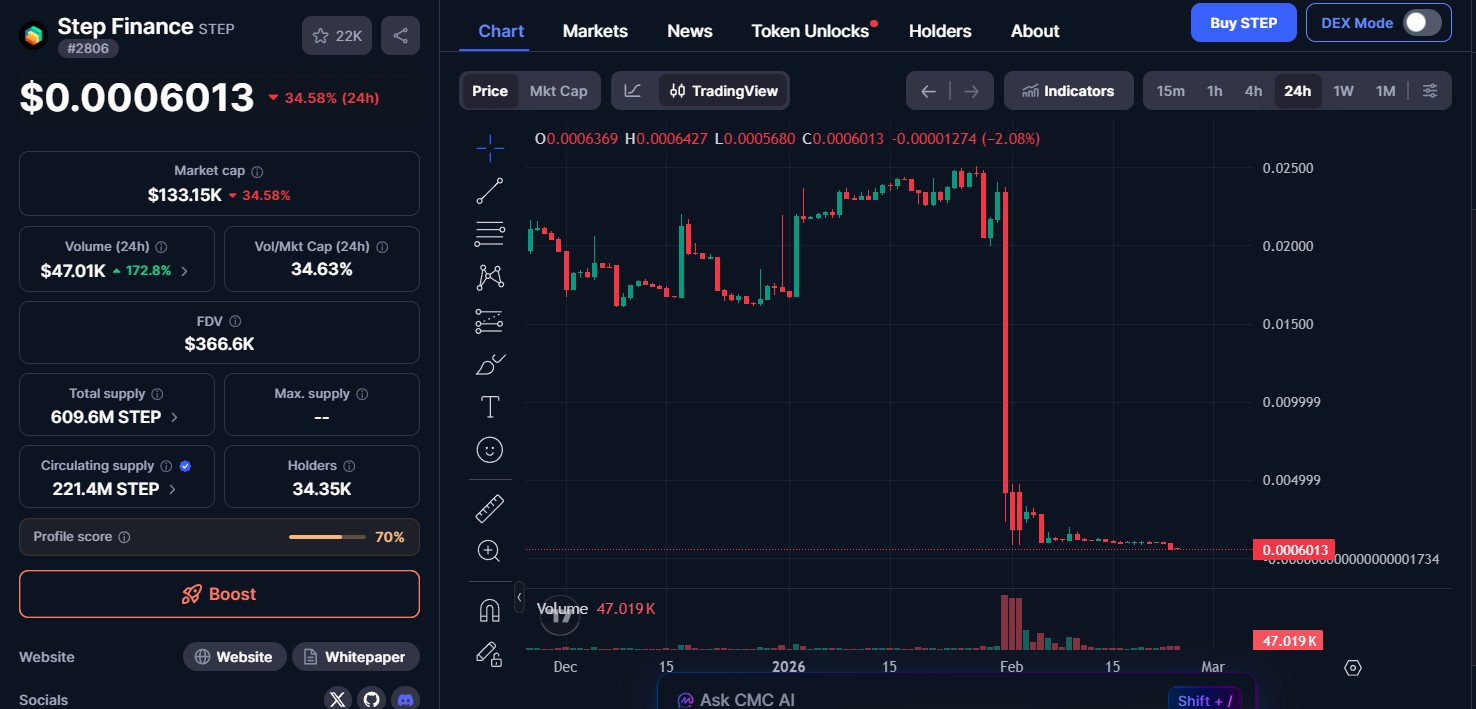
The token plunged over 34% in 24 hours after Step Finance announced its shutdown following a $40 million hack. The price collapsed to $0.0006013, with selling pressure and volume, reflecting panic among investors and weakening confidence across the solana ecosystem.
Source: CoinMarketCap
What does this mean for the Solana Ecosystem?
The most popular DeFi dashboard and portfolio tracker was known as Step Finance, which was referred to as the front page of Solana. Its shutdown shows larger threats in decentralized finance, specifically:
Weaknesses in operational security.
Centralized access vulnerability in so-called decentralized systems.
The treasury losses lead to liquidity shocks.
According to market analysts, such exploits in the past have resulted in a decline of 80-90% of the token values in the impacted projects. Although the STEP buyback will mitigate the effects, there are long-term effects of damaged confidence. The incident has also rekindled demands on:
Post-mortem transparency of the public.
Tighter security measures in the treasury.
Multi-gadget and multi-sig working protection.
Is this a warning sign to DeFi Platforms?
The shutdown highlights one important lesson: despite the safety of smart contracts, human and operational weaknesses can collapse whole protocols. Security should go beyond code audits to include:
Hardware security practices.
Device isolation
Cybersecurity training at the executive level.
Compartmentalization of the treasury.
This incident is a reminder to the Solana ecosystem and the rest of the crypto market that no security is as strong as the weakest point. Further information about buybacks and Remora redemptions will be made in the near future, as the community will receive more updates about the team.
Disclosure: It is not financial advice. Do Your Own Research before investing. CoinGabbar is not liable to any financial loss. Cryptocurrencies are very risky, and you may lose all the money you invested.
