SBI Holdings’ $64.5M XRP Rewards Bond Launch: A Landmark On-Chain Offering

Traditional finance just got a crypto-powered upgrade—and a passive income twist.
The Hybrid Instrument That's Turning Heads
SBI Holdings isn't just dipping a toe in the digital asset pool; it's building a new diving platform. The Japanese financial giant's latest move stitches blockchain yields directly into a conventional bond structure. Forget abstract promises of future utility—this product delivers XRP rewards on-chain, directly to the holder's wallet. It's a tangible bridge between yield-hungry investors and the fluid mechanics of decentralized finance.
Why This Isn't Just Another Crypto Gimmick
The scale speaks to serious intent. With a $64.5 million on-chain offering, SBI is targeting institutional and sophisticated retail players, signaling a maturation phase for asset tokenization. This isn't a speculative meme coin launch—it's a regulated entity using blockchain to enhance a proven financial product. The mechanism bypasses traditional custodial layers, slashing administrative overhead and automating distributions. Efficiency, it turns out, can be a compelling feature all on its own.
The Ripple Effect Beyond the Price Chart
Look past the XRP ticker. This launch validates a broader thesis: that blockchain's killer app in finance is streamlining settlement and enabling programmable assets. When a heavyweight like SBI—with its deep ties to Japan's Financial Services Agency—executes this play, it provides a blueprint for global peers. It forces a question onto every traditional asset manager's desk: if a bond can natively carry crypto rewards, what other hybrid instruments are possible?
A Cynical Footnote for the Purists
Let's be real—the old guard isn't adopting crypto out of ideological fervor. They're chasing yield and client demand in a zero-interest-rate hangover. If wrapping legacy products in blockchain tech keeps the fees flowing, they'll happily call it innovation. Sometimes progress is just the next profitable compromise.
The takeaway? The future of finance isn't a hostile takeover; it's a strategic merger. And the dividends—both in fiat and crypto—are starting to hit wallets.
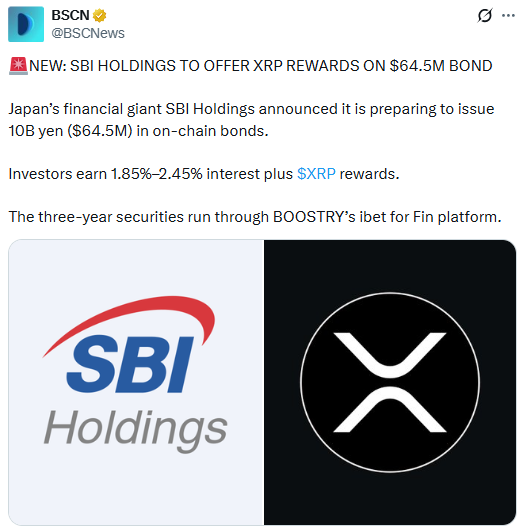
This debt instrument is a "security token," which means it is managed and recorded entirely on a blockchain rather than through old-fashioned paper systems. The Japanese financial giant is using a platform called "ibet for Fin," built by the company BOOSTRY, to keep everything secure and transparent. The bonds are set to be priced on March 10, with the official launch happening on March 24, 2026.
How the SBI Holdings XRP Rewards Bond Works for Investors
The Japanese financial giant Holdings XRP rewards bond offers two ways for investors to make money. First, it pays a regular interest rate, which is expected to be between 1.85% and 2.45% per year. This interest is paid to investors every six months. Second, the debt instrument gives out rewards in token, a popular digital token.
Simple Reward Structure
To get the XRP bonuses, investors must buy at least ¥100,000 worth of bonds, which is roughly $650. They also need to have an account with SBI VC Trade, the company’s crypto platform.
Investors get ¥200 worth of XRP for every ¥100,000 they invest right when the bond starts.
Investors receive the same amount of XRP every time they get an interest payment through the year 2029.
If investors want to sell their bonds before the three years are up, they can do so on the Osaka Digital Exchange starting March 25.
Why SBI is Using XRP
SBI Holdings has a very close relationship with Ripple, the company behind this digital token. In fact, The Japanese financial giant owns about 9% of Ripple Labs. By using the SBI Holdings XRP rewards bond, the company is helping to make token more useful in the real world. If many people buy these bonds, The Japanese financial giant might even need to buy more tokens on the open market to pay out all the rewards.
Expert Analysis: The Future of Digital Bonds
This bond is a major test for the Japanese market. It shows that big banks are now comfortable using blockchain to offer products to regular people, not just big institutions. While the total size of the bond is small compared to the whole crypto market, it represents a "bridge" between traditional banking and the new digital economy. If this launch is successful, we could see many more bonds in Japan that offer crypto rewards alongside regular cash interest.
Investing in security tokens and cryptocurrencies carries high risk. Prices can go up or down quickly. This article is for information only and is not financial advice. Always talk to a professional advisor before investing your money.
