Pi Network’s Persistent Struggles: Has the Banished Era Already Begun?

Is Pi Network's much-hyped 'inclusive' crypto revolution hitting a wall of silence? The project, promising mobile-mined digital currency for the masses, faces mounting questions as its open mainnet remains a moving target.
The Core Tension: Promise vs. Progress
Critics point to the prolonged development phase. The core appeal—earning Pi through a phone app—garnered a user base in the tens of millions. Yet the crucial step of a fully functional, open blockchain where Pi holds tangible value remains unrealized for the general user. This limbo fuels speculation: is this strategic caution or a fundamental roadblock?
Community on Edge
The ecosystem fractures between unwavering pioneers and growing skeptics. Enclosed mainnet transactions for verified users offer glimpses of functionality, but the broader market can't touch it. Every delayed timeline or vague update amplifies the 'when mainnet?' chorus—a soundtrack familiar to any vaporware-adjacent project in crypto's history.
The Regulatory Shadow
Operating in a pre-launch state may have avoided regulatory scrutiny, but that grace period isn't infinite. Global watchdogs are now hyper-focused on crypto. Any move to a true open network would invite immediate scrutiny over its distribution model and legal status—a hurdle that has flattened more established projects. Sometimes, staying in the lab is safer than facing the market's verdict, a truth even traditional finance's most cynical bankers understand.
Path Forward or Fade Out?
The coming months are critical. The team must transition from building hype to delivering utility. Concrete progress on mainnet scalability, real-world use cases, and regulatory compliance is non-negotiable. Otherwise, 'banished' won't be a question of external forces, but a self-imposed exile into irrelevance. The clock is ticking—loyalty in crypto burns fast.
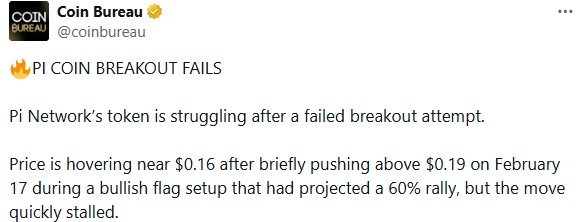
As of latest data, Pi Coin price today is hovering around $0.158, down roughly 4–6% in the last 24 hours, underperforming the broader crypto market, which fell closer to 3% over the same period. Market capitalization now sits around $1.4 billion, while trading volume remains steady but far from aggressive buying levels.
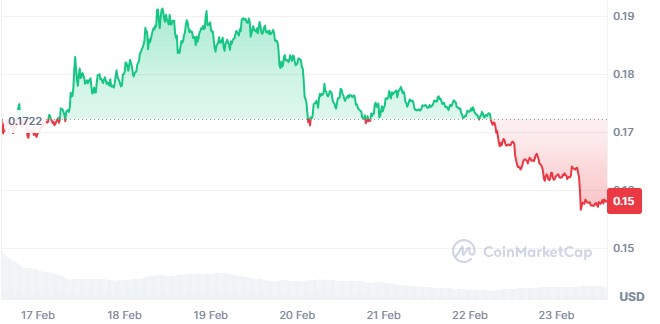
The pullback comes just days after the project marked one year since its Open Mainnet launch in February. Earlier the month, the coin rallied nearly 35% ahead of its anniversary milestone. However, once the breakout stalled NEAR $0.20, traders moved to lock in profits, dragging prices lower.
This pattern isn’t new for the network and its community. Since its open mainnet launch in February 2025, the network has seen multiple sharp price rallies, but almost all of them have ended the same way: fast reversal, heavy sell-offs, and long consolidation phases.
This repeated pattern has raised a growing question among investors and early adopters alike: Why is the network price still struggling after more than a year on mainnet?
And more importantly, is Pi Coin already losing market relevance?
Historical Data: From Hype to Heavy Selling
The network has followed a long-waited rally then fast fall pattern in a consistent way since launch in 2025. Each surge was driven by specific events or speculative catalysts, but almost every one ended with a sharp drop or extended sideways price action.
Here’s how it has played out so far.
The token spiked sharply after Open Mainnet went live, reaching nearly $3.00. The rally faded quickly as heavy supply entered the market, sending the prices ($1.7) into a steep decline, with a 37.04% loss within a week.
A 2025 May rebound lifted the coin into the $1.20–$1.23 range due to upgrades (v19.6 rollout, v19.9 preparation) and oversold technical bounce. Momentum stalled as the MOVE failed to attract sustained demand, and prices drifted back towards the low-$0.63 in just 2-3 days following the surge.
Setting new lows near $0.13 following months of continuous downtrend, Pi rebounded into the $0.19–$20 range amid v19.6 upgrade completion and anniversary-related optimism. The move lost strength near resistance, and the price slipped back into consolidation.
Possible Reasons Behind Fall
Millions of tokens unlock regularly with limited demand
Weak utility and minimal external integrations
Low liquidity makes pumps easy, but dumps faster
Ongoing migration and KYC delays frustrate long-term users
Speculative buyers often take profits at key resistance levels
Is Pi Network Already Banished by the Market?
The platform isn’t dead, but it’s clearly struggling to escape its own structure.
The market continues to price Pi Coin as a high-supply, low-utility token. However, repeated surge-then-fall cycles reflect structural challenges, not a lack of interest alone.
To break this cycle, it needs more than upgrades or anniversaries:
A fully active DEX and smart contracts
Proven real-world utility at scale
Tier-1 exchanges listings with deep liquidity
Demand strong enough to absorb daily unlocks
Until then, the pattern of short-lived spikes followed by extended pullbacks will likely continue.
Pi Network isn’t gone, but it’s not out of the woods yet.
This article is for informational purposes only. It does not constitute investment advice. Readers should independently verify information before making decisions.
