Institutional Rotation Accelerates: XRP Outperforms as Capital Flees BTC and ETH

Forget the old guard—smart money is pivoting hard.
While Bitcoin and Ethereum have long dominated institutional portfolios, a seismic shift is underway. Capital isn't just trickling into alternative assets; it's flooding toward one standout: XRP. The rotation signals a deeper hunt for utility and regulatory clarity in a market tired of pure speculative narratives.
The Rotation Rationale
It's not mere diversification. Institutions are actively reallocating—cutting exposure to the giants and bypassing traditional altcoin pathways to target XRP directly. The move hinges on a clear calculus: established networks face scaling debates and energy scrutiny, while XRP's consensus mechanism and settlement speed present a frictionless alternative for cross-border value transfer. It's a bet on practical application over store-of-value dogma.
What's Driving the Flow?
Look beyond the charts. The momentum stems from a convergence of factors—real-world adoption by payment providers, a regulatory landscape that's becoming less opaque (though never simple), and a network effect that's quietly building while crypto Twitter argues about memes. This isn't retail FOMO; it's cold, institutional redeployment based on infrastructure and efficiency gains. After all, what's a better hedge against volatility than a token actually designed to move money?
The New Hierarchy
The message is stark. Portfolio dominance is no longer a birthright for the two largest cryptos. Performance is being redefined by use case, and XRP's recent outperformance is a direct report card. It underscores a market maturing—or at least pretending to—by rewarding technological throughput over brand recognition. The silent verdict from fund managers? Maybe you don't need to 'HODL' an entire blockchain's history to turn a profit.
So, while Bitcoin maximalists debate halving cycles and Ethereum fans await the next upgrade, institutional sheets are getting a quiet, deliberate overhaul. The rotation toward XRP isn't a fluke—it's a calculated repositioning in a sector where yesterday's blue chip can quickly become tomorrow's legacy tech. Just ask any former finance VP who backed Lehman Brothers in '07.
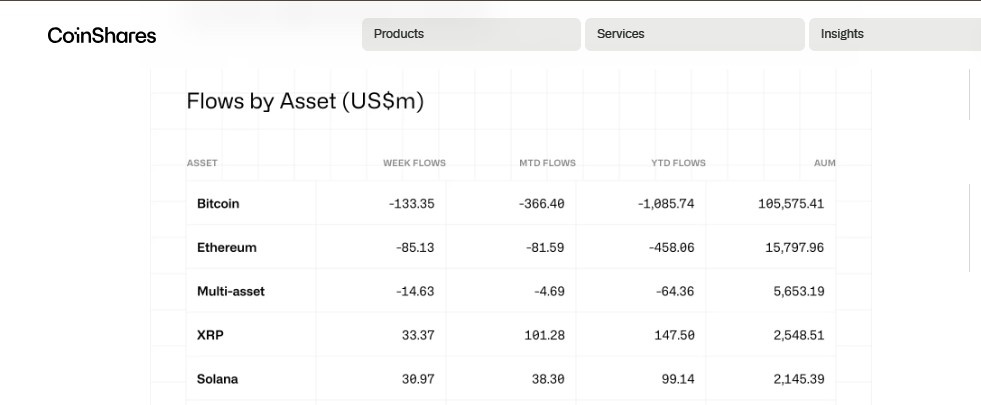
Institutional Flow Data and Price Context
CoinShares reported sustained inflows into XRP-linked products, while competing assets recorded persistent withdrawals.
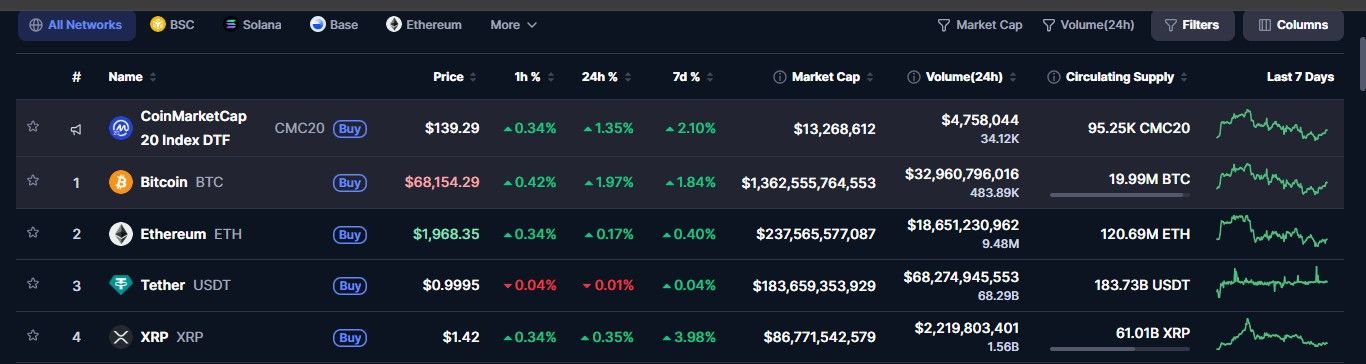
CoinMarketCap price snapshots show XRP trading near $1.42, Bitcoin around $68,154, and Ethereum close to $1,968 during the reporting window.
Additional weekly datasets indicated about $63.1 million inflows into XRP at one point, outperforming several competing altcoins combined. Another period showed $33.4 million entering XRP products, while Bitcoin saw approximately $133 million withdrawals and Ethereum around $85 million outflows. Over a longer timeframe, year-to-date allocations reached roughly $109 million, reinforcing consistent institutional interest.
ETF Exposure and Comparative Performance
Structured investment vehicles tied to blockchain experienced steady demand, including a single-day inflow of nearly $46 million after launch activity.
Institutional disclosures revealed around $152 million exposure from a major global bank, representing roughly 14% of its ETF allocations.
Relative performance metrics also strengthened the narrative. Market analytics showed XRP gaining roughly 15–20% during certain recovery phases while bitcoin and Ethereum lagged. In ratio terms, The token appreciated about 20% versus Bitcoin in comparative performance metrics. Some broader research estimated approximately $1.3 billion in activity tied to token-related institutional positioning and whale accumulation, suggesting deeper market engagement.
Why Institutions Are Moving Toward XRP
Real-world payment infrastructure remains the primary attraction for financial firms seeking faster settlement rails.
Existing partnerships with banks and payment providers provide confidence in long-term adoption.
Unlike speculative tokens, it focuses on cross-border settlement, enabling near-instant transactions at lower cost compared with legacy systems such as SWIFT. This functional design positions the asset as infrastructure rather than purely a trading vehicle. Growing ETF availability further supports professional participation by offering regulated exposure.
From a strategic perspective, XRP Outperforms narratives are linked to capital rotation themes where investors diversify beyond large-cap assets into utility-driven networks. During uncertain macro conditions, infrastructure-focused tokens often attract attention due to perceived real-world demand and enterprise integration potential.
Ecosystem Advantages and Market Signal
Borrowing frameworks, liquidity bridges, and tokenization tools on the XRP Ledger expand financial use cases.
Proposed lending vault models aim to deliver institutional credit products directly on blockchain rails.
For customers, benefits include cheaper remittances, faster international transfers, and enterprise-grade payment capabilities. For institutions, advantages extend to liquidity management, settlement efficiency, and tokenized asset experimentation. These features help explain why capital continued flowing towards token while competing assets saw withdrawals.
The broader implication suggests growing recognition of blockchain networks as financial infrastructure. As tokenization and real-world asset markets expand, payment-focused ecosystems could receive increasing allocations from professional portfolios.
Conclusion:
The latest data confirms XRP Outperforms competitors in institutional capital rotation. Strong inflows, ETF demand, and payment utility are reshaping investor perception, positioning it as an infrastructure within digital finance while highlighting shifting priorities across professional crypto portfolios globally.
