Hong Kong Mystery Firm’s $436M ETF Staking Move Signals Chinese Influence in Crypto Markets

A massive, unidentified Hong Kong entity just dropped $436 million into ETF staking—and whispers point directly to mainland Chinese capital making its quiet, calculated entry.
The Shadow Play
Forget retail frenzy. This is institutional-grade positioning. That nine-figure sum isn't chasing memecoins; it's a strategic deployment into the staking infrastructure of exchange-traded funds. It's capital seeking yield, yes, but more importantly, it's capital seeking influence and a stake in the foundational layers of crypto's regulated future.
Reading the Tea Leaves from Beijing
The 'mystery' label is almost a formality. Market veterans see the fingerprints of sophisticated Chinese investors—capital navigating the gray zone between Hong Kong's crypto-friendly pivot and Beijing's cautious stance. This move isn't a speculative bet; it's a long-term anchor. It provides steady, protocol-level returns while building a strategic position in a key financial vehicle. Call it financial statecraft with a blockchain ledger.
The New Institutional Playbook
This massive stake cuts through the noise of daily price swings. It reveals a mature, next-phase strategy: bypass the volatility, target the plumbing. Staking ETFs offers a hybrid model—exposure to a basket of assets combined with the passive income of network validation. It's the ultimate 'set it and forget it' move for whale capital, proving that sometimes the smartest trade is to become the house. After all, why gamble at the tables when you can quietly buy the casino? A classic finance maneuver—dress up long-term control as a simple yield play.
The $436 million question is no longer 'who,' but 'what's next.' This capital injection signals a deeper, quieter institutionalization of crypto markets, where influence is built not through headlines, but through foundational stakes. The era of loud money might be fading, replaced by the silent, steady accumulation of power by players who understand that in global finance, the most profitable moves are often the ones nobody sees coming.
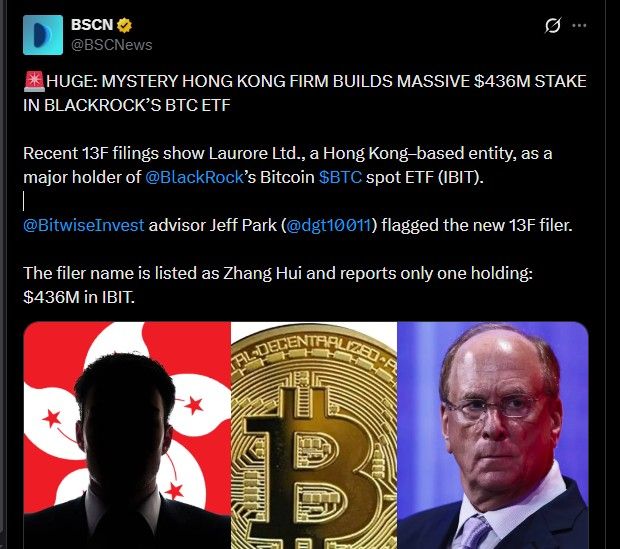
13F Filing Details and Jeff Park’s Observation
The disclosure relates to a FORM 13F covering the quarter ending December 31, 2025. According to the document, Laurore reported ownership of 8,786,279 IBIT shares, representing a significant allocation into a single digital asset investment product.
Jeff Park emphasized that the filing stands out because of the limited transparency surrounding the entity. Laurore appears to be newly formed, with no public website, minimal references, and almost no online footprint beyond the SEC submission. Park described the listed name Zhang Hui as comparable to a generic placeholder, similar to John Smith, suggesting a non-anonymous identity.
Key points highlighted:
Only one holding is listed in the portfolio
The entity lacks a visible corporate presence
This Mystery Hong Kong situation raises questions about who ultimately controls the allocation while reinforcing the scale of institutional participation in ETF products. Is this a chinese backed firm?
Staking relevance with China
Jeff Park pointed out that Laurore’s portfolio includes only IBIT shares, without any stocks, tech exposure, or hedging positions, which suggests the vehicle was created purely to gain BTC exposure rather than build a typical US investment portfolio. He linked this structure to a possible China-related motive, explaining that investors in China cannot easily hold Bitcoin directly. Because of that restriction, using a regulated US spot ETF like IBIT could be a practical route for institutional Chinese capital to enter Bitcoin markets without relying on exchanges or unofficial channels. Park described this approach as the most “transparent non-transparent” method — meaning the exposure is visible through regulatory filings, while the real capital source remains unclear. This matters because spot Bitcoin ETFs have become the simplest institutional wrapper for BTC exposure, allowing large allocators to avoid custody risks, exchange access challenges, and the need to build internal crypto infrastructure while still participating in the asset’s growth.
Why the $436M Allocation Matters
Reports suggest the Hong Kong organization built its position gradually rather than through a single transaction. The total holding value — around $436M — classifies this as a substantial institutional allocation rather than a short-term trade.
The development signals several broader trends:
Growing institutional confidence in BTC exposure via ETFs
Long-term portfolio positioning rather than speculative entry
Large concentrated filings typically indicate strategic accumulation, reflecting expectations of future digital asset growth and sustained ETF demand. Analysts often interpret such allocations as evidence that global capital continues entering regulated crypto investment vehicles.
The opacity surrounding Laurore adds another dimension. While the identity remains unclear, the scale suggests sophisticated capital deployment rather than retail activity. Mystery Hong Kong inflows, therefore, highlight how international investors increasingly access U.S. Bitcoin ETFs as part of diversified macro strategies.
Conclusion:
Overall, Mystery Hong Kong allocation into IBIT highlights rising global institutional participation through regulated vehicles. The $436M disclosure, unusual opacity, and single-asset focus signal strong conviction, reinforcing Bitcoin ETF demand as long-term digital asset investment strategies expand worldwide.
