Clarity Act Approval Gains Steam as Polymarket Signals 60% Odds

Prediction markets are betting on regulatory green lights—and the smart money sees a path forward.
The Polymarket Pulse
Sixty percent. That's the number flashing on the board right now. It's not a stock price or a bond yield—it's a collective wager on the future of crypto regulation. Polymarket's prediction contract has become the de facto thermometer for Washington's regulatory fever, and the reading suggests the temperature is rising in favor of the Clarity Act.
Why the Odds Are Shifting
Market sentiment doesn't move in a vacuum. This uptick mirrors a growing, if grudging, consensus among institutional players that clear rules beat regulatory purgatory. The alternative? A continued patchwork of state-level maneuvers and enforcement-by-press-release that does little but fuel compliance departments and lawyer bonuses—a classic finance sector value-extraction play.
The act itself proposes a framework. It draws lines, defines jurisdictions, and theoretically separates the digital asset wheat from the scammy chaff. For builders, that's the holy grail: knowing the goalposts won't be moved mid-play.
The Stakes Beyond the Bet
A 'yes' outcome doesn't just mean a contract settles in the green. It signals a potential pivot from antagonism to architecture. It suggests policymakers might finally be looking to build guardrails instead of just waving stop signs. That shift could unlock institutional capital currently sitting on the sidelines, priced out by pure regulatory risk.
But let's not pop the champagne yet. Prediction markets are brilliant sentiment aggregators, but they're not crystal balls. They track probability, not certainty. The remaining 40% odds represent a very real chance of delay, dilution, or outright political paralysis.
The Bottom Line
The market is leaning bullish on regulatory progress. For an industry accustomed to operating in the gray, a 60% chance of clarity feels almost like a sure thing. Whether D.C. delivers—or reminds everyone why betting against bureaucratic inertia is often the wiser move—remains the final, unhedgeable risk.
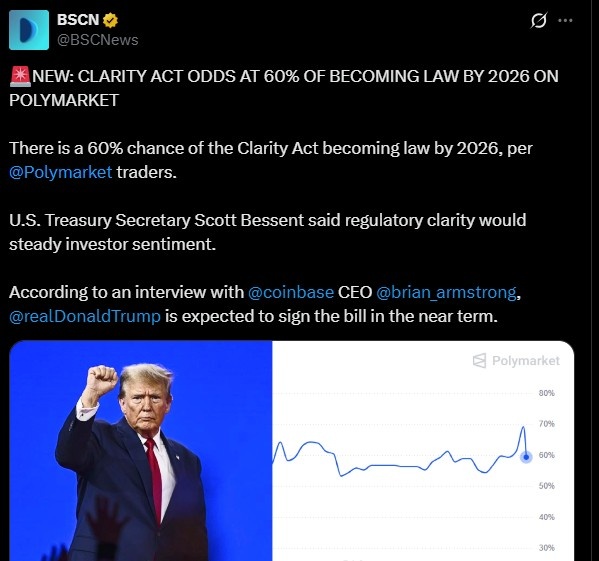
Polymarket Data Signals Rising Confidence
Polymarket provides real-time probability tracking for major political and policy events. One specific market asks: Clarity Act signed into law in 2026? The outcome resolves Yes if Congress passes the proposal and the President signs it before December 31, 2026.
Odds have shifted over time, moving from roughly 53% to 59% and recently hovering NEAR 61–62%, which media coverage summarizes as about a 60% chance.
Why media references Polymarket:
Reflects investor sentiment and insider expectations
Shows policy momentum with real-time updates
Prediction markets matter because they translate collective belief into measurable probability. Rising percentages suggest improving confidence, while sudden drops indicate uncertainty. For Bill Update Approval, the steady upward movement signals a stronger belief that lawmakers may reach an agreement.
Armstrong Interview Highlights Progress
Coinbase CEO Brian Armstrong discussed negotiations during a CNBC interview, stating that talks are making “great progress” and that a clear path forward now exists. His comments boosted optimism across the digital asset sector and supported the narrative that Clarity Act Approval could happen sooner than previously expected.
Armstrong explained that TRUMP may sign the proposal soon for several reasons:
The President is responsible for final approval
The administration has shown support for crypto regulation
The framework aligns with broader policy priorities
Lawmakers want progress before political conditions change
He also noted that a successful outcome could deliver multiple benefits:
A win for crypto industry growth
A win for banking integration
A win for consumer protection
Previous Disagreements and New Momentum
Earlier discussions around the legislation stalled because banks and blockchain companies struggled to reach consensus on rules, especially regarding oversight, stablecoin treatment, and compliance standards. These differences slowed progress and prevented a final decision.
Recent developments suggest that negotiations are improving. Financial institutions and digital asset firms are increasingly working toward common ground, focusing on frameworks that balance innovation with risk management. Reports indicate ongoing discussions are producing compromise models that align interests across both sectors.
This shift is important because regulatory bill often unlocks institutional participation, reduces uncertainty, and supports long-term ecosystem expansion. As dialogue becomes more constructive, expectations surrounding Clarity Act Approval continue to strengthen.
