Russia’s Crypto Exchange Crackdown Ignites Global Market Jitters - What’s Next for Digital Assets?

Regulatory shockwaves from Moscow ripple through crypto markets worldwide.
Russia's sudden move against cryptocurrency exchange platforms has traders scrambling and analysts recalibrating risk models. The crackdown—targeting both domestic and internationally accessible platforms—signals a hardening stance from one of crypto's most significant mining and trading hubs.
Fear Spreads Faster Than Code
Market sentiment nosedived within hours of the announcement. The usual volatility metrics spiked as automated trading systems reacted to the news flow. It's a stark reminder that geopolitics can trigger sell-offs faster than any technical glitch.
The Compliance Domino Effect
Global exchanges with Russian user bases now face impossible choices: comply with expansive new restrictions or lose access entirely. This creates compliance headaches that make KYC paperwork look like child's play—and potentially sets a precedent other nations might follow.
Decentralization's Stress Test
True believers point to decentralized exchanges as the obvious workaround. But liquidity fragmentation remains a real concern when major fiat on-ramps get blocked. The 'uncensorable money' narrative faces its latest practical exam.
Miners Caught in the Crossfire
Russia's massive mining operations—fueled by cheap energy—now operate under increased scrutiny. Any disruption to hash rate distribution could temporarily impact network security, though the blockchain's distributed nature should absorb the shock.
The Silver Lining Playbook
History suggests crypto markets overcorrect on regulatory news. Savvy accumulators see these moments as buying opportunities, betting that innovation outpaces legislation every time. After all, nothing boosts crypto adoption like government attempts to control it.
Meanwhile, traditional finance bros are placing bets on how long until the next 'this time it's different' crash—their favorite sport besides golf and insider trading.
The crackdown exposes crypto's enduring paradox: it thrives on both institutional acceptance and rebellion against those very institutions. Moscow just reminded everyone which side of that equation still calls the shots when push comes to shove.
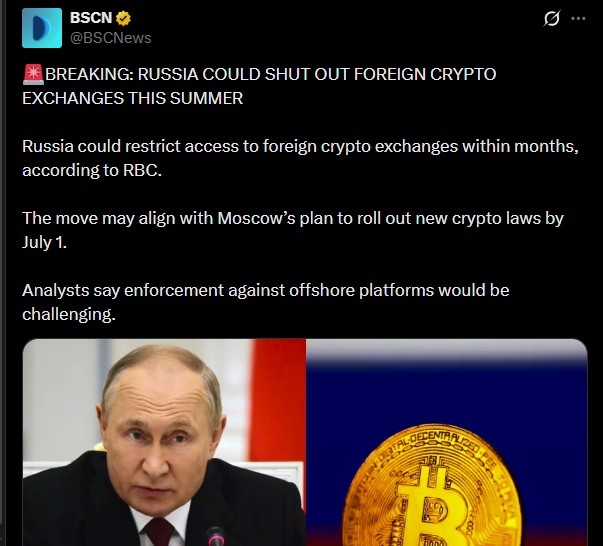
Source: X official
The proposal signals a turning point in Russia’s approach to blockchain finance. While not a ban on digital assets themselves, the measure WOULD target overseas platforms serving local traders.
Why Is Russia Taking This Step?
Officials argue the MOVE aims to retain capital and improve financial oversight. Currently, Russian users are estimated to send roughly $15 billion in annual trading fees to offshore platforms. Authorities want to redirect that volume into domestic, licensed systems instead of allowing foreign operators to capture revenue.
Regulators believe limiting activity to approved platforms will:
Strengthen monitoring of digital transactions
Improve tax collection and regulatory supervision
By consolidating activity within national frameworks, policymakers say they can better manage risk exposure and compliance standards.
Experts suggest authorities may rely on DNS blocking, which prevents internet connections to specific domains, alongside enhanced network monitoring tools. If restrictions are implemented, traders might turn to VPN services or peer-to-peer systems to bypass controls. However, such methods could introduce legal uncertainty and add security risk.
Industry observers indicate enforcement could begin this summer, coinciding with the July 1 legislative timeline.
Impact on Global Exchanges
If Russia moves forward with blocking international trading sites such as Binance, Bybit, OKX, and others, consequences could Ripple across the sector.
Loss of User Base: Many large platforms currently serve millions of traders in Russia through global portals. Restricting access could cut off substantial participation and reduce market depth originating from that region.
Revenue Pressure: Trading volume from Russian customers contributes significantly to fee income and liquidity. A shutdown of website access could dent earnings for some companies.
Shift to Alternative Channels: Users may pivot toward decentralized exchanges, P2P markets, or indirect access routes. Such transitions could dilute centralized oversight and complicate compliance efforts for both regulators and service providers.
Although analysts describe enforcement as technically challenging, even partial restriction may reshape regional activity patterns.
Will Exchanges Change Their Strategy?
At present, no major platform has publicly confirmed structural adjustments in response to the proposed Russia Crypto Exchange restriction. Companies often avoid formal comment until regulations are finalized.
However, several possible responses are emerging:
Legal Registration: Firms seeking a continued presence might apply for licensing under Russia’s upcoming framework. Operating as a regulated domestic entity would allow lawful service provision once policies are enacted.
Local Partnerships: Global platforms could collaborate with Russian brokers or financial institutions, acting as liquidity or technology providers rather than direct operators.
Decentralized Expansion: Some companies may emphasize DeFi infrastructure, which relies less on centralized web portals and may prove harder to restrict through DNS measures. Still, oversight of decentralized tools remains uncertain within Russian jurisdiction.
Until the legal framework is fully defined, most operators appear to be monitoring developments rather than committing to specific actions.
Conclusion:
The proposed Russia’s Crypto Exchange restriction reflects a broader effort to localize digital asset oversight and retain billions in trading revenue. While enforcement may face hurdles, the shift could significantly alter regional access, reshape exchange strategies, and influence global cryptocurrency market dynamics.
