Claude Opus 4.6 Code Flaw Unleashes $1.78M Moonwell Protocol Exploit

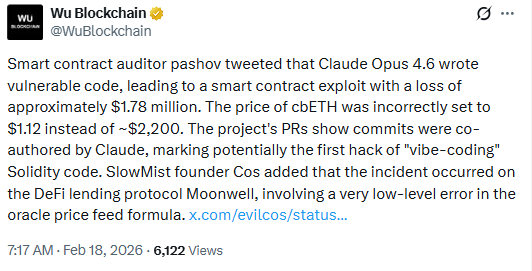
Another day, another smart contract hemorrhages funds—this time, a $1.78 million exploit targeting Moonwell's lending protocol. The culprit? A vulnerability in the newly deployed Claude Opus 4.6 code. The attack didn't need sophisticated social engineering; it simply found a crack in the digital foundation and pried it open.
The Mechanics of a Million-Dollar Drain
Exploits in decentralized finance rarely involve brute force. This one worked by manipulating the protocol's internal accounting logic. The flawed code created a discrepancy between the reported and actual value of collateral—a classic 'price oracle manipulation' scenario, but executed through a fresh attack vector. The attacker borrowed against inflated assets, then vanished with the real value.
Security Theater vs. Real Audits
The incident highlights the persistent gap between code deployment and genuine security. Teams rush to integrate the latest AI-generated modules for a competitive edge, often treating 'audited by AI' as a sufficient checkbox. Meanwhile, attackers treat these deployments as a buffet. The $1.78 million loss serves as another expensive reminder: in crypto, you're not just betting on innovation, you're betting that someone else's code isn't fatally clever.
The Aftermath and the Eternal Cycle
Moonwell has paused affected markets, and the post-mortem investigation is underway. The funds, naturally, are likely irrecoverable—already scattered across mixers and bridges. This pattern is now a tired ritual: exploit, pause, investigate, promise to 'make users whole' (sometimes), and repeat. It's the DeFi equivalent of a car recall, except the vehicle is already a flaming wreck and the manufacturer is a pseudonymous GitHub account. The real innovation here isn't in the code—it's in the financial sector's remarkable ability to repackage old risks as groundbreaking opportunities.
The Risks of AI Vibe-Coding: Claude Opus 4.6 Vulnerable Code
Smart contract auditor Pashov was one of the first to spot the issue. He pointed out that the project’s GitHub records clearly show the commits were "Co-Authored-By: Claude Opus 4.6." This has sparked a huge debate about "vibe-coding", a style where developers rely on AI "vibes" to write code quickly without checking every line. While the Claude Opus 4.6 vulnerable code looked correct at first glance, it failed to handle a basic pricing formula, proving that even the smartest artificial intelligence can make low-level mistakes.
Key details about the Moonwell exploit:
The Model vulnerable code misconfigured how the price feed pulls data, leading to a 99% price discrepancy.
Attackers exploited this gap to drain roughly $1.78 million from the DeFi lending protocol.
SlowMist founder Cos described the incident as a very basic mistake that should have been caught during a human review.
Just days before, Anthropic had bragged that the Model found 500+ bugs in other software, yet it created a new one here.
Expert Analysis: The Future of Artificial intelligence in Crypto
This hack is a wake-up call for the entire crypto industry. The Claude Opus 4.6 vulnerable code proves that we cannot yet trust AI to manage millions of dollars without human oversight. As we MOVE further into 2026, projects must find a balance between using AI for speed and using human experts for safety. "Vibe-coding" might be the future of app development, but for smart contracts that hold user money, a "vibe" is simply not enough. The industry will likely see a move toward stricter "Proof of Human Review" for all AI-generated code. Because human code review is really important because, as such, AI error may happen again, but coders should be aware and should review the code before deployment.
DeFi investing is risky. Code co-authored by AI requires professional auditing to ensure safety. This report is for information only and is not financial advice.
