Sky Protocol’s $100M Buyback Bombshell: Is This the SKY Tokenomics Game-Changer?

Sky Protocol just dropped a nine-figure bomb on the market—announcing a $100 million token buyback program. That's not a typo. It's a direct assault on circulating supply, a move that could rewrite the entire supply-demand equation for SKY overnight.
The Mechanics Behind the Move
Forget vague promises. This is capital allocation with a capital C. The protocol is deploying treasury funds to systematically remove tokens from the open market. It's a classic deflationary play, but at a scale that makes most DeFi projects look like they're playing with pocket change. The goal? To create artificial scarcity and, theoretically, upward price pressure. It's corporate finance 101, repackaged for the blockchain—though whether it's genius or just financial engineering depends on who you ask.
A Turning Point or a Temporary Fix?
Buybacks can signal immense confidence—or desperation. Is Sky Protocol's management so bullish on future cash flows they're betting the treasury on their own token? Or is this a strategic maneuver to shore up confidence after a rough patch? The market's initial reaction will be telling, but the real test is long-term sustainability. A one-off buyback is a sugar rush; integrated, sustainable tokenomics are the steady diet. This move forces the question: what's the long-term plan after the $100 million is spent?
The Cynic's Corner: A Jab at Finance-as-Usual
Let's be real—in TradFi, a buyback announcement often sends stock prices soaring while executives quietly cash out their options. It's a well-rehearsed dance. In crypto, the transparency of the blockchain ledger means everyone can watch the wallets. The real magic trick will be seeing if this capital deployment actually builds lasting value for holders, or just provides a convenient exit liquidity event for the usual suspects. The proof, as always, is in the on-chain pudding.
Sky Protocol isn't just tweaking its economics; it's attempting a controlled burn of its own supply. If successful, it could set a new precedent for treasury management in decentralized finance. If it fails? Well, that's a very expensive lesson in market dynamics. The countdown to the first buyback transaction has begun.
What's behind Sky Protocol Massive Buyback in 2025?
One of the most successful token-economic projects in the field of decentralized finance (DeFi) this year is the Sky Protocol Token buyback program. According to the latest disclosure of the ecosystem, significantly expanded its buyback program during the year 2025, with the total amount of the repurchase growing to an estimated amount of almost 100 million, nearly twenty-six times higher than the previous year.
Such an aggressive capital allocation policy indicates the increasing revenue power of the protocol and its further transition to sustainable tokenomics in the DeFi ecosystem.
The repurchase scheme, which is paid out of protocol-generated fees, is an indication of a shift to value-accrual schemes akin to traditional equity buybacks, on blockchain-based governance tokens.
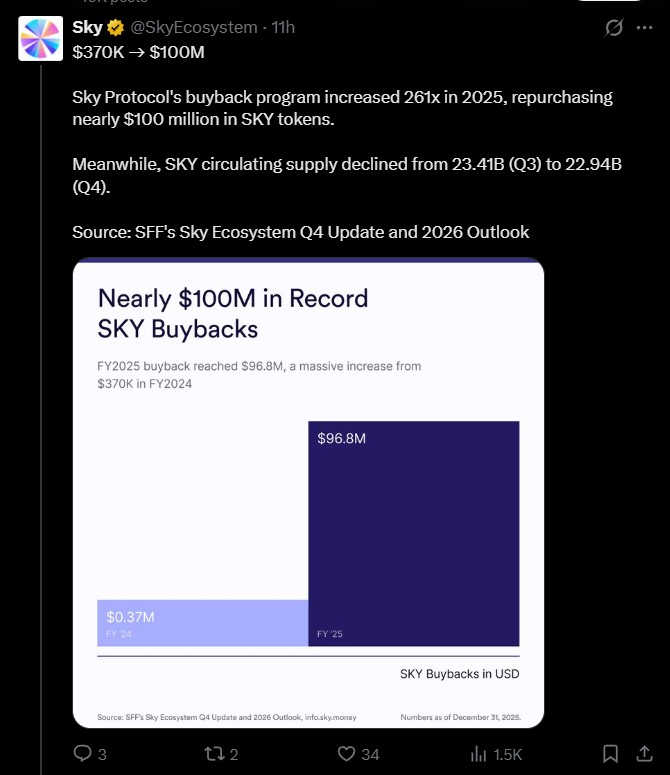
Source: Official X
How Much SKY Supply Actually Been Reduced?
The effect on the supply of tokens is one of the most valuable consequences of the extended buyback program. According to the quarterly update of data released by the ecosystem, the circulating supply dropped to around:
23.41 billion tokens in Q3 2025
22.94 billion tokens in Q4 2025
This is equal to about a 2% decrease in circulating supply, which was brought about by repurchases of approximately $96.8 million of SKY tokens, including about 1.55 billion tokens bought and taken out of circulation.
The deflationary effect was also partially due to quarterly burns of non-upgraded MKR tokens, which tied the new SKY tokenomics to the old MakerDAO system of governance.
As a measure to create scarcity, Protocol is strengthening supply by lowering it and demand by incentivizing staking, which is commonly linked to token price floors in economies over the long term.
Is Protocol Revenue Sustainable to the Buyback Strategy?
The protocol's financial performance was high and thus enabled the buyback expansion. It is estimated to have earned nearly $338 million in annual revenue in 2025, which gives it enough liquidity to engage in massive token buys.
In the future, it is estimated that the growth will keep increasing:
2026 revenue projection: $611.5 million (81% annual growth)
Earnings forecast: $157.8 million (198% annual growth)
When achieved, such numbers may enable the protocol to sustain or speed up buybacks on top of the existing cumulative total of $106 million already completed, reinforcing the deflationary model.
What is the benefit of the Buyback Program to SKY Stakers?
In addition to the reduction of supply, the strategy is closely associated with staking rewards and ecosystem incentives. During Q4 2025 alone:
Stakers were given 324 million tokens.
The staking returns were about 16.14% APY.
This incentive scheme makes the ecosystem one of the biggest yield-generating stablecoin-based DeFi platforms, backed by:
USDS supply: $9.2 billion
Total value locked (TVL): $11.9 billion.
The growth plan of the protocol is more and more based on the extension of the use of the USDS stablecoin, non-custodial savings products, and the development of new credit infrastructure.
What is “SKY Token-Buyback Pioneer?"
The buyback disclosure indicates that the token is shifting towards a shareholder-value-style framework of holders - a framework that may affect other DeFi protocols.
In comparison with the emission models of the past DeFi cycles that are heavy on inflation, aims to:
Revenue-funded buybacks
Token supply contraction
Green rewards on staking.
The growth of stablecoin ecosystems.
Assuming that the adoption of USDS and credit products is increasing, the buyback mechanism may be an example of the sustainability of tokenomics in DeFi.
Conclusion: Can SKY Buybacks Continue Into 2026?
The project already surpasses $106 million, and the revenue is expected to increase substantially. The program seems to continue being one of the most prominent elements of the strategy of the ecosystem in 2026.
Using deflationary token dynamics, high revenue generation, and growth of stablecoins, it is trying to build a more robust DeFi economic design - one that balances user, staker, and long-term token holder incentives.
The success of this strategy in the long-term positioning will be determined by the further use of USDS, the expansion of the DeFi market environment, and the possibility of maintaining revenue-based buybacks.
Disclaimer: This is not financial advice. Please DYOR before investing. CoinGabbar is not responsible for any financial losses. Crypto assets are highly volatile, and you can lose your entire investment.
