XRP Price Update: Standard Chartered Slashes 2026 Target by 65% - What’s Next for the Digital Asset?

Standard Chartered just took a chainsaw to its XRP forecast. The banking giant's revised 2026 price target now sits a staggering 65% lower than its previous projection—a move that's sent ripples through crypto trading desks.
The Big Cut
Forget gentle revisions. This is a full-scale strategic retreat. The bank's analysts didn't just trim expectations; they lopped off nearly two-thirds of their former bullish outlook. That kind of downward revision isn't a tweak—it's a statement.
Reading the Tea Leaves
What prompted such a dramatic reassessment? While the official report cites "evolving regulatory headwinds" and "shifting adoption timelines," the subtext is clearer: the path to institutional crypto integration is proving rockier than many predicted. It's the classic finance dance—overly optimistic modeling meets harsh reality, followed by a hasty spreadsheet correction.
Market Mechanics in Play
Price targets aren't pulled from thin air. They're built on models factoring in transaction volume, network utility, competitive positioning, and yes, good old-fashioned speculation. A 65% cut suggests fundamental cracks in at least one of those pillars. It forces a brutal question: was the initial target always built on sand?
The Ripple Effect
This isn't just about one bank's opinion. When a major financial institution with Standard Chartered's clout makes such a pronounced move, it influences fund allocations, shapes derivative markets, and alters the narrative for retail holders. Confidence, as they say, is a currency too.
Looking Beyond the Headline
Yet, in the volatile world of crypto, today's dire prediction can be tomorrow's forgotten footnote. Market sentiment shifts faster than a trader can hit 'sell.' While the bank's new target paints a cautious picture, it also resets the bar—potentially setting the stage for a narrative of 'underpromise and overdeliver' should the tide turn.
The final take? One bank's spreadsheet says 'caution.' The market, forever the rebellious teenager, will decide whether to listen. After all, in crypto, the only constant is the crowd's uncanny ability to prove both bulls and banks wrong—usually at the most expensive moment.
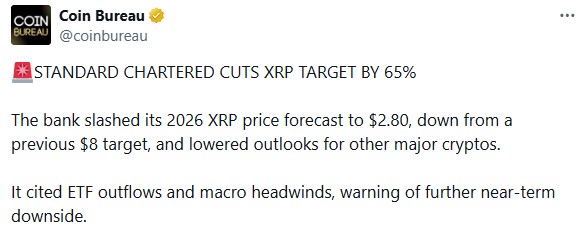
Importantly, the cut was not limited to XRPs. In early-Feb, Standard Chartered reduced targets for many major coins. Bitcoin’s 2026 target was trimmed to $100,000, Ethereum’s to $4,000, and Solana’s to $135.
The MOVE underscores growing caution among institutions as the broader crypto markets struggle through a difficult start to 2026, which dipped around 15% since the year started.
Market Effect On XRP Price Journey: Support StandChart’s Reserved View
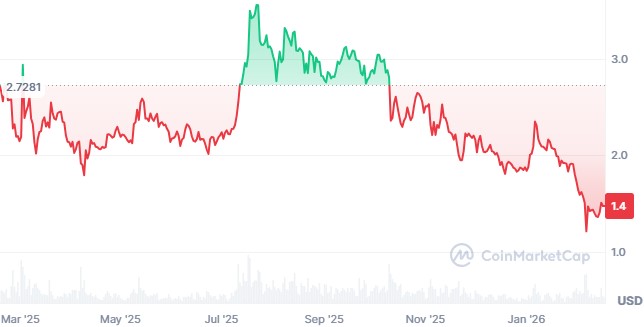
The coin carried strong momentum into 2025 after hitting a $3.65 peak in July amid regulatory clarity and growing ETF optimism. Into early 2026, the token traded NEAR $1.80-$2.00, briefly spiking toward $2.40 before broader market weakness set in.
Since then the token continuously struggles to reach the $2 mark, and at the time of writing, it trades near $1.48, up 1.17% in 24 hours, even as it remains down nearly 28% monthly and over 45% year-on-year.
Despite this, the XRP ETF has shown strong resilience even after noting around $500 in outflows since January. The ETFs currently manage over $1.14 billion in total AUM, with seven active funds and a positive weekly net Flow of +3.5 million coins.
Major Reason Behind XRP Price Move
Standard Chartered cited multiple reasons behind the downgrade, which also included the $500 million outflow of the ETFs along with:
Broad crypto selloff in early 2026 amid inflation worries and tighter liquidity. Because of that risk assets, including XRPs, experienced heavier outflows.
One of the major reasons behind the large liquidation of the markets is the rising war situations and sanctions among major economies, mainly including the United States under President Trump’s intense policies.
The much awaited–CLARITY Act, expected to bring clarity in crypto management, continuously facing delays as major banks and crypto platforms remain divided over its stablecoin yield provisions.
Perpetual futures traders dominate near-term price action. Data shows $13.5M in long liquidations, a $245.7M drop in open interest, and negative funding rates, all bearish near term.
Macroeconomic pressure also played a major role. Ongoing inflation concerns, tighter financial conditions, and global deleveraging have dampened risk appetite. As a result, optimistic crypto forecasts made during late 2025, when regulatory sentiment was improving, are now being reassessed.
What Comes Next For XRP Price Target
Despite near-term pressure, not all signals are bearish. Long-term utility remains a key theme. Japan continues to integrate XRPL into its regulated fintech ecosystem, backed by SBI Holdings, which owns over 9% of Ripple Labs.
At the same time, quiet accumulation has been reported in South Korea, where large players have added hundreds of millions of XRPs during periods of fear, often a sign of strategic positioning.
In simple terms, XRP’s next move depends on balance. If derivatives pressure fades and ETF flows stabilize, the foundation for a stronger recovery could form. If macro stress deepens, however, volatility may persist.
This content is for informational purposes only and does not constitute financial advice.
