Trump Impeachment Debate Intensifies in 2026 US Midterm Election

Political volatility hits fever pitch as impeachment talk dominates the 2026 midterm landscape—and Wall Street barely flinches.
The Echo Chamber Roars
Debate over a potential Trump impeachment has become the central fault line of the 2026 election cycle. Campaign trails are littered with soundbites, attack ads, and constitutional arguments, creating a political spectacle that consumes traditional media. Meanwhile, capital keeps flowing to sectors that operate outside the daily drama.
Digital Assets: The Parallel Economy
While cable news panels dissect every political maneuver, decentralized networks hum along. Blockchain transactions don't pause for congressional hearings. Smart contracts execute irrespective of who's testifying before a committee. This isn't just technology—it's a burgeoning financial system that exists orthogonal to political theater, attracting capital seeking stability in code rather than promises.
The Real Impeachment Question
Perhaps the more relevant inquiry isn't about impeaching a former president, but about impeaching the legacy financial system itself. Voters argue over political accountability while crypto-native users vote with their wallets, steadily delegitimizing intermediaries that have failed to innovate for decades. The real impeachment proceedings happen every time a user bridges assets without a bank.
As political operatives count votes on Capitol Hill, the market has already rendered its verdict on systems that prioritize spectacle over utility. The 2026 election might change who sits in a committee chair, but it won't stop the relentless, apolitical march of cryptographic truth—a reality that makes political scandals look like expensive, slow-moving soap operas funded by taxpayer dollars.
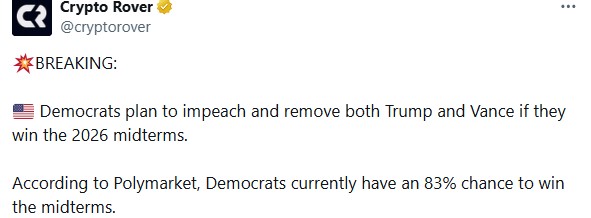
Discussions around Trump impeachment cite allegations such as abuse of power, obstruction of justice and broader concerns about democratic norms. Some House Democrats have introduced investigation resolutions, but party leaders have emphasized a cautious, step-by-step approach rather than immediate action.
While these claims are drawing attention, the reality appears more complex. The Trump impeachment is now closely tied to crypto behaviours, as the President presents a pro-crypto figure and is currently leading the country into crypto reforms.
US Midterm Election Odds Fuel Political Debate
According to Polymarket, traders currently price an 83% probability that Democrats will win the House in the 2026 midterms elections of the US. These odds are based on real-time market activity as of February 13, 2026, and reflect expectations tied to economic pressures, policy uncertainty, and voter sentiments.
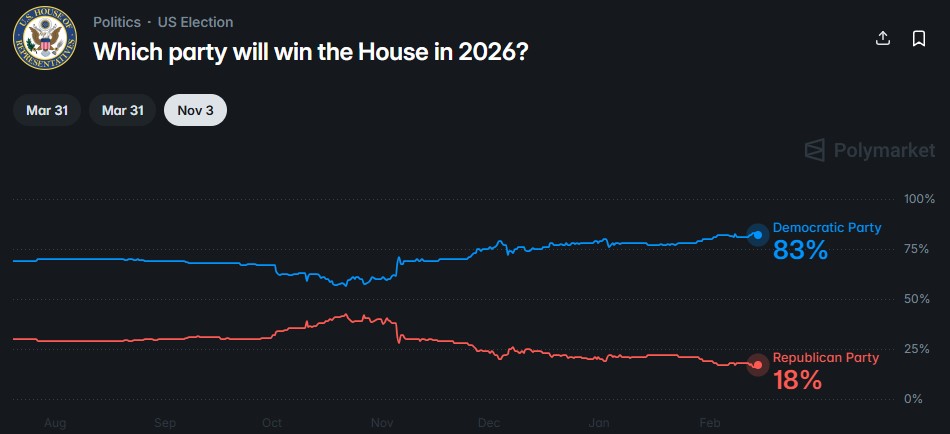
However, claims that Democrats are actively planning for Trump impeachment mostly come from Republican leaders, like Donald Trump and House Speaker Mike Jonhson, not from Democrats themselves.
This kind of warning is common election-time talk, seen in past elections also to support rallies, even when no formal removal plans existed.
So far, there have been no official statements from Democratic leaders saying they intend to impeach anyone.
If impeachment passed the House and Senate – something unlikely to happen without support from both parties, the line of succession WOULD apply. In that case, the Speaker of the House would become president.
Analysts believe Hakeem Jeffries would likely be Speaker from Democrats, a possibility that leaders like Nancy Pelosi mentioned before.
Why Does This Matter For Broader Crypto Markets?
Political instability tied to the US election 2026 could create pressure on crypto markets, not only because the country experiences a wide range of digital assets’ institutions, exchanges, and most importantly, user base.
President Trump has positioned himself as openly pro-crypto, promoting:
Friendly regulations like launch of the GENIUS Act, first stablecoin law in the nation,
Market clarity through the CLARITY Act, under procession of parliament, and
Even ideas like strategic Bitcoin reserves.
This potential stance supported strong rallies in 2025, with bitcoin reaching record highs before recent pullbacks–also linked to Trump’s tariff wars.
A sudden shift in leadership or prolonged impeachment could trigger risk-off behaviour. Historically, crypto reacted sharply to political shocks, with altcoins often selling first, followed by Bitcoin, which is already suffering from $60K low range. Analysts, by judging from recent behaviours, note that even without policy changes, uncertainty alone can drive volatility.
On the other hand, for many traders, volatility linked to the US midterms is seen not just as risk, but also as potential opportunity.
Information above is based on market-present data. The article does not constitute claims regarding any financial or legal advice.
