Indiana Bill Paves Way for Cryptocurrency Retirement Funds - A Game-Changer for Digital Asset Investors

Indiana just dropped a legislative bombshell—retirement funds can now officially hold crypto.
The Regulatory Shift
Forget waiting on federal guidance. Indiana's bill cuts through the red tape, letting retirement plans allocate directly to Bitcoin, Ethereum, and other digital assets. No more synthetic exposure through Grayscale trusts or futures contracts. This is direct ownership.
Why This Matters
It bypasses the traditional gatekeepers. Financial advisors who've dismissed crypto as 'too volatile' now face a new reality—clients can demand it in their 401(k)s. The bill treats qualified digital assets like any other investment option, provided they meet custodial and disclosure standards. Expect a flood of institutional-grade custody solutions targeting this market.
The Retirement Calculus
Younger workers—already stacking sats in private wallets—get a tax-advantaged path. Employers adding crypto options could become talent magnets. But the compliance burden isn't trivial. Plan sponsors must navigate valuation, security, and fiduciary duties. One misstep could trigger a lawsuit faster than a memecoin rug pull.
The Bigger Picture
Indiana isn't alone. Several states are drafting similar frameworks, creating a patchwork of regulations that pressures the SEC to act. This could accelerate spot Bitcoin ETF approvals for retirement accounts nationwide. Meanwhile, Wall Street firms are scrambling to retrofit their legacy systems—because nothing says innovation like adding blockchain support to COBOL-based pension software.
A cynical take? The same finance industry that called crypto a 'fraud' five years ago will now charge 2% annually to manage your Bitcoin IRA. Some things never change.
Bottom line: The retirement savings game just got a digital asset upgrade. Whether that's a smart diversification move or a regulatory headache in the making depends on your risk tolerance—and your lawyer's hourly rate.
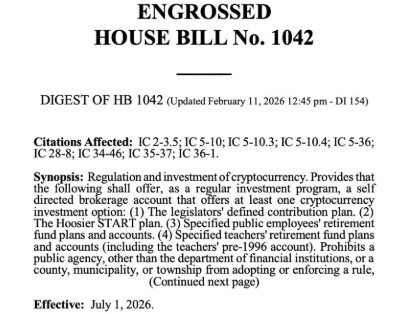
The proposal moved forward on February 11–12, 2026, after clearing the Indiana Senate Insurance and Financial Institutions Committee with a “do Pass” recommendation. The MOVE reflects a growing interest among U.S. states to cautiously test cryptocurrency exposure, while still keeping tight controls in place.
However, the risks from crypto’s volatility keep the bill under scrutiny of market analysts, even though the regulators have amended the bill to make it more secure.
What the HB1042 Legislation Defines: Amended To Secure Future Plans
Under HB1042, Indiana WOULD require self-directed brokerage accounts to be offered within certain state retirement and saving programs. These include:
the Hoosier START 529 education plan,
legislation’s defined contribution plans, and
specific public employee and teacher retirement accounts.
Importantly, the bill limits cryptocurrency retirement funds exposure to crypto ETFs only, explicitly excluding payment stablecoins.
Earlier versions of the bill allowed direct ownership of cryptocurrencies, but lawmakers amended the bill to remove that provision, shifting all risk and decision-making to individual participants.
This ETF-only structure is designed to reduce volatility and custodial risks, making the approach more acceptable for conservative superannuated savers.
However, cautious Optimism still remains.
Risks Tied To Cryptocurrency Retirement Funds Initiative
Despite the safeguarding, risks remain. Digital asset markets have been highly volatile in late-2025 and continue in 2026, and ETFs tied to them, are not resilient with this. US Bitcoin spot ETF has been facing $693.18M in monthly outflow, where ethereum Spot ETFs measure $337.23M outflow as per SoSoValue Data.
Altcoins, like XRP and SOL, are comparatively performing better while recording positive inflows on a monthly basis.
Aside from this, there are also concerns around financial literacy, behavioural risks like panic selling, and broader regulatory uncertainty at the federal level, which possibly affect ETF liquidity or availability.
Why Indiana Is Taking This Step Now
Indiana’s approach appears driven by two forces: rising mainstream acceptance of crypto ETFs and pressure to modernize investment options without exposing public pensions to excessive risk.
With roughly $40 billion managed across public pensions to excessive systems, even limited participant-led exposure could eventually bring modest institutional flows into regulated crypto products.
At the same time, the ETF-only structure signals restraint. Lawmakers are not forcing crypto into retirement portfolios but allowing optional access for those who actively choose it.
