Bitcoin Braces for $50K Test as Standard Chartered Slashes Price Targets

Standard Chartered just threw cold water on the crypto rally. The banking giant cut its Bitcoin forecasts, sending a shiver through the market and putting the critical $50,000 support level squarely in the crosshairs.
The Analyst Axe Falls
Forget the moon-shot predictions—the mood just turned cautious. The revised targets signal a stark reassessment of near-term momentum, forcing traders to confront a more sobering reality. It's a classic Wall Street move: talk up the asset on the way up, then pull the rug when things get interesting.
$50,000: The Line in the Sand
All eyes are now on that key psychological number. A sustained break below it could trigger a wave of automated selling and shake out weaker hands. This isn't just a number on a screen; it's the battleground where bullish conviction meets bearish pressure head-on.
Volatility is the Only Guarantee
Welcome to crypto, where the only constant is change. One day you're eyeing new all-time highs, the next you're defending major support. This pullback, driven by traditional finance's fickle sentiment, serves as a potent reminder: in this market, fundamentals often play second fiddle to fear and greed. Maybe the suits in London know something—or maybe they're just proving that old banks and new money will always have a tense relationship.
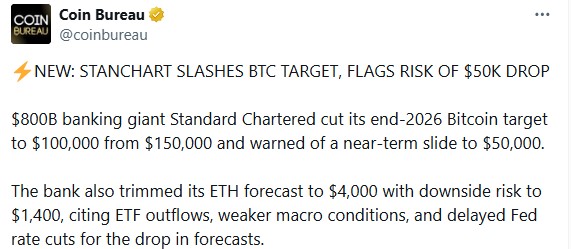
Among them, Standard Chartered remains the most recent and attention gatherer. The $800 billion banking giant cut its end-2026 Bitcoin price target to $100,000, down from $150,000. The bank also warned that continued pressure could drag prices toward $50,000 in the short-term.
Along with that, ethereum price target was also trimmed, with the new end-2026 level set at $4,000 and downside risk toward $1,400 if tension continue.
This is the bank's second downgrade in just three months, after once projecting much higher levels, highlighting how quickly the outlook has changed.
Reasons Behind Cut: Why Standard Chartered Lowered its Bitcoin Price Forecast
Standard Chartered pointed to a mix of market and macro factors behind its decision.
The biggest drag has been persistent outflows from spot Bitcoin ETFs, with more than $8 billion leaving since November. These ETFs were expected to act as a steady demand engine, but recent redemptions have instead added supply pressure.
At the same time, geopolitical conditions have turned less friendly, mainly due to President Trump’s intense acquiring or policies structure. Delayed rate cuts by the Federal Reserve have further tightened financial conditions, weighing on risk assets like crypto.
And the overall uncertainty in BTC’s recent performance, which highlights how frequent the values react even on macro-conditions.
Bitcoin Price Performance So Far: Driving the Narrative
Recent price action itself has become a key influencing factor.
The coin peaked NEAR $126,000 in October 2025, driven by ETF inflows, election-era optimism, and strong risk-on sentiment. That rally has since unwound sharply.
By early Feb, 2026, the digital asset fell to the $60,000 range, making a roughly 52% decline from the peak. Aside from this ATH mark, in a general calculation of year-to-date, the coin has dropped 31.5%, where it was trading around $96,600 in Feb 2025.
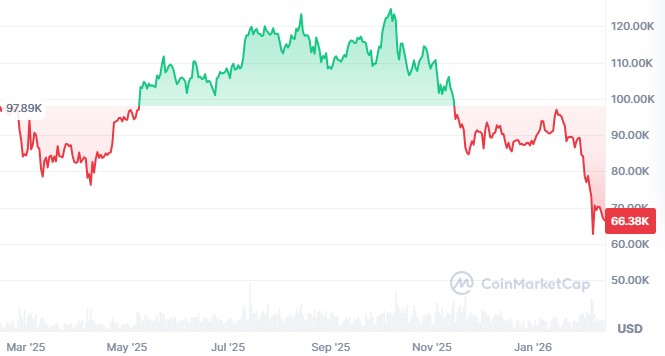
As of now, BTC is trading around $66,000, showing a modest rebound in weekly data which is up by 1.35%, with a 0.8% decline in market cap.
Even with this, investors’ confidence builds in its historical data. Post-halving cycles often see 50–80% corrections after major highs, placing the current drawdown well with past norms.
Trust In Asset: Long-Term Outlook Remains Intact
Despite near-term caution, Standard Chartered kept its long-range outlook unchanged. The bank still projects a BTC price of $500,000 by 2030, arguing that institutional adoption, limited supply, and maturing market infrastructure remain powerful tailwinds.
On-chain data also shows large holders accumulating during the dip, while retail sentiment stays fearful, a pattern that has often preceded recoveries in past cycles.
Note: The article above is for informational purposes only and does not constitute financial advice.
