Pi Network Mainnet Upgrade Deadline Feb 15: What About Node Rewards?

The clock is ticking. Pi Network's Mainnet upgrade deadline hits February 15, leaving node operators in a familiar crypto limbo: promises versus payouts.
Reward Reckoning
Node operators—the backbone of any decentralized network—are staring down the barrel of a hard deadline. The protocol's upgrade mandates a full transition, but the burning question remains: what happens to the incentives that keep these machines humming? The silence on concrete reward structures is louder than a mining rig at full tilt.
Speculation vs. Substance
Community forums are alight with theories, ranging from adjusted token emission schedules to new staking mechanics. Yet, without official figures, it's all digital fortune-telling. The core tension? Balancing network security with sustainable economics—a puzzle that's bankrupted more than one ambitious chain. It's the classic crypto dance: technical brilliance tripping over financial foresight.
Countdown Consequences
Post-deadline, nodes running outdated software become dead weight. The network cuts them off. This forces a binary choice: upgrade or become irrelevant. For operators, it's a capital allocation problem wrapped in a tech upgrade. Will the revised rewards justify the hardware costs and energy bills? Or is this just another round of 'have faith in the whitepaper'? Remember, in decentralized finance, the only guarantee is volatility.
The upgrade promises a more robust network. The reward mechanism needs to be equally resilient—otherwise, Pi risks having a cutting-edge blockchain maintained by ghost nodes. After all, what's a decentralized future without someone actually being incentivized to show up? Just ask the bankers—they've built entire careers on that model.
Pi Network Mainnet Update
The constant upgrades are in line with a gradual protocol improvement strategy that will fortify the blockchain infrastructure before the much-anticipated Open Networks era.
Pi Mainnet is currently under an Enclosed Network firewall that restricts external connections. During Open Network, the firewall will be lifted, and the community should be more involved in the running of the nodes. The consequences of not upgrading by the 15th of February may include:
Disconnection of a temporary or permanent node.
Dropped connection to the blockchain.
Disqualified to receive benefits of network participation in the future.
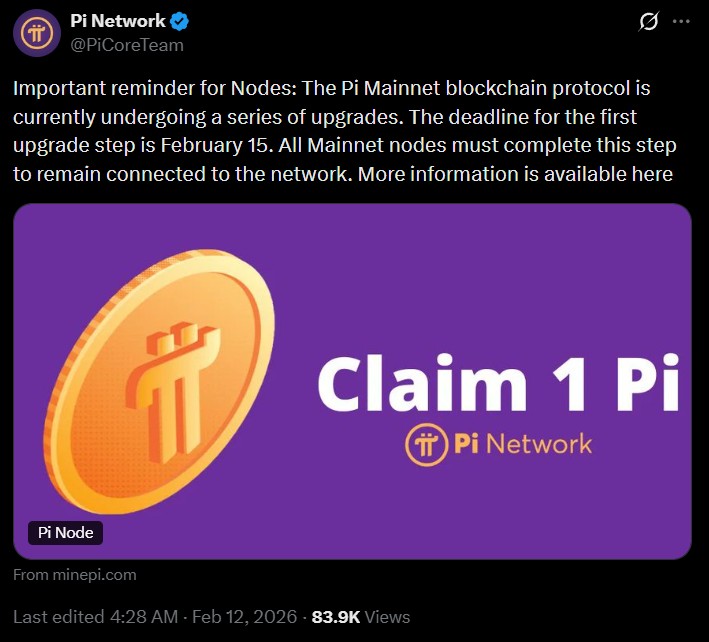
Source: Official X
What's Changing in the Pi Mainnet Upgrade?
Mainnet upgrades Starting with the compulsory v19.6 update, the Core Team is deploying upgrades in stages, from version 19 to version 23. Such upgrades will ensure that the network becomes quicker, more stable, and more secure.
They enhance the communication, processing, and connectivity between the nodes. The update also enhances Pi Stellar Consensus Protocol (SCP), in which trusted nodes jointly agree on transactions rather than mining transactions using energy-consuming methods, as is the case with Bitcoin.
How Pi Nodes Work? What Makes it Different?
It is progressive in its decentralization strategy, whereby blockchain involvement is available to ordinary users. Contrary to the classic crypto networks, Pi nodes are not costly mining machines, but ordinary laptops and desktops. This does not rely on Proof-of-Work mining, which is energy-consuming.
It instead makes use of the stellar Consensus Protocol (SCP). Nodes create trusted groups known as quorum slices and only authenticate the transactions that are accepted by such groups. User Security Circles form a global trust graph, which assists in keeping the network safe and also allows it to expand interactively.
Pi Node Participation: 3 Levels Explained
Desktop interface of Pi Coin App.
Enables checking of balance, access to chat, and viewing of media.
No blockchain authentication.
Checks the validity of blockchain.
Submits transactions.
Technical packages have to be installed.
Should be chosen and KYC authenticated.
Backbone of the blockchain.
Agrees to an agreement and drafts transactions.
Should be 24/7 and have a constant internet connection.
Selected by Core Team.
Needs powerful equipment and KYC verification.
Selection Criteria For Nodes and SuperNodes
Selection of Nodes and SuperNodes is based on several technical and community-focused criteria. Applicants must maintain 24/7 uptime, have a stable and fast internet connection, and initially be able to open router ports. Adequate processor power and memory are also required.
Beyond hardware, strong security circles, prior contributions to the community, and a high node reliability and trust score are important factors. Completing KYC is mandatory, and selected applicants are notified directly through the node interface.
Testnet Roadmap: The Foundation of Mainnet Stability.
The development of Pi Mainnet is based on the organized Testnet experiment.
Selection Stage: Checking hardware reliability and connection level.
Revision Stage: Stress testing and refinement of consensus algorithms in a scenario. Simulated quorum experiments and testing of scalability.
Live Testnet: Actual processing of transactions with real security circle information.
Before complete decentralization, the centralized testing LAYER employed in the Testnet will be eliminated.
Will there be Rewards to Node Operators?
None of the Testnet nodes are mined.
Incentive mechanism under consideration.
Core Team is gathering information to develop an equitable reward system.
There is still a division of community feeling. Most expect payouts of KYC rewards in March 2026, and some are worried about the lack of incentives.
Security and Open Source Transparency.
The blockchain part will be open-sourced with Github repository under preparation. Contributions by the community will be encouraged and mass installations are likely to result in Microsoft Defender SmartScreen warnings first. The Latest Pi Node Software Version of 0.5.4, supporting Windows, Mac, and Linux.
Community Sentiment: Hopefulness and Disillusionment.
Although the upgrade is a positive indication of the MOVE to Open Mainnet, the community is divided:
An optimistic view of the development of decentralization.
Expectation of KYC reward distribution.
Discontent with delayed node rewards.
Continuous verification bottlenecks.
This is indicative of the greater conflict between the explosive user base and technical maturity.
Concluding Remarks: One Step Closer to Open Mainnet.
The Pi Network Update is one of the most important milestones in the history of the blockchain. The push towards scalability and security is reflected in the compulsory node upgrades, enhanced SCP implementation, and organized decentralization initiatives.
To the operators of nodes, it is not optional but necessary to upgrade to a point before February 15, 2026. These technical improvements may either cause the ecosystem to smoothly shift to full decentralization or continue to delay the process as it approaches Open Networks.
Disclosure: This is not financial advice. Do Your Own Research before investing. CoinGabbar has no liability for any financial losses. Cryptocurrencies are extremely risky, and one can lose all their money.
