Danske Bank Lifts Crypto Ban, Unleashes Bitcoin and Ethereum Access Across Denmark

Denmark's banking giant just ripped up its crypto rulebook.
The Policy Pivot
Danske Bank is flipping the switch. After years of blocking customer access to digital assets, the institution is now opening direct trading for Bitcoin and Ethereum. It's a stark reversal—one that signals a major shift in how traditional finance views the crypto frontier.
Why the Sudden Change?
Regulatory clarity from Denmark's Financial Supervisory Authority (FSA) provided the green light. The bank cites "evolving market demand" and "mature custody solutions" as key drivers. They're not dipping a toe; they're building the on-ramp.
The New Gateway
The move creates a direct pipeline for Danish investors. No more workarounds through obscure exchanges or offshore accounts. Clients can now buy, sell, and hold the two crypto heavyweights alongside their traditional stocks and bonds—all from a single, familiar interface. It's mainstream adoption, served on a silver platter.
The Bigger Picture
This isn't just a product launch. It's a legitimacy stamp from one of Scandinavia's most conservative financial pillars. When a bank that once treated crypto like contraband starts offering it, the narrative shifts from speculation to allocation.
Sure, the cynics will say they're just chasing fees from a client base that was going to buy it anyway—because what's a bank without its vig? But the real story is simpler: the walls are coming down. Resistance is proving more costly than evolution. The future of finance isn't knocking anymore; it just walked in the front door.

Source: Press Release
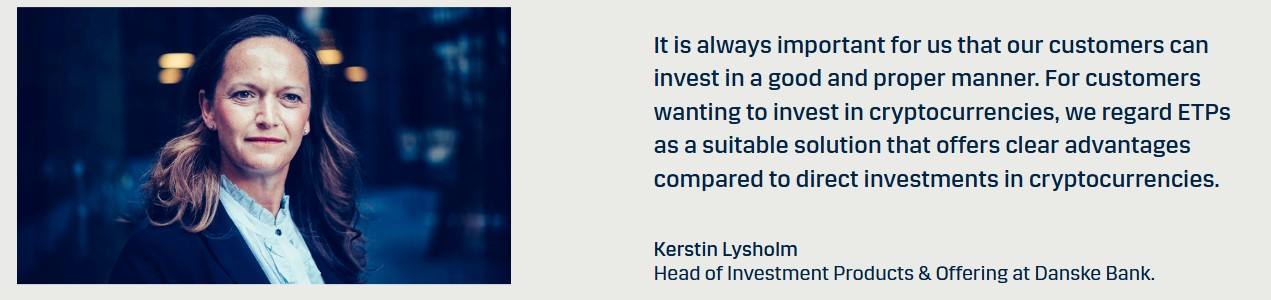
Danske Bank, which serves more than 5 million customers across Northern Europe, confirmed that users can now access selected crypto-linked products directly through its eBanking and Banking apps. The MOVE marks a major shift for a bank that blocked crypto-related services in 2018 due to regulatory and transparency concerns.
What Will the Bank Offer Now: What the Crypto Ban Lift Off Brings
Instead of direct digital asset trading or self-custody wallets, Danske Bank is offering access through Exchange-Traded Products (ETPs), a product that lets investors gain exposure to assets without owning them directly.
At launch, three ETPs are available:
Two tracking Bitcoin (BTC)
One tracking Ethereum (ETH)
These products are issued by well-known providers such as BlackRock, WisdomTree, and 21Shares, and operate under strict EU frameworks like MiFID II (Markets in Financial Instruments Directive II), offering higher transparency and investor protection. Customers can invest using familiar banking tools, without relying on external or offshore digital asset exchanges.
However, the banking organisation has been clear on cryptocurrency’s volatile nature, stating that it remains a high-risk and speculative asset class. The products are available only to self-directed investors, and Danske will not provide investment advice or recommendations related to cryptocurrencies.
Why Did Danske Change Its Stance?
The decision comes down to two main factors:
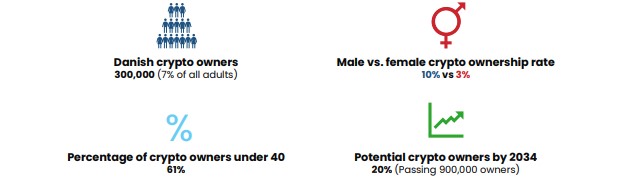
The banking institute reported a steady rise in client requests for cryptocurrency exposure. This aligns with the country’s growing digital asset user-base. According to the Danish Crypto Adoption Survey 2024 by K33 Research and EY, around 300,000 Danes, ~5% of total population, own cryptocurrency. This number is expected to rise up to 900,000 by 2034, a massive 20% increment. Traditional institutions have to accept the growing demand when numbers are this strong.
Second most important player is the growth in clear trading rules. The European Union and many states are exploring ways to make digital asset trading more compliant.
The EU’s MiCA (Markets in Crypto-Assets) framework, which standardizes cryptocurrency rules across Europe and reduces uncertainty for traditional banks, emerged as a key benchmark. It covers all 27 member states with Iceland, Liechtenstein, and Norway.
This shift reflects a wider European trend. Other major banks, including ING and DZ in Germany, are also integrating regulated cryptocurrency products rather than avoiding the sector entirely.
At Last
While the market reaction for BTC and ETF prices has been muted so far,
Bitcoin: Around $67,000, facing 26.72% monthly and 29.81% yearly loss,
Ethereum: Near $1,960, lost 37% on monthly and 24.24% on yearly basis,
Analysts see this as another step toward mainstream adoption. With the Danske Bank crypto ban end, crypto became more accessible to everyday retail investors, bringing the gap between traditional finance and digital assets in Europe.
