South Korea’s Crypto Reset: How a Billion-Dollar Scare Forced Strict New Laws

Seoul slams the regulatory hammer down. After a financial tremor shook the nation's digital asset landscape, South Korea isn't just tightening the screws—it's rebuilding the entire machine.
The Wake-Up Call That Cost Billions
Forget minor market corrections. This was a systemic shockwave, a billion-dollar lesson in what happens when speculative frenzy outpaces oversight. Investors watched fortunes evaporate, exposing gaping holes in a system that was running too hot, too fast.
The New Rulebook: No More Wild West
The Financial Services Commission (FSA) isn't asking nicely anymore. New mandates demand real-name verification, strict capital reserves for exchanges, and ruthless transparency on fund flows. It's a brutal compliance sprint that's already weeding out the weak. Think of it as a corporate Darwinism—funded by taxpayer-backed bailout fears.
Innovation in a Straitjacket?
Legitimate builders welcome the clarity, but the cost is steep. The 'move fast and break things' ethos just met its match in Korean bureaucracy. Development cycles are lengthening, and the compliance overhead alone could crush smaller players. It's the classic finance sector trade-off: stability versus agility, with the government firmly choosing the former.
The Global Ripple Effect
Watch this space. As a top-tier crypto market, South Korea's regulatory pivot sets a precedent. Other nations eyeing their own digital asset frameworks are taking notes—seeing what sticks and what stifles. It's a live-fire experiment in taming decentralization.
The reset is complete. South Korea's crypto scene just graduated from its reckless adolescence into a heavily monitored adulthood. The party isn't over, but now there's a stern regulator at the door checking IDs and bank statements—a necessary buzzkill for an industry that forgot risk management isn't just for traditional finance guys in boring suits.
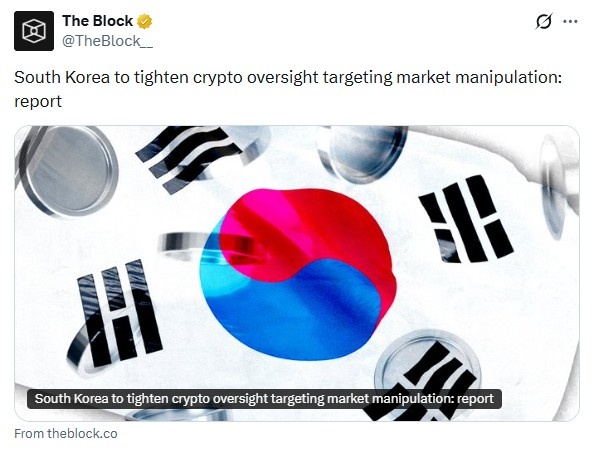
Source: X official
What’s changing: the main rule upgrades
1) Stronger investor protection rules are already in force
South Korea’s Virtual Asset User Protection Act requires exchanges to protect customer assets and targets unfair trading like manipulation using AI surveillance, while empowering regulators to supervise, inspect, and sanction.
Customer deposits and holdings must be safeguarded.
Unfair trading gets clearer definitions and enforcement tools.
2) App-store access tightened for unregistered overseas platforms
Beginning January 28, 2026, Android users in South Korea may be blocked from downloading or updating apps from unregistered overseas exchanges, tying distribution to local compliance.
Offshore apps without required registration can lose reach overnight.
This can push more trading activity onto approved domestic venues.
3) “Next law” drafting and stablecoin focus
The FSS said authorities are drafting additional legislation and are also considering rules around won-based stablecoins, aiming to pull more activity under formal guardrails.
Why it matters for the Korean economy
Tighter rules can reshape market behavior inside the country:
Trust boost: Clearer protections can improve confidence for households and institutions, reducing fear after exchange failures.
Compliance costs: Smaller platforms may struggle with surveillance, custody, and reporting requirements, potentially shrinking the number of players.
The policy message is simple: Seoul wants digital assets to behave more like regulated finance, especially on system reliability and user protection—areas the Bithumb error put under a spotlight.
Global market impact: will it move prices worldwide?
Yes—mostly through sentiment and liquidity routes, not because South Korea alone sets global pricing.
Risk mood channel: Tough enforcement can trigger short-term volatility as traders reprice regulatory risk across Asia.
Flow channel: Restricting access to unregistered offshore apps can shift volume toward compliant venues, affecting spreads and arbitrage patterns.
Looking ahead: what the system could look like next
The direction is toward a market where exchanges must prove operational resilience, custody discipline, and surveillance strength. The FSS also pointed to unresolved issues such as potential “ghost coin” concerns revealed by the giveaway incident—exactly the kind of gap regulators want closed before wider acceptance.
Past crackdowns and failures—especially the 2022 crypto turmoil that helped spur Korea’s 2024 protection law—show what weak guardrails can lead to: sudden collapses, confidence shocks, and pressure for rapid reforms.
Conclusion:
The latest push signals a more controlled era for South Korea crypto markets: stricter access, tougher supervision, and fewer “wild” operational risks—moves that may steady local participation and briefly stir global sentiment when big rules land.
