Japan Election 2026: How the Vote Could Reshape Crypto Policy

Japan's 2026 election isn't just about politics—it's a referendum on the future of digital finance.
The Stakes for Crypto
Right now, Japan's Financial Services Agency (FSA) walks a tightrope. It wants to foster innovation but fears another Coincheck-style hack. The current rules are a patchwork: strict on exchanges, cautious on DeFi, and downright skeptical of anything smelling like an unregistered security. That regulatory fog is what the 2026 vote aims to clear.
The Policy Battle Lines
One faction pushes for a 'Web3 Special Zone'—a sandbox where startups can build with minimal red tape. Their argument? Japan is losing its early lead. The opposition warns that lighter rules invite fraud and systemic risk, preferring a slow, EU-style framework that prioritizes investor protection above all else. It's a classic clash: growth versus guardrails.
Why 2026 is the Tipping Point
Global pressure is mounting. From Hong Kong's aggressive crypto hub play to the U.S.'s regulatory chess game, Japan can't afford to dither. The election winner will inherit a ticking clock. Will they unlock pension fund inflows by green-lighting Bitcoin ETFs? Or will they double down on compliance, forcing another wave of crypto firms to seek friendlier shores? The decision will ripple through Asian markets overnight.
The outcome could either cement Japan as a blockchain pioneer or relegate it to a footnote—another finance heavyweight that talked a big game but got bogged down in committee. After all, in the race for the future of money, the most valuable currency is often political will, not the token price.
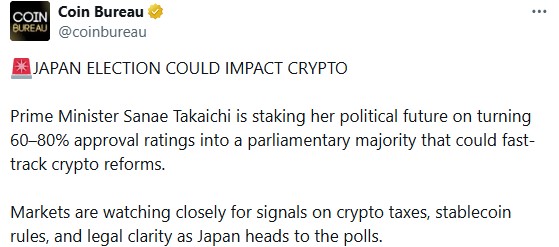
While crypto was not the centerpiece of her campaign, the election result has raised expectations for faster reforms around Japan crypto regulation, taxes, and stablecoin rules.
Markets are now watching how quickly policy promises turn into action.
Japan Election: Matter of Cryptocurrency Policy?
Sanae Takaichi’s supermajority landslide win on February 8, 2026, removes many political hurdles that slowed reforms under past administrations. A potential ruling party can speed up the legislation work, including developments in the domestic cryptocurrency market.
While Takaichi’s platform focused on economic stimulus, defense spending, and national security, her administration has shown openness to digital asset reform.
Tax on crypto gains in Japan is currently calculated as miscellaneous income, which pushed the rates higher, up to 55%, when local taxes were merged. This structure has been pushing local traders and platforms offshore.
Under plans discussed by the ruling coalition:
Cryptocurrency gains could shift to a flat tax of around 20%, similar to stock investments
Losses may be carried forward by investors up to three years
Some digital assets might be classified as financial products of formal kind
These proposals were contained in the FY 2026 tax reform blueprint released in late 2025. With the backdrop of the Japan Election 2026, their implementation is now clearly much easier.
Despite being early on cryptocurrency adoption, the country's crypto-specific journey remained turbulent, where major exchange hacks like 2014 Mt. Gox, which witnessed the loss of nearly 7% of total Bitcoin’s supply, forced regulatory intervention.
Clear rules for issuance of digital assets, custody services, and utilization could encourage domestic participation. Japan already has a potential user-base and exchange ecosystem, including platforms like BitFlyer, but uncertainty is limiting the broader adoption.
With a supermajority in place, the government could MOVE faster on defining stablecoin rules under updated Japan crypto regulation frameworks.
Adding to the growth momentum, Japanese Financial Service Agency with the support of SBI Holdings and Nomura, is preparing for the launch of crypto ETFs in the country, where 2028 is seen as the earliest possible timeline.
However, officials stress discussions are preliminary, with no confirmed timeline yet. With the new government aimed at the fast working of the legislation, this uncertain timeline could get a faster development or possibly a fixed date.
Japan Crypto Market: Current and Future View
The country holds a notable position in global digital asset adoption. The nation accounted for around 5.8% ($368.5M) of overall cryptocurrency revenue in 2025 as per Grand View Research, and currently manages more than 1% of Bitcoin’s overall supply according to Chainalysis data.

If Sanae Takaichi follows through on her reform pledges, analysts expect:
Increased domestic retail participation
Greater institutional involvement
Stronger long-term confidence in the Japanese cryptocurrency market
Forecasts suggest this could climb to USD 1,168.1 million by 2033, growing at a solid 15.9% CAGR between 2026 and 2033.
Post-election Optimism has already shown up in markets, with rising BTC/JPY activity and improved sentiment across digital assets.
Risks and Open Questions in the Wake of the Japanese Election
Of course, there's still some ambiguity over that optimism. For one, critics note that Takaichi's agenda seems to be dominated by fiscal stimulus, defense expansion, and debt management. Reforms in cryptos might have to fight for legislative priority with these larger agendas.
Still, in comparison with previous governments, the outcome of the Japan Election clearly favors faster progress rather than delay.
