US Crypto Regulation Nears Decision Point With February Deadline: The Final Countdown Begins

Washington's regulatory hammer is poised to strike. A long-awaited decision on US cryptocurrency regulation is barreling toward a February deadline, setting the stage for a landmark shift that could either legitimize or cripple the digital asset industry on American soil.
The Regulatory Showdown
For years, the crypto market has operated in a gray zone—a patchwork of state rules and federal uncertainty. That ambiguity ends now. Lawmakers face a hard stop, a legislative cliff that forces clarity on everything from stablecoin issuance to exchange oversight. The industry holds its breath; the rules written this month will define the next decade of digital finance.
What's Actually at Stake?
This isn't just bureaucratic box-ticking. We're talking about the fundamental guardrails for a $2 trillion asset class. Will the US embrace innovation with a clear framework, or will it strangle it with legacy financial regulations that treat code like a securities prospectus? The deadline pressures agencies to move from theoretical debates to enforceable law—finally giving builders and investors the rulebook they've begged for.
The Global Domino Effect
Make no mistake: the world is watching. A progressive US framework could trigger a global race to attract crypto capital and talent. A restrictive one might just hand the future of finance to overseas hubs—a classic Washington move, protecting yesterday's banks while missing tomorrow's economy. After all, nothing says 'financial innovation' like a committee deciding the fate of decentralized protocols over lukewarm coffee.
The clock is ticking. By month's end, we'll know if America chooses to lead the digital asset revolution or gets left holding an empty bag of regulatory sand.
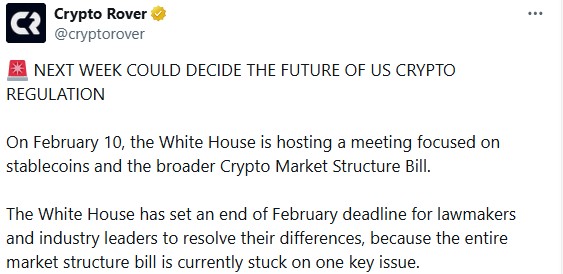
On February 10, 2026, the White House will host a high-stakes meeting focused on stablecoins and the broader crypto market structure bill, widely known as the CLARITY Act. The outcome could determine whether the most important US crypto regulation effort in years moves forward, or remains stalled.
What Makes Feb 10 Meeting Significant?
The upcoming meeting is the second staff-level session, following an earlier one, conducted on Feb 2–3, 2026, that failed to resolve US crypto legislation stalemate. This time, pressure is higher.
The administration has set end-February as a hard deadline for compromise. If the decision is not finalized until the deadline and delays continue, it could push the bill into election season and possibly the next Congress.
As a result, full implementation WOULD likely take years, extending regulatory uncertainty for exchanges, DeFi platforms, and institutions.
Banks vs Crypto: How the Bill Reached a Standstill
The CLARITY Act USA began with strong momentum:
Introduced in May 2025
Passed House committees in June 2025
Approved by the House in July 2025 with strong bipartisan support
The bill, which is designed to clearly define SEC and CFTC roles in cryptocurrency management, protecting self-custody, and creating a legal path for digital assets to mature, paused when stablecoin yield became the central issue.
Traditional Banks strongly oppose yield-bearing stablecoins, citing that it could slowly drain deposits from the traditional banking system.
Their concern is based on basic comparisons:
Savings accounts: 0.3%–0.4%
Checking accounts: near 0%
Stablecoins: 3%–4% rewards
If stablecoins continued to offer yield, banking groups warn that trillions in deposits could shift out of banks over time.
Because deposits are critical for lending and financial stability, banks are pushing lawmakers to ban or tightly restrict stablecoin yield under this crypto market structure bill.
On the contrary, digital asset platforms say yield is non-negotiable. For exchanges, stablecoin rewards are a Core business model, not a side feature. Many firms argue that banning yield would:
Make US platforms uncompetitive
Push users and capital offshore
Slow DeFi and payment adoption
Some industry leaders have said openly they would rather see no bill passed than accept a framework they believe protects banks at cryptocurrency’s expense. This hard stance is why the CLARITY Act Senate vote remains delayed.
Committee markups were delayed
Draft texts were revised multiple times
Industry support fractured
This contradiction and the importance of the act led directly to WHITE House involvement.
CLARITY Act: What’s at Stake for the Crypto Market
Stablecoins are no longer niche tools. They are becoming a CORE part of financial infrastructure with hundreds of billions in market value, trillions in annual transaction volume, and key liquidity source for global markets.
If a compromise emerges, the outcome will shape exchange operations, DeFi growth, institutional participation, and payment adoption in the US.
For now, the upcoming CLARITY Act meeting may be the last chance before politics take over.
