ENS Labs Ditches Namechain L2, Bets Big on Ethereum Mainnet for ENS V2

ENS Labs just made a power move—scrapping its dedicated Namechain Layer-2 plan to double down on Ethereum's mainnet for the upcoming ENS V2 upgrade. It's a bold pivot that cuts through the noise of endless sidechain announcements and puts its chips squarely on the original blockchain's long-term viability.
Why This Mainnet Move Matters
Forget fragmentation. This decision bypasses the complexity of managing a separate L2, aiming instead to leverage Ethereum's entrenched security and sprawling network effects directly. It signals a maturation—choosing battle-tested infrastructure over the allure of a shiny, isolated chain. One less ecosystem to bootstrap, one less set of bridges for users to trust.
The Ethereum Alignment Play
This isn't just a technical choice; it's a strategic alignment. By deepening its integration with Ethereum's core layer, ENS reinforces its position as a fundamental primitive of the ecosystem, not just another app on a rollup. It's a bet that the mainnet's scaling roadmap—fueled by ongoing upgrades—will be sufficient for its global namespace ambitions.
A Cynical Take from Finance
Let's be real—in a landscape cluttered with 'visionary' L2s promising the moon, this feels like a refreshing dose of pragmatism. It's the crypto equivalent of a company opting to renovate its downtown flagship store instead of opening a risky pop-up in a trendy but unproven mall. Sometimes, the best innovation is not building something new, but better using what already works. The move might disappoint L2 maximalists, but it quietly pleases those who still believe Ethereum's base layer is the ultimate settlement frontier—proving that in crypto, the biggest statements are sometimes made by what you choose not to build.
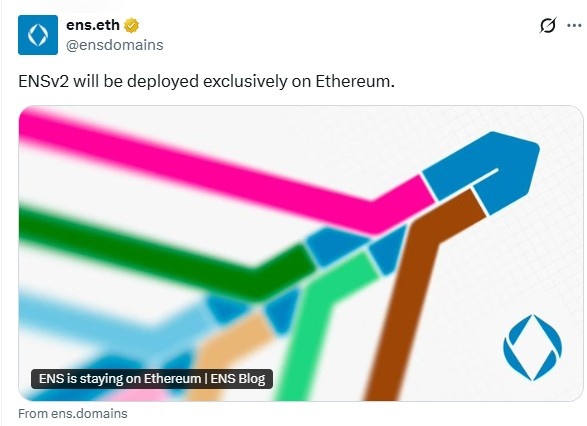
The announcement quickly drew attention across the digital asset sector, attracting developers, traders, and investors, while also influencing token price movement and market activity.
Why the Project Is Dropping Its L2 Plan
The Ethereum Name Service is widely recognized as a decentralized naming protocol that converts complex wallet strings into readable domains like alice.eth, helping simplify on-chain transactions and Web3 interactions.
According to the team, the base network has scaled faster than anticipated, with registration and interaction costs falling sharply over the past year. Infrastructure upgrades boosted block capacity and reduced fees by nearly 99%, making a separate chain less necessary.
Key reasons behind the pivot include:
Stronger security: Operating on the primary chain provides higher reliability than maintaining an independent network.
Simpler user experience: Participants no longer need bridging tools or additional accounts.
Better ecosystem compatibility: Remaining on the same layer improves connectivity with wallets, DeFi platforms, NFTs, and cross-chain applications.
The developers added that although Namechain development will end, features planned for ENS V2 — including easier registrations, stablecoin payments, and an upgraded registry — will still roll out.
What It Means for the Base Network
The MOVE signals growing confidence in the scalability of the primary chain. While many teams continue experimenting with Layer-2 solutions, this decision suggests that core infrastructure can now function efficiently without launching separate environments.
Potential effects include:
More stable fee generation tied to domain and identity usage.
Stronger integration across Web3 tools.
Reduced dependence on bridges, lowering operational risk.
Token Price Jump After Announcement
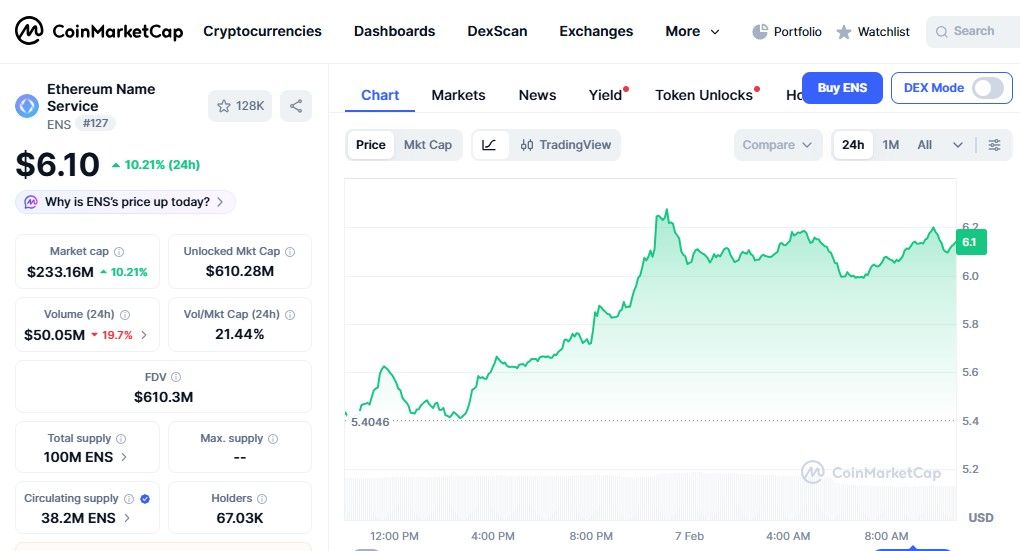
Following the update, the native token recorded a sharp rise within roughly 13 hours. Prices climbed from about $5.80 to a high NEAR $6.27 and are currently trading around $6.12. CoinMarketCap data also showed increased trading volume, indicating renewed investor interest as the news gained traction.
Future Outlook: Why This Matters
Scrapping Namechain and advancing ENS V2 on the main network marks an important milestone for decentralized identity technology. It demonstrates that infrastructure improvements are reaching a level capable of supporting essential services without specialised chains.
For builders and users, the transition points toward smoother operations and stronger long-term reliability. More broadly, it highlights a shifting industry mindset — one that increasingly favors security and operational clarity over fragmented scaling paths.
As blockchain adoption accelerates, ENS V2 could become a foundational LAYER for digital identity, reinforcing network utility and supporting the next phase of Web3 expansion.
