Bithumb’s Bitcoin Blunder: Free BTC Payout Sparks Flash Crash Chaos

Free money? Not so fast. A technical error at South Korean crypto exchange Bithumb triggered a wild market swing, proving once again that in crypto, the only sure thing is volatility.
The Glitch That Gave It All Away
An internal system failure led to users erroneously receiving Bitcoin payouts. The 'free' crypto didn't stay in wallets for long, as a cascade of sell orders hit the order book almost immediately. The platform's automated systems, scrambling to correct the error, collided with a surge of opportunistic trading.
Algorithmic Domino Effect
The result was a classic flash crash. Liquidity vanished in key price ranges as stop-loss orders triggered en masse. The brief but violent dip wiped out leveraged positions and left arbitrage bots feasting on the price dislocation across global exchanges. It was a high-speed reminder of how fragile synthetic liquidity can be when real assets are on the line.
Aftermath and Accountability
Bithumb moved quickly to freeze affected accounts and reverse the erroneous transactions, a standard but controversial playbook. The incident immediately drew scrutiny from South Korea's Financial Services Commission (FSA), reigniting debates about exchange operational integrity and consumer protection in a market that still treats user funds with the care of a Wall Street bonus day—everyone's excited until the check bounces.
While the market stabilized within hours, the psychological dent remains. For all the talk of decentralized finance, most traders still rely on centralized pillars like Bithumb. When those pillars glitch, everyone feels the tremor. It’s a costly lesson in trust, wrapped in the unstable packaging of free Bitcoin.
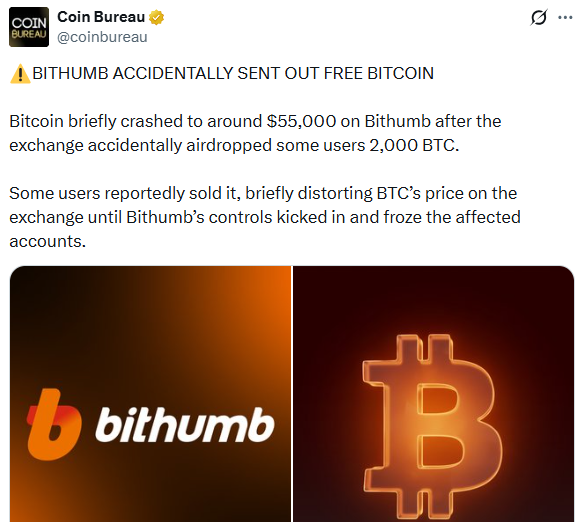
Bithumb meant to send small cash prizes of 2,000 Korean won (about $1.40). Instead, an employee chose "Bitcoin" as the currency unit. This meant users received 2,000 BTC each. At the time, this put about $44 billion into user accounts by mistake.
Why the Bithumb Bitcoin Error Caused a Price Crash
The Bithumb Bitcoin error caused prices to fall very fast. When users saw thousands of Bitcoin in their accounts, they tried to sell them right away. This massive sell-off crashed the price on the Bithumb platform. Within minutes, Bitcoin fell 17% to 81 million won (about $55,000). At the same time, global prices on other exchanges stayed steady near $66,000. This created a rare "reverse Kimchi premium" in South Korea.
The South Korean platform acted quickly to stop the damage. Their security systems flagged the odd trades within five minutes. The exchange then froze the 695 affected accounts. They also paused all withdrawals to keep the assets safe. This helped protect the exchange from a total loss. By the next day, The South Korean platform reported that they recovered 99.7% of the missing coins.
The Details of the $44 Billion Glitch
The exchange error is one of the biggest mistakes in history. Even though the coins were only on an internal list, the impact was real. Many traders who saw the low price tried to buy more, but the system was already frozen.
Event Fact | Data Point |
Intended Prize | 2,000 Korean Won |
Actual Prize | 2,000 Bitcoin |
Price Low | $55,000 (17% Drop) |
Total BTC Sent | 620,000 BTC |
Recovery Rate | 99.7% of Funds |
While The South Korean platform recovered most of the funds, about $2.2 million was withdrawn before the freeze. Bithumb is now working with the police to get those funds back. This event shows that even big exchanges can make simple mistakes that lead to huge risks.
Expert Analysis: A Lesson for 2026 Markets
From a news perspective, this exchange error shows that human error is still a big threat. As crypto moves into 2026, safety rules must improve. Experts suggest that exchanges should have a "second check" for all large payouts. This WOULD stop one person from making a multi-billion dollar mistake.
South Korean regulators are now looking at Bithumb’s internal rules. They want to make sure this never happens again. For now, the market is back to normal, but the event will be remembered as a major wake-up call for the industry. Looking ahead, similar incidents may accelerate automated safeguards and dual-approval systems across centralized exchanges, particularly in jurisdictions like South Korea where retail participation dominates trading volume.
This content is provided for informational purposes only and does not constitute financial, investment, or legal advice. Cryptocurrency investments involve risk, and readers should conduct independent research before making decisions.
