Tria Airdrop Reality Check: Why 90% of Users Were Declared ’NOT Eligible’?

The promise of free crypto just hit a wall of fine print.
A staggering 90% of hopeful participants in the recent Tria airdrop found themselves locked out, their wallets greeted not with tokens but with a cold, automated 'NOT Eligible' message. The event, hyped across crypto forums and social feeds, has morphed into a case study in community disillusionment.
Eligibility: The Ghost in the Machine
What separated the lucky 10% from the rejected majority? The criteria weren't pulled from thin air—they were buried in the protocol's mechanics. It wasn't about mere registration; it was a silent audit of on-chain behavior, snapshot dates, and interaction depth that most users never saw coming.
The Fine Print Always Wins
This isn't just a crypto story; it's a universal finance lesson dressed in blockchain jargon. For every 'free' distribution, there's a ledger calculating who truly qualifies—a reminder that in both TradFi and DeFi, if you're not reading the terms, you're probably the product, or in this case, the marketing cost.
The fallout cuts through the typical airdrop euphoria. It exposes the gap between viral marketing and verifiable on-chain action. While the selected few celebrate, the broader community is left parsing what went wrong—their engagement metrics now a currency that didn't spend.
Next time you see 'free,' remember: the blockchain gives, but the smart contract definitely takes.
Tria Airdrop Claim News: Why Is the Community Angry?
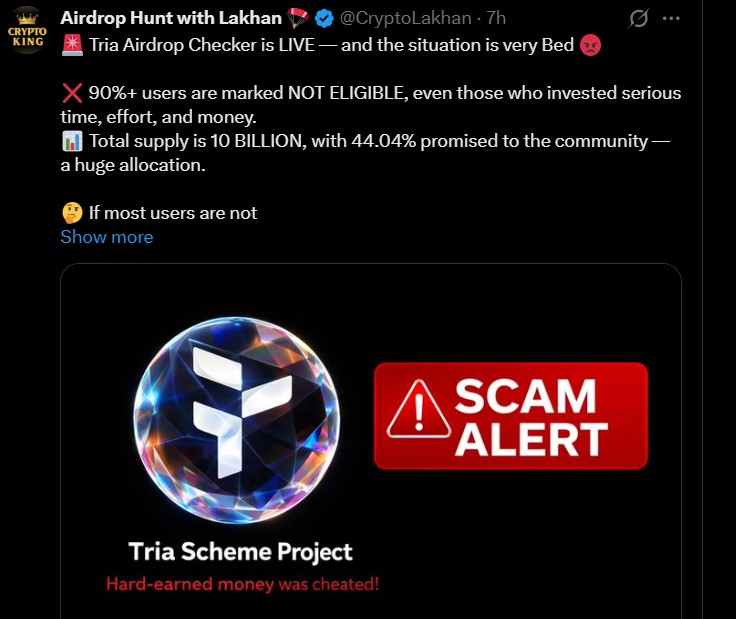
Currently, the most discussed subjects with the airdrops checker declare more than 90% of users as Not Eligible.
This response was disheartening to users, and it was especially severe among premium members and the initial participants who had spent time, money, and effort in the ecosystem.
The backlash got even worse, with tokenomics that were offering more than 41% of its 10 billion total supply to the community, which cast serious doubts on the aspects of fairness, transparency, and eligibility requirements.
Source: Cryptolakhan X
The Airdrop Snapshot: When Was Eligibility Decided?
On January 30, 2026, the snapshot was taken officially.
Any activity on or after this date does not qualify as S1 and is charged against S2.
This is one of the key reasons why many active users could not receive any rewards even after they continued to use it.
Season 1 vs Season 2 Airdrops: What is the difference?
Single reward on the basis of stringent rules.
Required approximately:
25,000 XP, or
$100+ paid membership, or
$25,000 futures trading volume
Most of the users did not exceed these thresholds.
The claim can be earned by eligible users within the app.
Rewards are given out in bits through loyalty token rewards.
Focuses on:
XP accumulation
Staking
Active usage of the Tria wallet
Rewards in Season 2 will be bigger than in Season 1.
Tria Airdrop Scam or Miscommunication?
The term is trending at the moment, yet no official evidence of fraud has been established as yet. Rather, the scandal is due to:
Failure to communicate XP requirements.
High spending thresholds
There was a lack of clarity prior to subscriptions by the users.
Some influencers have not said anything, supposedly because they are active in other SocialFi sites, which compounded the lack of trust in the community.
Tokenomics and TGE Information.
Total Supply: 10,000,000,000 tokens
Community Allocation: 41.04%
Circulating Supply at TGE: 21.89%
TGE done on February 3, 2026
Unlocked at TGE: 20% of distributed tokens.
Vesting: 3-month cliff and 6-month linear.
Tria Token Price Today After Listing
Tria airdrop listing date is the same as TGE, and is listed on such large exchanges as Binance, Bybit, Bitget, and KuCoin on Feb 3, 2026. This has augmented short-term speculation of Tria crypto.
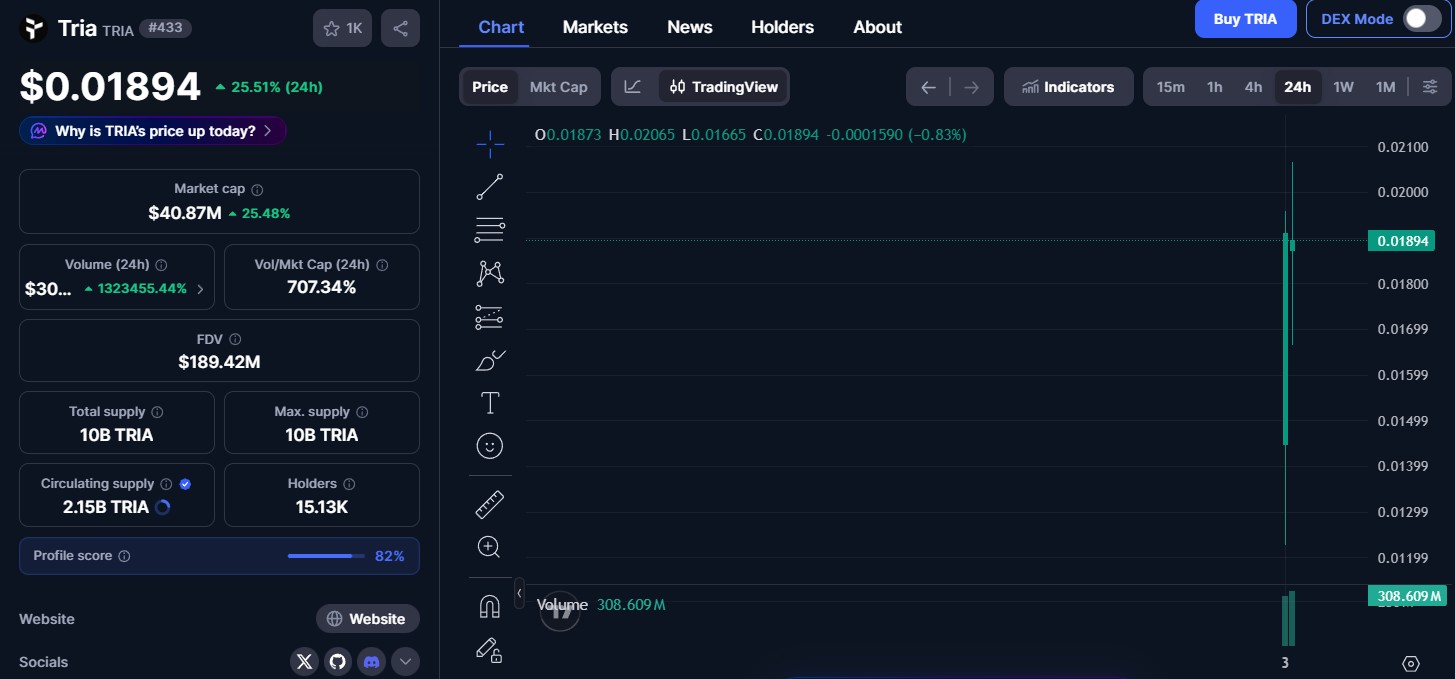
The token price today stands at $0.01894, up 25.51% in 24 hours, with a market cap of $40.87M and strong 24-hour trading volume of $308.6M, reflecting heightened market activity. It is recommended that investors follow the news on tokens before making decisions.
Source: CMC
Conclusion
The controversy underlines ineffective communication, rather than the case of proven fraud. Season 2 remains crucial. It will be transparency that will determine whether it will regain trust or be a lesson in crypto.
Disclaimer: This is not financial advice. Please DYOR before investing. CoinGabbar is not responsible for any financial losses. Crypto assets are highly volatile and you can lose your entire investment.
