Ripple Scores Major EU Victory: Secures Full EMI License in Luxembourg

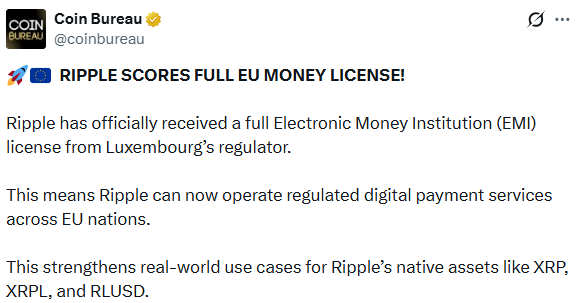
Ripple just bulldozed a major regulatory wall in Europe. The firm secured a full Electronic Money Institution (EMI) license in Luxembourg—a green light to operate across the entire EU bloc.
The Regulatory Gateway
Forget piecemeal approvals. This license isn't a limited sandbox pass; it's a master key. It grants Ripple the authority to issue electronic money and provide payment services throughout all 27 EU member states from its Luxembourg base. The move strategically positions Luxembourg, already a fintech hub, as Ripple's operational command center for Europe.
Why This License Changes the Game
This isn't just another compliance checkbox. An EMI license is the gold standard for digital payment firms in Europe. It bypasses the need for separate national registrations, slashing time-to-market and legal overhead. For Ripple's clients—mainly banks and financial institutions—it translates to faster, cheaper cross-border settlements using XRP, all under a fully regulated umbrella. It’s a direct challenge to the SWIFT network's dominance, offering a sanctioned alternative that actually understands what century we're in.
The Ripple Effect on Crypto Regulation
Ripple's full approval throws a spotlight on the EU's Markets in Crypto-Assets (MiCA) framework. While MiCA aims for harmony, Ripple's proactive move shows that navigating individual member states with robust regimes—like Luxembourg's CSSF—can be a faster path to scale. It’s a masterclass in regulatory arbitrage, proving that playing the long game with established financial authorities pays off more than waiting for pan-European consensus—which often moves at the speed of a committee deciding on committee formation.
A Cynical Finance Jab
Meanwhile, traditional finance giants are still trying to tokenize their paper trails, a bit like putting a horse saddle on a sports car.
Ripple's Luxembourg coup does more than expand its territory; it signals that the future of institutional crypto isn't in dodging regulators, but in outmaneuvering legacy systems by fully embracing their toughest rules. The old guard's moat just got a bridge built right across it.
For big banks and investors, this is a very important moment. It proves that blockchain technology is ready for the real world. It meets the high rules of a major financial hub. With this license, The Firm can now "passport" its services to all 27 European countries. This creates a SAFE and regulated bridge between traditional financial institutions and new digital assets.
Impact of New Ripple EU EMI License on Digital Asset Payments
The biggest benefit of the Ripple EU EMI License is clear. It lets The Firm offer a fully legal way for banks to MOVE money. In the past, many European banks were afraid to use blockchain because the rules were not clear. Now, with the new EU "MiCA" laws, this license gives them the safety they need. They can move from small tests to big, daily operations.
Why Luxembourg Matters
Luxembourg is the main gateway for big money firms in Europe. By setting up their EU base there, The Firm gets three big wins:
They can offer services in Germany, France, and Italy without asking for new permits.
The CSSF is a very tough but fair regulator. Their stamp of approval means a lot.
It makes it easier for The Firm to connect its tech with the The Eurozone banking system.
Helping XRP and RLUSD Grow
This license is not just about paperwork. It helps strengthen the assets used on the network. As more regulated paths open up, we expect more people to use XRP and the RLUSD stablecoin.
It works as a bridge to move money between different countries fast and cheap.
The Authorization lets The Firm manage its stablecoin under strict EU e-money rules.
The XRP Ledger is now a trusted tool for big European businesses.
Over 75 Licenses Worldwide
This European win comes right after Ripple's success in the UK. There, they also got a Authorization from the FCA. Now, The Firm has more than 75 licenses across the globe. This includes big markets in Asia and North America. This makes them one of the most trusted and regulated names in the crypto world.
Expert Analysis: The Move to Big Banking
The days of Ripple being a small startup are over. The Ripple EU EMI License removes the last big wall. European companies can now stop using slow systems like SWIFT. Instead, they can use instant blockchain payments that follow the law. While some people look at daily price changes, the real value is in the "pipes" of the global money system.
By staying in Luxembourg, Ripple is ready for all future EU rules. We expect to see many new deals with major European banks soon. These banks want to use this new, legal way to move money across borders.
