Chainlink Executes Largest $LINK Purchase in History: Is a Price Surge Inevitable?

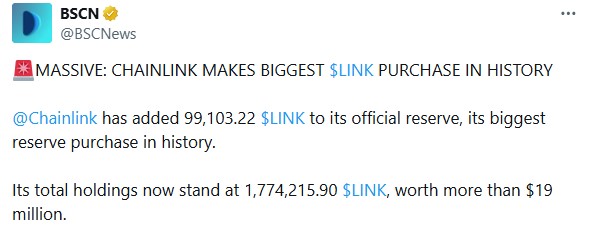
Chainlink just made its biggest $LINK buyback ever. The oracle giant's treasury just got a massive injection of its own token—and the market is watching.
The Signal in the Noise
This isn't just another routine treasury management move. The scale is unprecedented. When a foundational protocol like Chainlink makes a purchase of this magnitude, it sends a direct signal about perceived value. It's a bet on its own infrastructure, a move that often precedes a re-rating by the broader market. Forget the vague promises of roadmap updates; this is capital allocation in action.
Oracle Mechanics Meet Market Forces
The buyback directly reduces circulating supply, applying textbook supply-side pressure. In the often-irrational crypto markets, a major protocol acting as a consistent, large buyer can create a powerful psychological floor. It tells speculators and long-term holders alike that the core developers see more upside than downside at current levels—a potent narrative in a sentiment-driven asset class. Of course, this assumes the tokens are permanently removed from circulation and not just earmarked for future vendor payments or team incentives.
The Bull and Bear Case
Optimists see this as a masterstroke: a confident, capital-efficient move to align the protocol's treasury with its long-term success, potentially catalyzing the next leg up. Skeptics will call it financial engineering—a desperate attempt to manufacture price action when organic adoption growth might be slowing. After all, what's a better use of protocol funds: buying back your own token or building something new? It's a debate as old as corporate finance, now dressed in decentralized clothing.
Bottom Line: Watch the Flow, Not the Fluff
The real impact won't be found in press releases or community hype. Watch the on-chain data, the exchange net flows, and the order book depth. If this buyback represents a sustained absorption of sell-side liquidity, the price mechanics could shift meaningfully. If it's a one-off event drowned out by broader market sell pressure, it'll be a footnote. In crypto, as in traditional finance, sometimes the most eloquent statement a company can make is opening its wallet.
This purchase highlights the revenue-to-token conversion strategy, where coins are not directly bought from the open market to reduce supply immediately. Instead, it converts revenue generated from the in-platform's activity such as Oracle services, partnerships and data feeds into $LINKs.
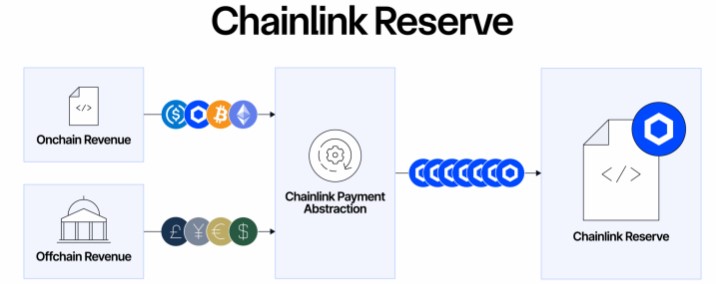
Around 90% of the recent purchase came from Uniswap swaps, with the remaining from direct LINK fees, showing an indirect buyback approach to strengthen network economics while reducing circulating supply.
Why Companies Do Reserve Purchases
Companies use reserve purchases to strengthen their networks sustainability and token economics. Here, Chainlink, by converting revenue into tokens, creates a growing treasury to fund ecosystem development, incentivize validators and support long-term infrastructure.
These purchases also reduce circulating supply without sudden market disturbance, potentially adding scarcity while acting as a subtle form of buyback. For the Chainlink LINK token, this presents that the platform is committed to long-term growth, aligning network revenue with the coin value.
LINK Price: Current Performance
Despite the record accumulation news, the token’s price remains under pressure, trading around $10.40–$10.50 at the time of writing. This is down roughly 3–4% in the last 24 hours aligning with its 14.15% weekly decline. The coin is also presenting the broader crypto market dynamics after 2025 highs.
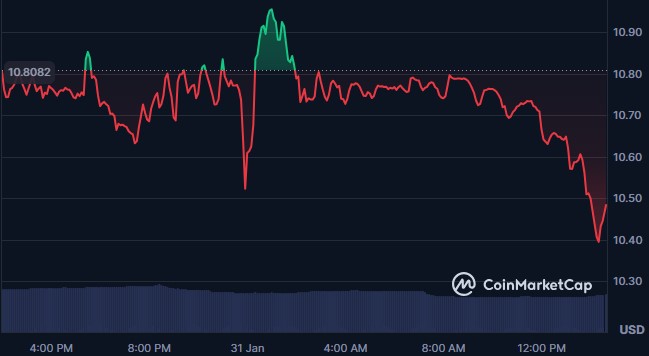
However, analysts see the coin purchase as a bullish sign for the future. The reserve’s growth could support long-term price stability, especially if the platform expands adoption through real-world asset tokenization and institutional integrations.
While short-term volatility is likely, the news could strengthen confidence among investors in the coming months.
In the Last
Chainlink’s largest token accumulation shows strategic accumulation, platform growth, and long-term coin scarcity. Some skeptics argue the buy is a routine fee conversion, others highlight its significance as a network-strengthening move, reinforcing trust in the tokenomics.
While the Chainlink coin's price may remain volatile short-term, this MOVE strengthens confidence in the token and its future potential.
This article is for informational purposes only; It does not provide any financial or legal advice.
