Crypto Market Crash After US Shutdown 2026? Analysts Reveal Shocking Predictions

Washington gridlock sends tremors through digital asset markets—analysts scramble to map the fallout.
The Domino Effect
Government paralysis doesn't just halt federal paychecks—it freezes regulatory clarity. Key decisions on digital asset frameworks grind to a standstill. Institutional capital, already skittish, hits the pause button. Liquidity? It starts to thin faster than a politician's promises.
Decoupling or Dependence?
Some voices argue crypto's core thesis is independence from traditional systems. A shutdown should be a non-event—proof of concept. Yet, trading charts tell a different story. Every headline from Capitol Hill still triggers algorithmic sell-offs. The old world's problems remain the new world's volatility index.
The Analyst's Playbook
Predictions hinge on duration. A brief shutdown becomes a buying opportunity—the 'fear dip.' A prolonged stalemate morphs into a stress test, exposing which projects built for real utility versus those running on hype and cheap leverage. Watch the stablecoin corridors; they'll bleed truth.
The Cynic's Corner
Let's be real—Wall Street has turned economic uncertainty into an art form for centuries. A little government shutdown is just another excuse to whip up volatility, shake out weak hands, and reposition before the inevitable rebound. Some things never change, even on the blockchain.
The ultimate takeaway? Crypto's crash narrative is often a prelude to its next act. Chaos isn't a bug in this system; it's a feature. The market might bend, but the underlying code—decentralized, global, relentless—doesn't break.
US Shutdown 2026 Shock Is Already Breaking Traditional Safe Havens
The partial US shutdown came into effect on January 31, 2026, with no clear end date. Historically, shutdowns shave around 0.2% off GDP for every week they last, but this time the impact looks faster and deeper.
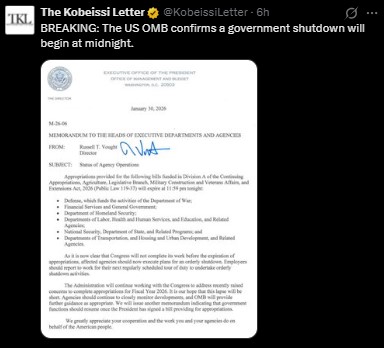
According to The Kobeissi Letter, silver saw an intraday fall of nearly 35%, the largest in history, before still closing the month up 19%. Gold suffered an even bigger shock, losing about $6.3 trillion in value within 24 hours—roughly $263 billion per hour. At the time of writing, gold close below $4,900 and silver around $85.238.
This matters because when traditional hedges break, risk assets rarely stay calm for long.
Crypto Market Crash: Bitcoin Price and Altcoins Feel the Pressure
Despite a small bounce in total value, signals point to stress, not recovery. Data from CoinMarketCap shows the global market cap up just 0.33% to $2.82 trillion, masking deeper weakness.
Bitcoin price today: $83,281.97, down over 10% in a week
Ethereum: $2,666.20, after a 2.58% intraday drop
XRP: $1.71, down 2.40% in a day
ETF flows confirm the risk-off mood. Bitcoin ETFs saw $653.98 million in daily outflows, while ethereum ETFs lost $113.83 million, based on SoSoValue data.
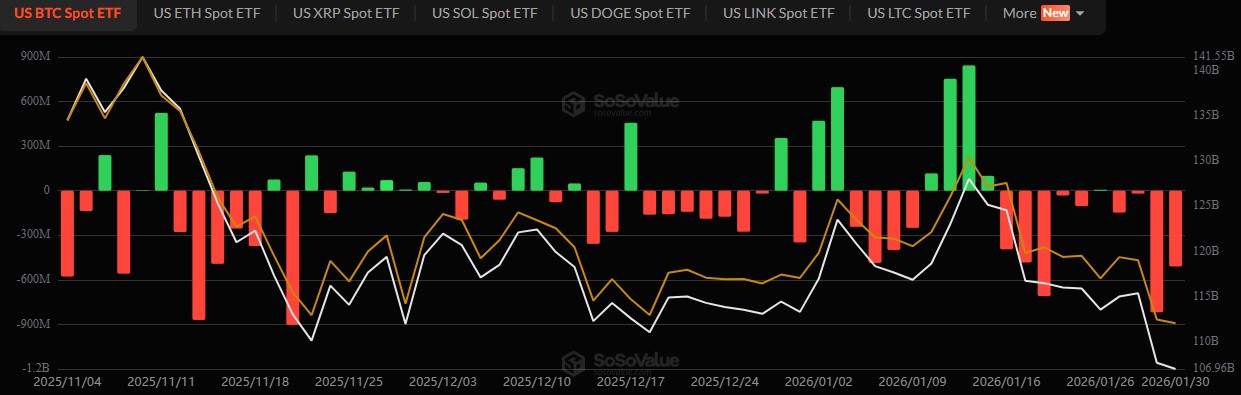
This is why many traders see the current crypto market crash phase as unfinished.
Data Blackout Risk and Why It Scares Markets
If the shutdown drags on, a data blackout becomes a real threat. CPI, PPI, GDP, PCE, and CFTC positioning reports may pause. Without these inputs, policy decisions turn reactive instead of measured. Historically, the space dislike uncertainty more than bad news, which explains why the crypto market crash story is gaining momentum.
Can Kevin Warsh Change the Ending?
Amid the turmoil, Kevin Warsh and crypto discussions are heating up. As TRUMP Fed pick speculation grows, some investors see hope. Warsh previously invested in the project Basis and advised Electric Capital. According to Trump’s public statements, Kevin Warsh was the youngest Federal Reserve Governor at 35 and represented the central bank at the G-20.

If confirmed as New Fed chair, sector will closely watch his stance on rates and liquidity. A more growth-friendly approach could stabilize sentiment, but expectations alone will not stop a crypto market crash without clear policy signals.
Conclusion
The biggest crypto market crash risk of 2026 is being driven by politics, not blockchain flaws. With the US shutdown active and SAFE havens shaking, caution dominates. Whether this becomes a historic buy zone or a deeper exit signal depends on policy clarity, not hope.
This content is for informational purposes only and does not constitute financial advice. Digital assets are highly volatile, and readers should consult financial professionals before making investment decisions.
