Bit Digital’s Ethereum Pivot: A Bold Strategic Reset Targeting ETH Dominance & AI Integration

Bit Digital just flipped the script. The crypto miner's decisive shift from Bitcoin to Ethereum isn't just a portfolio rebalance—it's a full-throated bet on the future of programmable blockchains and the AI revolution.
The ETH Gambit
Forget subtle adjustments. This move cuts deep into the core of their mining operations, redirecting hash power and capital toward the Ethereum ecosystem. It bypasses the Bitcoin-or-bust narrative entirely, betting that ETH's utility as a computational layer will outpace pure store-of-value plays in the coming cycle.
AI: The New Hash Rate
The strategy doesn't stop at ETH. By explicitly tying its future to artificial intelligence, Bit Digital signals that the real value isn't just in securing a ledger—it's in powering the next generation of intelligent applications. They're not just mining coins; they're positioning as infrastructure for a smarter web.
It's a high-stakes recalibration that reads the tea leaves of 2026: convergence. Where decentralized finance meets machine learning, and where the most valuable networks are those that do more than just sit there. Of course, on Wall Street, they'd call this 'visionary'—right up until the next quarterly earnings miss, when it becomes a 'distraction from core competencies.' The market's fickle like that.
One thing's clear: in the race for relevance, standing still is the biggest risk of all. Bit Digital just hit the accelerator.
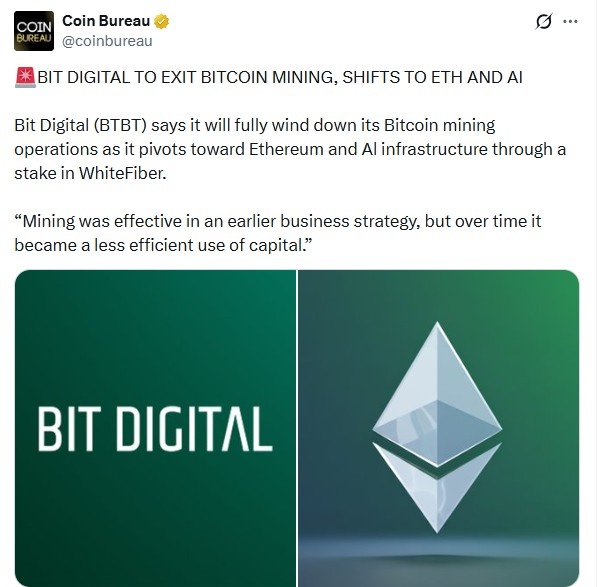
Source: CoinBureau Xofficial
Why Bit Digital Is Leaving Bitcoin Mining
The decision marks a sharp turn from Bit Digital’s earlier identity as a bitcoin miner. According to management, BTC mining has become increasingly expensive and less efficient. Rising energy prices, higher network difficulty, hardware replacement costs, and fixed block rewards have reduced margins. These challenges make scaling operations harder without taking on more risk.
The company's claims about Bitcoin mining are largely valid. Mining profitability today depends heavily on power costs and scale. Smaller efficiency gains no longer offset operational pressure. While BTC remains secure and dominant, mining has become a low-margin business for many public companies.
Why Ethereum Offers a Different Advantage
Unlike Bitcoin, Ethereum runs on a proof-of-stake system. This means companies do not need large mining farms or heavy electricity use. Instead, ETH can be staked to earn network rewards. Bit Digital disclosed that it holds more than 150,000 ETH already staked, generating yield while supporting network security.
Ethereum also benefits from broader use cases such as decentralized finance, applications, and tokenized assets. These factors give ETH exposure beyond price movement alone.
Key reasons behind the Ethereum focus include:
Lower operating costs compared to mining
Yield generation through staking
Exposure to a growing application ecosystem
AI Infrastructure and the Role of WhiteFiber
Alongside ETH, the company is expanding into AI computing through WhiteFiber, a firm focused on high-performance data centers. WhiteFiber provides infrastructure used for AI training and computing workloads. Bit Digital has confirmed it does not plan to sell certain WhiteFiber holdings, signaling confidence in this segment.
AI infrastructure allows the company to diversify revenue beyond crypto cycles. Demand for computing power continues to grow as AI adoption expands across industries. This reduces reliance on a single sector and improves business stability.
Market Impact and Investor Message
Analysts believe the Bit Digital Ethereum shift reflects growing pressure on Bitcoin mining firms to find lower-cost, scalable business models. This shift does not weaken Bitcoin’s network security. Large global miners still dominate hash power, and their exit represents a strategy, not failure. However, the MOVE sends a clear signal to markets that some miners are rethinking capital efficiency.
For Ethereum, the announcement reinforces confidence in staking-based economics. It shows that institutional players see value in yield-driven participation rather than hardware-heavy models.
To investors and the public, the message is simple: adaptability matters. Bit Digital is positioning itself as a virtual infrastructure company rather than a pure miner.
What This Could Mean Long Term
If successful, this strategy may inspire other miners to explore ETH staking or AI hosting. It reflects a broader shift toward energy-efficient networks and diversified revenue models.
The company’s pivot highlights a changing crypto landscape—one where flexibility, lower costs, and real-world demand shape future growth more than tradition alone.
