Paul Atkins’ Crypto 401(k) Plan Could Open the $40 Trillion Retirement Market to Digital Assets

Wall Street's retirement fortress just got a new blueprint—and it's written in blockchain.
The Regulatory End-Run
Former SEC Commissioner Paul Atkins didn't just propose a new investment option. He drafted a structural bypass. His plan carves a direct channel for crypto into employer-sponsored 401(k) plans, sidestepping decades of fiduciary hand-wringing. It treats digital assets like any other alternative investment—no special pleading, just cold allocation logic.
The Custody Conundrum, Solved?
The real innovation isn't permission; it's packaging. The framework tackles the twin demons of institutional adoption: security and compliance. By wrapping crypto exposure in a familiar retirement wrapper, it neutralizes the 'too risky for grandma' objection. Suddenly, Bitcoin isn't a speculative asset—it's a diversifier in a tax-advantaged account. A masterstroke of financial rebranding.
The $40 Trillion Prize
This isn't about capturing retail traders. It's about plumbing. Opening the pipes of systematic, monthly contributions from American paychecks would create a demand waterfall unlike any crypto exchange has seen. We're talking predictable, recurring capital flows measured in billions—not the whims of Twitter sentiment.
Legacy finance will, of course, scoff. They'll mutter about volatility and 'appropriate' asset allocation—usually while collecting 2% fees on underperforming mutual fund menus. The irony? Their own product-laden plans are often the riskier proposition.
The gatekeepers are circling, but the door is already ajar. When retirement accounts finally plug into the blockchain, the flow of capital won't be a trickle. It'll be a tidal shift.
Why Crypto in Retirement Plans Is Being Discussed?
During a CNBC interview, Atkins explained that many Americans already have indirect exposure to digital assets. This includes stocks of digital assets-related companies or funds that track digital assets. In his view, offering virtual assets through regulated retirement products could actually be safer than people buying it on unregulated platforms.
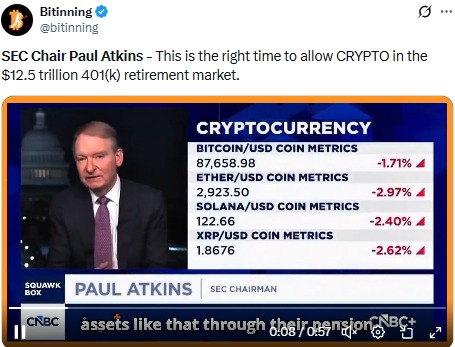
Source: X (formerly Twitter)
The Paul Atkins' idea is not about letting people gamble with retirement money. He clearly said that any crypto exposure must come with “guardrails.” This means professional fund managers, clear risk warnings, and strict rules to protect investors.
Congress and Regulators Are Moving Slowly but Surely
Atkins also spoke about progress on a major digital asset market structure bill. He said Congress has “never been this close” to passing clear cryptocurrency rules, though he admitted there is no fixed timeline yet.
The SEC is helping lawmakers by giving technical guidance. Atkins said that once the law is passed, both the SEC and the CFTC will be ready to act. This law could play a key role in deciding how virtual currency products, including retirement investments, are handled in the future.
SEC and CFTC Working Together
Another important part of the Paul Atkins crypto 401(k) view is cooperation between regulators. Atkins and Michael Selig said the SEC and CFTC are working closely to avoid gaps in virtual asset oversight.
They also mentioned Project Crypto, a joint effort to support innovation while keeping markets fair and safe. The two agencies are expected to sign a formal agreement on digital currency supervision soon. This coordination is seen as necessary if it is to enter 401(K) plans responsibly.
Innovation Rules and Clear Guidance Ahead
Atkins shared that the SEC plans to introduce special exemptions to support innovation. These may cover areas like staking, mining, and investment products. However, he warned that these changes may take more time than first expected.
The SEC has also released clearer guidance on tokenized securities. This helps companies understand how blockchain-based assets still follow existing US laws, even if they are issued on-chain.
Why Does This Matters for Everyday Investors?
If the Paul Atkins crypto 401(k) idea moves forward, it could bring digital currency closer to traditional finance than ever before. Retirement funds could get regulated exposure, and digital currency markets could see steady, long-term capital.
