Bybit Banking Services: Crypto Exchange Morphs Into Full Financial Hub

Crypto's quiet giant just made its most aggressive move yet—and traditional banks should be sweating.
Bybit, the exchange that clawed its way to a top-three spot by volume, is no longer content with just trading. Its new banking services mark a deliberate, calculated pivot toward becoming a one-stop financial ecosystem. Think less 'crypto exchange,' more 'digital fortress for your entire net worth.'
The Full-Stack Finance Play
This isn't about slapping a 'savings account' label on a staking product. Bybit's rollout targets the core utilities of legacy finance: deposits, withdrawals, fiat conversions, and wealth management—all wrapped in a single, crypto-native interface. It's a direct assault on the fractured user experience that forces people to hop between banks, brokers, and exchanges.
The strategy is brutally simple: capture more of the customer's financial life. Once you're trading, saving, and spending in one ecosystem, leaving becomes a monumental headache. It's the same playbook used by every tech-turned-finance titan, just executed with crypto's signature speed and without the legacy tech debt. A cynical observer might note it's easier to build a bank from scratch than to teach an old one new digital tricks.
Why This Changes the Game
For users, the promise is seamless sovereignty. Merge your volatile crypto assets with yield-generating stablecoin holdings and everyday banking rails, all without the permission slips and delays of traditional finance. For the industry, it signals a new phase of maturation. The winners won't just have the best trading engine; they'll have the deepest, most integrated financial stack.
Bybit's bet is clear: the future of finance isn't just digital, it's holistic. And they're building the hub to own it all, leaving the old guard to play catch-up—or risk becoming irrelevant.
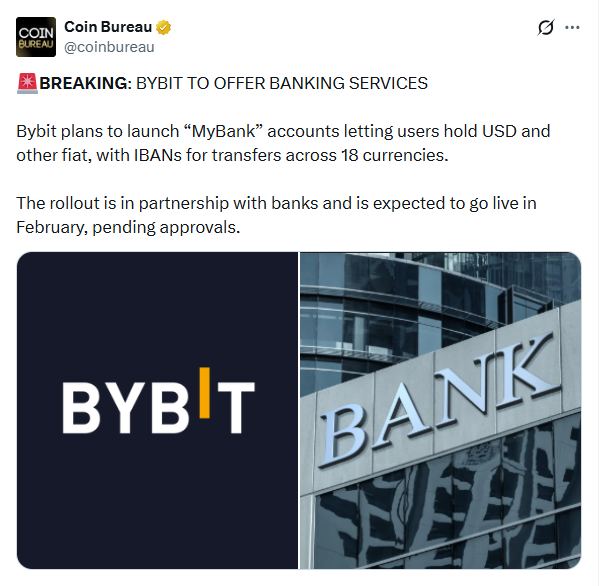
Source: Coinbureau Xofficial
How IBAN Works and Who Is the Regulatory Partner
Bybit fintech services will include IBAN support for global transfers. IBAN stands for International Bank Account Number. It is a global financial infrastructure standard used to send and receive money securely across countries. With an IBAN, users can receive salaries, make international transfers, and move funds between banks easily. By adding IBAN, the exchange is making virtual asset trading more connected with global finance.
Bybit is working with regulated financial infrastructure partners, including Pave Bank, to provide this service. These partners handle the legal and financial infrastructure side, while the trading platform acts as the platform interface. This also means that the system runs on traditional banking rails, not on blockchain or a decentralized network.
So the Flow becomes simple:
User → Bybit interface → Partner bank → Global banking system
Liquidity, Deposit Protection, and Redemption Windows
Liquidity management is a Core challenge for Bybit banking services. Unlike normal banks, crypto exchanges are not always covered by government-backed deposit insurance. Protection depends on how funds are legally held with partner banks. If the money is stored in segregated bank accounts under users’ names, protection can be stronger. If it remains on exchange balance sheets, risk is higher.
Redemption windows refer to how quickly users can withdraw their funds. Normally, withdrawals will follow banking schedules:
Instant or same-day transfers in some regions
1–3 business days for international transactions
In a stress-outflow situation, where many users try to withdraw at once, delays can happen. Banks may increase compliance checks, slow processing, or limit transactions temporarily. This is normal even in traditional financial infrastructure systems.
The challenge is that exchanges must always keep enough liquidity to handle withdrawals while staying compliant with financial infrastructure rules.
Market Impact and Future of Bybit as a Fintech Platform
This move could strengthen the exchange’s market position. Offering virtual currency trading plus fintech services in one app improves convenience and keeps users inside one ecosystem. IBAN can reduce friction when moving money between banks and virtual currency markets. It can help the trading platform compete with platforms that already offer fiat-friendly services.
If successful, this could:
Increase user trust
Boost institutional participation
Improve Bybit’s market share
Make the fiat-to-crypto movement much smoother
In the virtual asset market, it shows how exchanges are evolving into hybrid finance platforms. It brings virtual currencies closer to mainstream finance while keeping trading access flexible.
However, the risk is higher responsibility. Any failure in banking partnerships, liquidity management, or withdrawals could hurt the exchange’s reputation quickly.
