Russia Crypto Bill: Aksakov Confirms June Vote - Will Moscow Finally Embrace Digital Assets?

Russia's long-awaited cryptocurrency legislation is finally heading for a vote—and the timing couldn't be more critical. After years of regulatory limbo, State Duma deputy Anatoly Aksakov has confirmed the draft bill will hit the floor in June, setting the stage for what could become one of the world's most consequential crypto frameworks.
The Geopolitical Clock is Ticking
Sanctions pressure, capital flight, and a shifting global financial order have forced Moscow's hand. This isn't just about legalizing Bitcoin—it's a strategic move to build parallel financial infrastructure. The bill aims to regulate mining, define exchange operations, and establish taxation protocols, all while keeping capital within the new system. Think of it as a digital iron curtain, but for rubles.
What's Actually in the Framework?
Expect heavy state oversight—mining licenses, KYC mandates, and transaction reporting that would make a Swiss banker blush. The Central Bank of Russia gets a starring role, likely as the primary regulator. The goal? Control. Not decentralization. They want the innovation without the ideological baggage. It's crypto, but with a distinctly Russian flavor: centralized, monitored, and serving state interests first.
The Mining Gold Rush (If You Can Call It That)
Russia holds a dirty secret: it's a mining powerhouse thanks to cheap energy and cold climates. The bill could formalize this shadow industry, turning Siberia into a legalized mining hub. But don't expect a free-market paradise—permits will be political, and energy allocations will favor loyal operators. It's less 'Wild West' and more 'state-directed resource extraction.'
The International Ripple Effect
A regulated Russian crypto market fractures the global landscape. Will Russian exchanges be isolated? Can they interface with Western platforms? The compliance headaches alone will keep lawyers employed for years. Meanwhile, other BRICS nations are watching closely—this could become a template for alternative financial systems outside the dollar's reach.
The Bottom Line: Trust, But Verify
June's vote is a milestone, not a finish line. Implementation will be slow, bureaucratic, and likely amended by the time the first regulated transaction clears. For investors, it opens a massive, high-risk market. For the Kremlin, it's a hedge against economic isolation. And for crypto purists? It's another reminder that governments adopt technology not to liberate, but to control—because even in decentralization, someone always wants to be in charge. After all, what's the point of disrupting traditional finance if you can't just build a newer, shinier version of the same old gatekeeping? The irony is almost poetic.
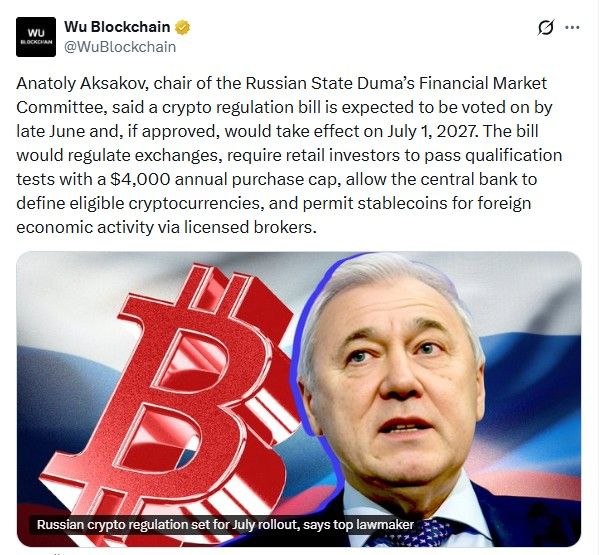
Source: WuBlockchain’s Xofficial
Key Features: Trading Caps, Exchange Rules, and Central Bank Control
The regulation will introduce several strong measures to shape the crypto market. Retail investors will face an annual trading cap that limits how much they can invest, protecting them from extreme losses. Crypto exchanges will be required to follow strict licensing and compliance rules, making their operations transparent and accountable. Only approved platforms will be allowed to offer trading services. The central bank will be empowered to define which virtual assets are eligible, ensuring that risky or unreliable assets are excluded. Retail investors will also have limits on the types of digital assets they can hold. Another major change is the permission to use stablecoins for foreign economic activity through licensed brokers. This helps businesses handle cross-border payments faster and more efficiently in global trade systems.
Parliamentary Process and Implementation Timeline
The Russia Crypto Bill is currently at a critical stage, as lawmakers actively debate its structure and enforcement, where lawmakers are refining the structure, responsibility, and enforcement.
Main points under discussion include:
Investor protection standards and trading safety rules.
Licensing requirements for virtual assets exchanges and brokers.
Clear penalties for unregistered or illegal platforms.
Monitoring systems for trading ecosystem transparency and reporting.
The draft law will be prepared for a parliamentary vote by the end of June. If approved, the regulations are expected to come into effect from July.
Implementation steps will include:
Mandatory registration of all digital asset exchanges.
Enforcement of annual trading limits for retail investors.
Activation of central bank oversight mechanisms.
These measures will create order, discipline, and accountability across the market. They will support safer long-term financial growth for the nation.
Economic Impact on Russia and the Global Market
The Russia Crypto Bill is expected to reshape both the nation’s financial landscape and its position in the global digital economy.
Positive impacts include:
Higher investor confidence due to legal clarity.
Safer markets with regulated and licensed exchanges.
Better use of stablecoins for international trade.
Stronger global credibility for Russia’s financial system.
Challenges that may arise include:
Reduced trading activity due to strict investment caps.
Higher compliance costs for digital asset platforms.
Slower innovation caused by heavy regulation.
Global influence of this MOVE includes:
Encouraging other countries to clarify their virtual asset laws.
Strengthening international focus on regulated digital finance.
This shows a global shift toward balance between freedom and control. If managed well, it can support safer vitual growth worldwide. It also promotes trust and stability in emerging markets through clear financial regulation systems globally.
