VIX-Bitcoin Correlation Roars Back: Political Chaos & Fed Uncertainty Fuel Digital Gold Rush

Fear is back on the menu—and Bitcoin's eating it up. The long-dormant link between Wall Street's 'fear gauge' and crypto's flagship asset just snapped back to life, signaling a tectonic shift in how investors view digital gold during turmoil.
When Traditional Markets Tremble
For years, proponents pitched Bitcoin as the ultimate uncorrelated asset—a digital island safe from the storms of traditional finance. That narrative's cracking. The VIX, which measures expected S&P 500 volatility, is moving in eerie sync with Bitcoin's price once again. It's not a gentle drift; it's a lockstep march driven by twin engines of chaos: political instability and monetary policy whiplash.
The Dual Catalysts: Politics & The Printer
Election-year rhetoric fuels the fire on one side. On the other, central bankers juggle inflation ghosts and growth fears, making every utterance a market-moving event. This combination creates a perfect storm where both the fear of traditional system failure and the fear of currency debasement point directly to Bitcoin's door. Suddenly, it's not just a speculative tech play; it's a hedge against the whole circus.
A New Playbook for Volatility
Traders are rewriting their algorithms. The old rules are out. The re-emergence of this correlation suggests sophisticated capital is treating Bitcoin less like a niche gamble and more like a core volatility asset—a staggering legitimization for the skeptics who dismissed it as a meme. It turns out digital scarcity looks pretty attractive when you're staring down the barrel of real-world uncertainty and the Fed's printing presses (which, let's be honest, have only two settings: 'on' and 'panic').
The message is clear: in a world where politicians and central bankers compete to create the biggest mess, Bitcoin's narrative is evolving from 'store of value' to 'port in a storm.' The correlation isn't a bug; it's a feature of a financial system running on fumes and faith. Maybe the real volatility index should measure the credibility of the suits in charge.
VIX–Bitcoin Correlation Highlights Sensitivity To Macro Stress
According to the report, the VIX–BTC Risk Correlation becomes a key framework for interpreting Bitcoin’s behavior in the current macro environment. This indicator tracks how spikes in traditional market volatility, measured by the VIX, align with local and cyclical bottoms in Bitcoin. Rather than acting as a timing signal, it functions as a stress thermometer, helping assess when risk in traditional finance begins to translate into inflection points in the crypto market.
Historical context reinforces its relevance. During 2025, bitcoin declined in 6 of the 7 FOMC meetings, with an average drop of 7.47% in the surrounding days. Policy expectations remain anchored, with the current federal funds rate in the 3.50%–3.75% range, the lowest since September 2022. At the same time, the Federal Reserve has announced plans to repurchase $40 billion in Treasury Bills over 30 days, adding liquidity without signaling an imminent rate cut.

On the volatility side, the VIX at 16.89 places markets in an alert zone of moderate stress. Historically, this same correlation framework flagged the last two local Bitcoin bottoms of the current cycle and also identified the bottom of the previous bear market.
The conclusion is not that a bottom is guaranteed, but that risk remains elevated. With markets pricing a rate cut only for March or September, Bitcoin continues to trade in sync with US-driven stress, making Super Wednesday another key test of the volatility–Bitcoin relationship.
Price Momentum Remains Fragile
Bitcoin price action on the daily chart shows a market trapped in a fragile consolidation after a sharp corrective phase. BTC is trading around the $89,000 area, struggling to regain momentum after failing to reclaim the descending cluster of moving averages.
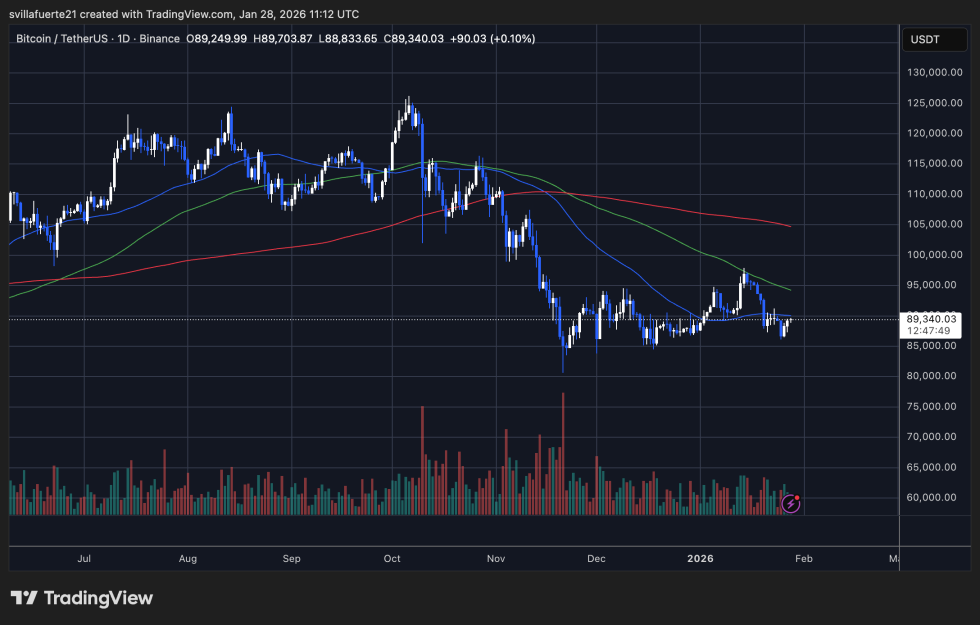
The 50-day SMA (blue) continues to slope downward and acts as dynamic resistance, while the 100-day SMA (green) is also trending lower, reinforcing the bearish medium-term structure. Above them, the 200-day SMA (red) remains intact but far from price, signaling that long-term trend support is still present, yet not immediately actionable.
The sell-off from the October highs established a clear lower-high and lower-low sequence, confirming a trend shift from expansion to distribution. Since the December low NEAR the mid-$80,000s, price has stabilized but remains capped below the $92,000–$94,000 zone, where prior demand flipped into resistance. Volume has declined during the recent sideways movement, suggesting reduced participation and a lack of conviction from both buyers and sellers.
Structurally, this is a compression phase rather than a confirmed reversal. Holding above the $86,000–$87,000 support range is critical to avoid renewed downside pressure. However, without a decisive reclaim of the 50- and 100-day averages, upside attempts remain corrective in nature.
The market is paused, not resolved, and direction will depend on whether demand returns with volume or sellers regain control.
Featured image from ChatGPT, chart from TradingView.com
