Fed Holds Steady Through 2026: Weak Jobs, High Inflation, and No Rate Change in Sight

The Federal Reserve just slammed the brakes on any 2026 pivot. Rates are frozen—jobs are sputtering, inflation's still hot, and the old playbook looks utterly busted.
The 'Wait-and-See' Stance Gets a 2026 Makeover
Forget a soft landing. The latest update paints a picture of stubborn price pressures colliding with a cooling labor market. The dual mandate is pulling in opposite directions, leaving policymakers in a holding pattern that's starting to look permanent.
Inflation Won't Quit, Hiring is Hitting a Wall
The data doesn't lie. Consumer prices refuse to bend fully to previous hikes, while employment indicators flash warning signs. It's the worst of both worlds for a central bank that promised normalization. The tools seem blunt, and the economic engine is misfiring.
Markets Left Reading the Tea Leaves—Again
With forward guidance essentially on mute, every minor data point becomes a seismic event. Volatility is the only certainty. Traders are left parsing payroll reports and CPI prints like ancient scrolls, hoping for a sign the Fed can't even give itself. Another masterclass in 'data dependency' that mostly justifies inaction.
So here we stand. No cuts, no growth catalyst, just a prolonged stalemate. It's the kind of gridlock that makes you wonder if the real innovation in finance is just finding new ways to describe doing nothing. Perfect conditions for assets that operate on a different clock entirely.
Why Did the Fed Hold Rates?
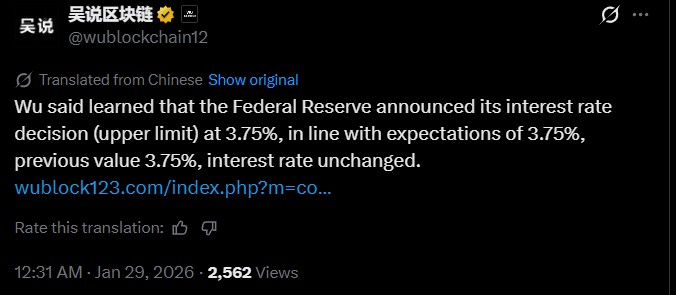
On January 29, 2026, the Federal Reserve said it was not changing the target range of the federal interest rate by keeping it at 3.5% to 3.75%, as it had been at the last meeting. The MOVE is in line with the market expectations, which shows that the central bank is cautious in its move, given the mixed economic signals.
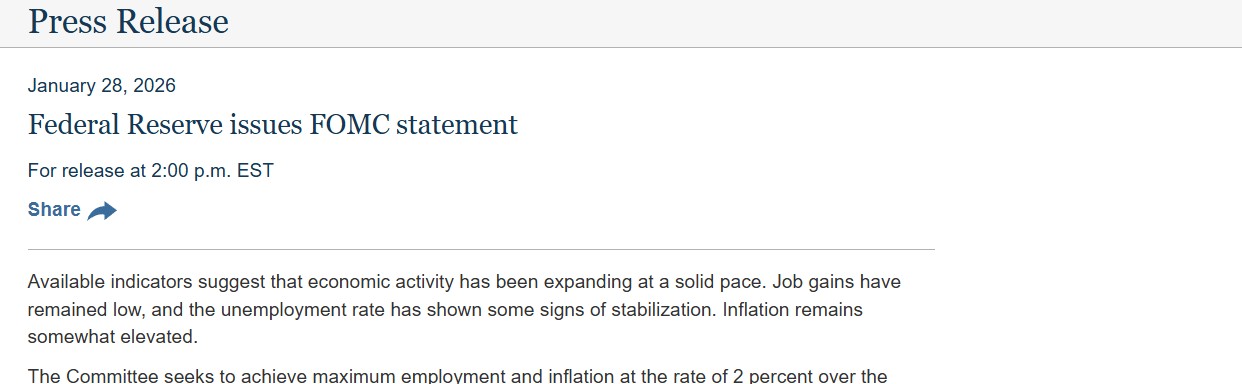
According to the FOMC statement, economic activity has been growing at a steady rate, job gains have been low, and inflation is slightly high. This balance of slow growth and constant inflation gives a complicated background to monetary policy.
Source: Wu Blockchain
What the FOMC Statement Revealed
The statement defined the Fed's dual mandate, maximum employment and 2% inflation in the long term. The Committee pointed out that:
The level of economic uncertainty is still high, and the Fed is keeping an eye on the risks on both sides of its mandate.
The changes in the federal funds rate in the future will be determined by the economic data that will be received, the developments of the outlook, and the evaluation of risks.
The Fed is still firmly determined to help in keeping employment in addition to restoring inflation to the 2% target.
Also reiterated the idea that any future changes in policy would be data-driven, considering the state of the labor market, the pressure on inflation, financial dynamics, and international dynamics.
Source: Official website
Who Voted For and Against the Decision?
Ten FOMC members, who include Chair Jerome Powell and Vice Chair John C. William,s voted in favor of keeping the rates.
Nevertheless, Stephen Miran and Christopher Waller opposed the move, instead desiring a 0.25% reduction, which indicates that some of the members believe that they can adjust the policy to help the job growth slow down.
Is a Fed Rate Hike Next?
The Federal's chairman, Jerome Powell, had to deal with speculation about the next step of the FOMC. He made it clear that no alternatives are excluded, but at present, a rate increase is not a part of a baseline expectation. Powell stressed that all the incoming information will be evaluated thoroughly by the Fed before it can change its position.
Market Reaction and Implications
The FOMC was widely expected to keep the existing rates by investors. The announcement confirms a stable policy perspective, implying that the central bank is content with moderate growth and ongoing pressure on inflation.
The dissenting votes indicate that there is still a debate in the Fed and that some policymakers worry about slower job growth and are likely to prefer easing in case the economic conditions deteriorate.
Conclusion
The fact that the Federal Reserve has decided to maintain the rates at 3.75% is a well-thought-out decision to maintain the growth and curb inflation at the same time, and any future action will be entirely data-based to avoid compromising employment and prices.
Disclaimer: This is not financial advice. Please DYOR before investing. CoinGabbar is not responsible for any financial losses. Crypto assets are highly volatile, and you can lose your entire investment.
