South Korea Finalizes Digital Asset Basic Law: Stablecoins Get Regulatory Green Light

Seoul slams the rulebook on the table. The Digital Asset Basic Act is locked in—stablecoins now have a legal framework to operate within South Korea's borders.
From Wild West to Walled Garden
Forget regulatory gray areas. The new law carves out clear definitions for asset-backed and algorithmic stablecoins, mandating strict reserve requirements and issuer licensing. It's a direct move to prevent another Terra-LUNA style meltdown on home soil. The Financial Services Commission (FSA) gets a beefed-up supervisory role, with powers to audit reserves and sanction non-compliant players.
Institutional On-Ramp, Activated
This isn't just about consumer protection. By establishing legal certainty, the law effectively builds an on-ramp for traditional finance. Banks and securities firms can now structure products around compliant stablecoins with a clear regulatory blessing. Expect custody services, payment integrations, and new derivatives to follow—the infrastructure play is real.
The Global Ripple Effect
South Korea's move pressures other major economies still drafting their own rules. It sets a precedent for treating stablecoins not as mere tokens, but as systemically important payment instruments. The message is clear: regulate or get left behind in the race for digital finance supremacy.
A cynical take? Wall Street will love this. They've been waiting for regulators to tidy up the space so they can repackage the innovation into fee-generating products you probably don't need. But for the crypto ecosystem, a clear rulebook beats regulatory ambiguity any day. South Korea isn't just watching the future of finance—it's writing the manual.
Chairman Lee Jeong-moon and Representative Ahn D0-geol of Digital Asset Task Force highlighted the need of such laws for market stability and investor protection under the regulatory guidance without preventing innovation.
What South Korea’s Digital Asset Basic Law Defines?
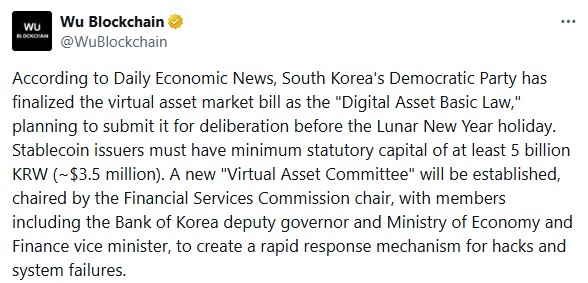
The bill requires all the stablecoin issuers to keep a capital reserve of minimum 5 billion KRW (around $3.5 million) to improve monetary stability and users safety. This approach mirrors the existing electronic currency businesses’ capital rules under Electronic Financial Transactions Act, providing importance to stablecoins as electronic money.
Following other major targets of the act include:
Avoidance of virtual coins-related rug pulls, such as Terra/Luna collapse
Protection to users from the financial failures from issuers side
Preservation of financial independence for non-USD stablecoins
Mitigation of unlawful financial risks
Enabling safe payment integrations, remittances, and tokenized assets.
What Makes the Law’s Working Efficient and Calculative?
The finalized bill uses a flexible regulatory infrastructure, dividing the virtual coin's market into eight categories. Here high-risk industries will mandate approval from financial authorities, while lower-risk sectors require registrations only. This framework empowers innovation with the maintenance of sufficient oversight in the country.
Adding on, the Digital-Asset Basic Law introduces a Virtual Asset Committee which will be chaired by the Financial Services Commission (FSC) along with other notable officials such as Deputy Governor of Bank of Korea.
The committee will assist with rapid responses in cases related to hacks, system failures, and other operational risks, ensuring stronger oversight for the ecosystem.
Global Stablecoin Regulations in 2026
South Korea’s Digital Asset Basic Law introduction follows the increasing global trends. Some of the major examples that come in 2025 to 2026 includes:
European Union: The MiCA framework of the EU requires stablecoins to maintain fully backed reserves, getting license, and redeemable guarantees. The act is live in 27 member countries currently.
United States: The country passed its most talked about stablecoin law, the GENIUS Act, in mid-2025. The act mandates 1:1 reserves, federal oversight and regular audits.
Hong Kong: Its Stablecoin Ordinance requires full reserves and an HKMA license. The first licenses are expected in early 2026, with high capital requirements leveraging established players.
Singapore: The MAS framework mandates stablecoins to peg to SGD or G10 currencies, maintain full reserves, and follow prudential standards.
The global economies are now gradually including digital money into mainstream finances as they understand the growing demand and significance of these assets in broader markets. South Korea with its Digital Asset Basic Law, also entered the phase, now its developments are under traders watch until it completely transforms into an act.
This article is for informational purposes only and does not constitute financial or investment advice. Cryptocurrency markets are volatile, always do your own research before investing.
