Crypto Whale Dumps $397M on Gemini—Market Tremors Follow

One wallet. One massive transfer. The entire market holds its breath.
The Whale Makes Its Move
A single, colossal transaction just ripped through the crypto ecosystem. An anonymous whale wallet shifted a staggering $397 million worth of digital assets directly to the Gemini exchange. This isn't a casual deposit—it's a statement. Movements of this magnitude don't happen in a vacuum; they're preludes. The immediate aftermath? A sharp, palpable dip across major charts. Liquidity pools shuddered as the order books scrambled to absorb the implied selling pressure.
Decoding the Signal
Why Gemini? Why now? While the speculators chatter about tax strategies or portfolio rebalancing, the street-level read is simpler: preparation for a major sell-off. When whales move to centralized exchanges, they're typically gearing up to convert crypto into cold, hard fiat—or at least threatening to. It's the crypto equivalent of a fighter jet entering a holding pattern near the border. The market isn't just watching the trade; it's obsessing over the intent. Is this a strategic exit or a tactical feint?
The Ripple Effect
The tremor was instant. Altcoins, always more volatile, felt the brunt. The move injected a fresh dose of fear into a market already parsing mixed macroeconomic signals. It's a stark reminder that for all the talk of decentralization, a few key players can still tilt the board. Analysts are now glued to Gemini's outflow data, watching to see if the funds get pulled back into cold storage—a sign of a bluff—or sold into the market, confirming the bearish bet.
A New Pressure Point
This event redefines the immediate support and resistance landscape. Technical levels that seemed solid now look tentative. Other large holders might be spooked into taking profits early, creating a cascade. It forces every investor, from the retail rookie to the institutional fund, to re-evaluate their risk exposure. In traditional finance, such a large block trade would be negotiated quietly over-the-counter to avoid panic. Here, it's a public spectacle—equal parts market mechanism and psychological warfare.
One thing's certain: the whale's move cuts through the usual noise of influencers and hype cycles. It's a raw power play, a multi-million-dollar reminder that in the sleek, digital future of finance, old-school market manipulation just got a software update. The only thing more impressive than the sum itself might be the fee paid to move it—probably less than a Wall Street banker spends on lunch.
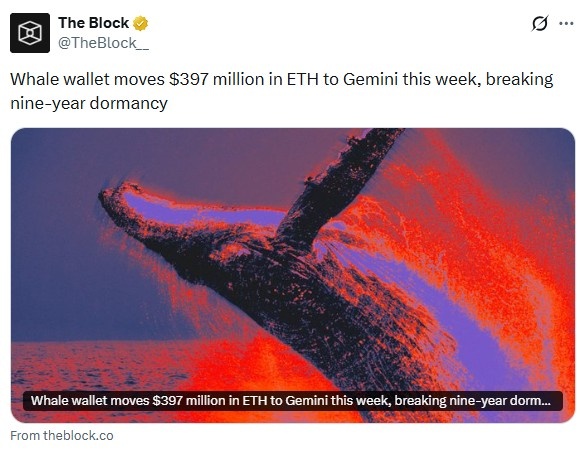
Source: X official
From Cheap ETH to Massive Profit Potential
Back in 2016 and 2017, ethereum was trading at extremely low prices compared to today, often between $80 or $90. Many early investors bought ETH during this period because they believed in the future of blockchain technology. If this Dormant holder purchased Ethereum at that time, the current value shows massive profits that can reach dozens of times the original investment. This is why analysts believe the moment when a whale wallet moves $397m to an exchange strongly hints at profit booking. Selling even a part of this ETH could create selling pressure in the market. This pressure may cause short-term price swings and higher volatility. It does not mean Ethereum will crash, but it shows that big players can influence price movement quickly and emotionally. This helps traders plan safer strategies.
A Nine-Year-Old Silent Whale Comes Back to Life
The whale wallet was inactive for almost nine years, which makes this event even more powerful. Such long silence usually means a strong belief in the asset or a carefully planned investment strategy. The owner may have trusted Ethereum’s long-term growth and waited for the right market phase to act. Another reason could be security, as early holders often stored funds safely and avoided frequent movement. Some also believe access to the wallet might have been regained recently. Choosing Gemini shows a professional decision because it is a regulated and trusted exchange. It offers high liquidity and institutional-level services. This choice suggests the Dormant holder wants a SAFE and controlled environment for any future actions without causing sudden panic in markets or damaging public confidence.
Traders Stay Alert as ETH Remains in Focus
Even after the huge transfer where a Whale Moves $397m, the Dormant holder has not started selling Ethereum yet. The movement only shows preparation, not confirmation of selling. Still, traders are watching every transaction from this wallet closely. Whale movements often act like warning signals for the market. If selling begins, Ethereum could face short-term pressure and quick price changes. If nothing happens, confidence may return, and the market may stabilize again. This is why on-chain data is so important. It helps investors understand what big players are planning before prices react. The current situation keeps Ethereum in focus and adds excitement to market activity. Such events remind everyone that large holders still control large power.
