CertiK IPO Launch: Web3 Security Firm Steps Into Public Markets

CertiK just went public. The blockchain security auditor—known for its smart contract reviews and red-flag reports—is now trading on a major exchange. This isn't just another tech listing; it's a direct bet that institutional money wants exposure to crypto's guardians.
The Security Pitch
Forget mining rigs and trading fees. CertiK sells certainty. Its IPO prospectus hammered home recurring revenue from audits and subscription services—a classic SaaS model draped in Web3 jargon. The firm audits code, spots vulnerabilities, and slaps a 'CertiK Verified' badge on projects that pass muster. In a space riddled with hacks and rug pulls, that badge is becoming a de facto requirement for serious builders.
Why Public Markets Now?
The timing is strategic. Regulatory scrutiny is intensifying globally. Projects face pressure to prove they're not just secure, but auditably secure. CertiK's move onto a public ledger (the stock market) provides a transparency layer its clients often lack—a neat bit of irony for the finance traditionalists watching from the sidelines.
The Cynical Take
Let's be real. This IPO lets early investors and employees cash out chips in a game where the house—crypto volatility—always wins eventually. It's a masterclass in converting 'blockchain promise' into old-fashioned, spendable dollars before the next market cycle turns. A hedge fund manager's dream: monetize the fear.
What It Means for Crypto
This listing legitimizes the security infrastructure layer. It signals that protecting digital assets is now a mainstream, investable business. Expect more security-focused firms to follow. The market isn't just betting on the next big protocol anymore; it's betting on the firms that make those protocols safe enough for Wall Street's money. The ultimate closer? In the race to secure Web3, the first guardian to the public markets just set the pace. The rest are now on the clock.
Source: X official
How CertiK Protects Web3 Platforms
With the CertiK IPO Launch, the company’s security technology is gaining attention from traditional investors as well as Web3 developers. Its Skynet system continuously scans blockchain activity to spot suspicious behavior before major exploits occur.
Founder Ronghui Gu has stated that the firm combines artificial intelligence with formal verification methods. Formal verification uses mathematical proofs to check whether code behaves exactly as intended. This approach reduces bugs, exploits, and logic flaws that traditional testing might miss. By mixing AI automation with academic-grade protection validation, It offers a stronger defense LAYER than standard auditing models.
This blend of technology allows developers, exchanges, and DeFi platforms to detect vulnerabilities early, protect user funds, and maintain trust within decentralized ecosystems.
Controversies, Market Value, and IPO Outlook
As the CertiK IPO Launch approaches, investors are closely watching its valuation, reputation, and long-term business stability. However, based on its last known valuation NEAR $2 billion and its IPO funding target, analysts estimate that its public valuation could fall between $3.5 billion and $5 billion.
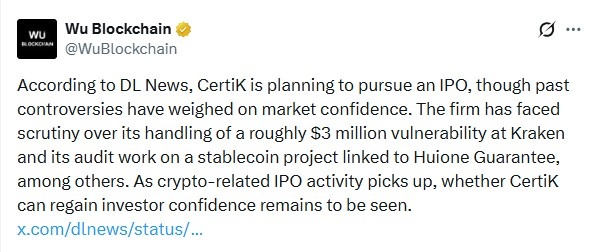
The company has faced criticism in the past. In 2024, its social media account was compromised, raising questions about internal security practices. It was also linked to controversy over a $3 million bug incident involving the Kraken exchange, where communication issues caused community backlash. CertiK defended its actions, stating that its role was limited to security assessment and responsible disclosure. In 2025, it apologized for auditing a platform later connected to illicit activities, promising stricter project screening going forward.
Prediction about the launch date and price:
Market rumors around the CertiK IPO Launch suggest the listing could happen in late 2026 or early 2027 if regulatory approvals move smoothly. Based on comparable cybersecurity listings, a per-share price between $18 and $25 is considered realistic at launch.
This IPO matters for one powerful reason:
It WOULD create a publicly traded vehicle for investors to gain exposure to Web3 security beyond cryptocurrencies.
That single shift transforms blockchain safety from a niche service into a recognized financial sector, opening the door for mainstream capital to support decentralized infrastructure without directly buying digital coins.
