Crypto Market Correction: BTC Tests $89K Support as ETF Outflows Surpass $1B - What’s Next?

Bitcoin stumbles, traditional finance flinches. The crypto kingpin dipped toward $89,000 today, a move directly tied to a massive $1 billion exodus from spot Bitcoin ETFs. It's a classic liquidity shuffle—when the big funds sneeze, the whole market catches a cold.
The ETF Effect: A Double-Edged Sword
These financial products, hailed as crypto's gateway to Wall Street, are proving their volatility. The recent $1 billion outflow isn't just a number; it's a sentiment shift. Institutional money moves in herds, and right now, the herd is taking some profits off the table. It's the price of admission for mainstream adoption—sometimes, your new best friends have the shakiest hands.
Beyond the Headline Numbers
Look past the red candles. This isn't 2022. The market structure is stronger, the players are more sophisticated, and the dips are getting bought. A billion-dollar outflow sounds apocalyptic until you realize it's a fraction of the total assets under management. It's a rebalancing, not a rout. The machines are just doing what they do best—overreacting to short-term flows while the long-term thesis remains intact.
The Silver Lining in the Sell-Off
Healthy markets need corrections. They shake out weak leverage and reset overextended valuations. This pullback to $89K might just be creating the launchpad for the next leg up. Remember, in crypto, the most painful dips often precede the most powerful rallies. The old guard on Wall Street might see this as validation of crypto's 'riskiness'—ironic, coming from the industry that brought us synthetic CDOs and repo market crises.
So, is crypto down? Technically, yes. But for those who understand the cycles, it's just another Wednesday. The infrastructure being built today—the regulatory clarity, the institutional plumbing, the real-world adoption—doesn't vanish with a few days of outflows. The narrative didn't break; it's just taking a breather. The real question isn't 'why is it down?' but 'how long until the buyers step back in?'
Real-Time Data: Bitcoin and Altcoins Under Pressure
According to live data from CoinMarketCap, the market is struggling to find a solid floor:
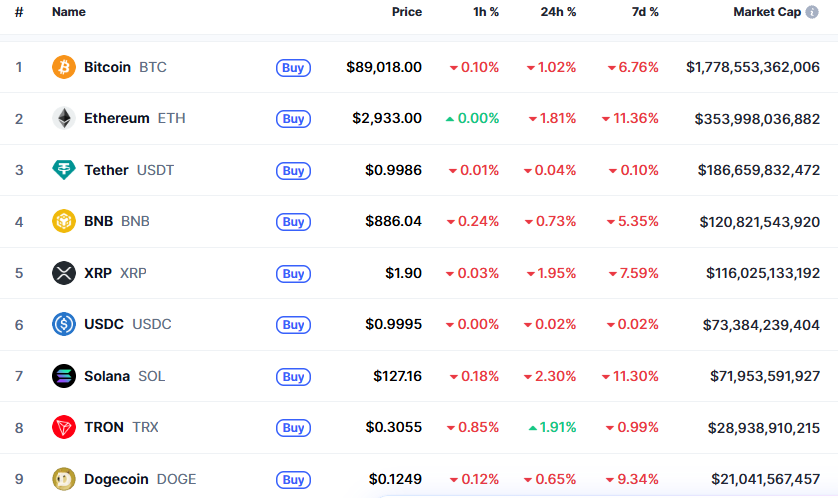
Bitcoin Trading at approximately $89,131, down nearly 0.90% today and roughly 7% over the past week. Daily trading volume has plummeted by 28.88% to $35.8 billion, signaling a significant drop in short-term activity.
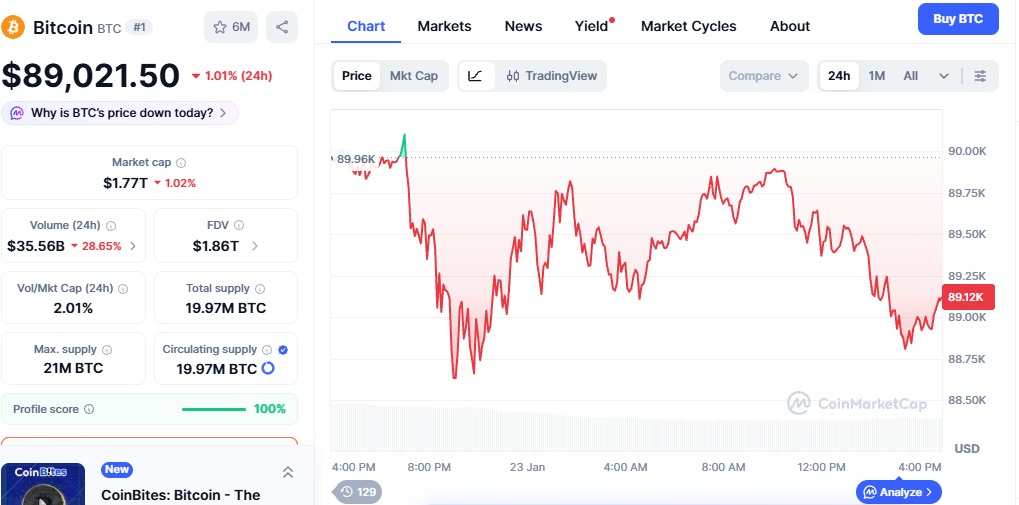
Down 1.37% to $2,975, failing to maintain the psychological $3,000 level after a steep 13% weekly decline.
Solana (SOL) dropped 1.04% to $128, while XRP fell 1.60% to $1.91.
Why Is Crypto Market Down Today? Key Drivers
Volatility returned to global risk markets following President Trump’s address at the World Economic Forum (WEF) in Davos. Markets were initially spooked by Trump's aggressive rhetoric regarding the acquisition of Greenland, including threats of heavy tariffs on European allies. Although he later softened his tone, hailing a "framework of a future deal" on January 21, the uncertainty triggered a massive shift toward traditional safe havens like gold, which recently hit record highs NEAR $5,000.
Institutional "paper hands" are a major factor in today's drop. Spot Bitcoin and ethereum ETFs recorded a staggering $1 billion+ in combined outflows on January 21.
BlackRock’s IBIT saw its highest one-day redemption of $356.6 million.
This marks three consecutive days of net outflows, indicating that major players are locking in profits after last year's run to $126,000.
Regulatory hope has turned to hesitation. The CLARITY Act, a bipartisan bill meant to define crypto rules, hit a major snag when Coinbase withdrew its support on January 18. CEO Brian Armstrong cited "fatal flaws" in the Senate's rewrite, including amendments that could "kill rewards on stablecoins" and grant the government excessive access to financial records. This has crashed the probability of a 2026 legislative signing from 80% down to 40% on Polymarket.
Investors are closely watching Japan. While the Bank of Japan held rates at 0.75% yesterday, its signal of continued policy normalization threatens the "yen carry trade". Historically, BoJ rate hikes have led to Bitcoin drawdowns of 20–30% as investors unwind Leveraged positions in risk assets to repay yen-denominated debt.
What’s Next: When to Expect Gains?
The market is currently in a high-risk consolidation phase. Analysts at Glassnode and Swissblock warn that the path forward depends on several technical and macro triggers:
Key Support: bitcoin must hold the $88,600–$88,800 demand zone. A sustained break below $87,000 could signal further downside toward $74,000.
Resistance for Bulls: A clean breakout requires BTC to reclaim and hold above the $98,400 short-term holder cost basis.
Timeline: Many insiders now project March 2026 as the next likely window for legislative movement, which could act as a catalyst for the next leg up.
Expert Opinion
This correction mirrors the Q1 2022 market structure, where repeated failures to reclaim support led to prolonged consolidation. Until Bitcoin reclaims $98,000, investors should remain cautious and prioritize risk management over chasing rallies.
