Japan’s Bond Market Flashes Red: Long-Term Yield Surge Signals Mounting Financial Risk

Tokyo's debt markets are screaming a warning. The relentless climb in long-term yields isn't just a blip—it's a tremor shaking the foundations of the world's most indebted economy.
The Yield Shockwave
Forget quiet stability. Japan's benchmark bond yields are breaking free from years of artificial suppression, driven by forces the Bank of Japan can't fully control. Global inflation, shifting monetary policies abroad, and a creeping loss of confidence in endless debt monetization are all converging. The market is finally starting to price in real risk, and the cost of borrowing for the government is ratcheting up. It's a classic case of the piper demanding payment—decades of ultra-loose policy coming home to roost.
A System Under Stress
This isn't just about government balance sheets. The ripple effects threaten to swamp the entire financial system. Banks, pension funds, and insurance companies—all stuffed to the gills with Japanese Government Bonds—are watching their core holdings lose value. The delicate carry-trade ecosystem, where investors borrowed cheap yen to fund bets globally, faces potential unwinding. Suddenly, the 'safe' asset at the heart of Japan's financial architecture looks anything but.
The Crypto Angle: Flight to Digital Hardness?
While traditional finance grapples with sovereign debt anxieties, a parallel narrative is gaining strength. For some investors, Japan's bond turmoil underscores the fragility of fiat-based systems built on perpetual debt expansion. It's the kind of environment that fuels the 'digital gold' thesis for assets like Bitcoin—a cynical but growing bet against the long-term viability of traditional monetary management. After all, you can't print more Bitcoin to cover a budget shortfall, a feature that's starting to look more like a bug for indebted governments.
The surge is a stark signal: the era of cost-free debt for Japan is over. The market is voting, and its verdict spells rising risk, higher costs, and a brutal new chapter for fiscal policy. Get ready for the squeeze—the free lunch served by decades of yield curve control is finally being taken off the table. A sobering thought for finance pros: sometimes, the 'risk-free' rate is the riskiest assumption of all.
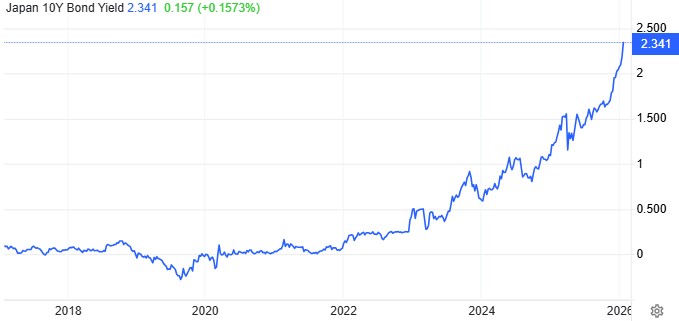
This significant rise highlights the growing nervousness in the investors about Japan's economic moves, finances, upcoming public elections, and the decision of the next interest rate.
What Is Happening in Japan’s Bond Market Now?
Looking at other major government-tied long term bonds, majority is showing a great increment in the interest rate across all time periods:
10-year bond: ~2.32% (highest since the 1990s)
20-year bond: ~3.35%
30-year bond: ~3.70% (record high)
40-year bond: 4.00% (first time ever)
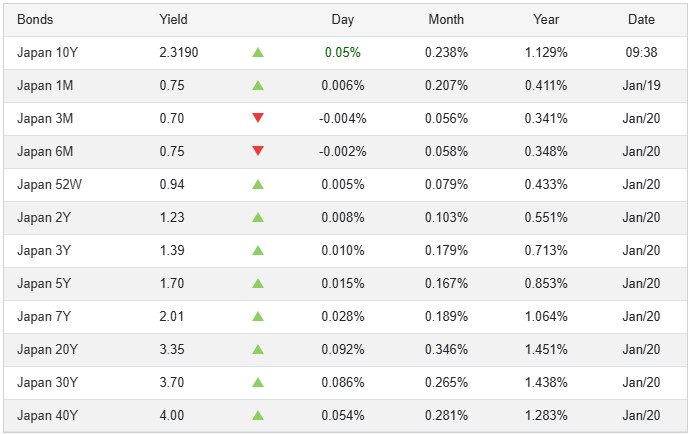
However, short term bonds like 1 month, 3 months, and six months are much lower, below 1%. They are staying close to the Bank of Japan (BoJ) policy rate of 0.75%. This gap in rates clearly shows that investors are expecting higher costs and risks in the future.
What Are Government Bonds and Why Do They Matter?
A government bond is simply a type of loan. Investors lend money to the government and the government pays interest to them in return. Rising yields are often not good for the country and the traders’ trust. Let’s break it for a more simple approach:
Yield: The interest rate paid on that loan.
Higher yield: Investors looking for higher returns when they see more risk in the markets.
Lower yield: Investors feel safe to lend money, and trust the safe return.
Bonds are seen as a major tool of the governments for generating funds and maintaining circulation. However, when yields rise, they create a problematic scenario:
Government borrowing becomes more expensive
Loan rates for businesses and people can rise
Markets start pricing in slower growth or higher inflation
Why Are Japan’s Yields Rising?
For now, the country is seeing major hikes in recent times. Some of the major influencing factors include:
Prime Minister Sanae Takaichi has proposed cutting the sales tax on food to 0%. Markets worry this could increase government debt, as there is no clear plan to replace the lost tax money.
Prime Minister Sanae Takaichi has proposed that the food sales tax should be reduced to 0%. This raises concerns for the markets over government debt, as there is no clear source of funding to cover the lost money from this cut.
An election has been called by Takaichi on February 8. Investors forecast her party to gain more power, which may result in higher expenditure and borrowing.
The Bank of Japan (BOJ) has decided to stop decades of monetary ease:
Negative rates ended in 2024
Bonds' purchases have fallen
Interest rates were increased to 0.75% in December 2025, which is the highest level in the past 30 years.
This means that the BOJ is no longer maintaining low debenture yields.
How Does it Matters for the Crypto World?
Japan’s bond market is not limited to the nation’s boundary. The country is surely one of the most significant economies in the world, and matters in its circulation drive global sentiments.
Higher Japanese yields reduce the yen carry trade (borrowing cheap yen to invest elsewhere)
This can cause global market volatility
Risk assets like Bitcoin and altcoins may see short-term pressure
On the other side, market experts take this rising debt and inflation risks as a long term benefit for cryptocurrencies like Bitcoin, which is generally used as a hedge tool during the weakness of traditional currencies.
Conclusion
Japan’s rising debenture yields indicate a major shift in the traders' sentiments. After decades of minimal rates, investors are now expecting higher returns over the concerns generated from fiscal and political changes with rising risks, and a more active central bank involvement.
However, for now, the jump is drawing a belief that the country has entered a new economic era – one with upper borrowing costs, limited money, where global Ripple effects are seen to affect major other markets also including stocks, currencies, and crypto.
